The 'New Normal' - Post COVID 19
‘Where have come from? where are we now?
and where are we going?’
This is the title of a painting by Paul Gauguin when he
was feeling depressed and suicidal. Which when he completed it he felt better
illustrating the power of creativity in moments of despair?
In the midst of the pandemic Covid 19 it seems
relevant.
We cannot go
back to the ‘old normal’!
The question is where are we going in the futures
because it seems we cannot go back to ‘normal’ because the normal it no answer
to challenges that lie ahead, most of all Global Warming, which requires a real
change in values, behaviors and creative action.
We can learn from the past, where we have come from,
because there are obviously lessons to be learnt. Mark Twain was said to have
said that ‘history doesn’t repeat itself but it sure rhymes’.
The Black
Death
If we go back to the Black Plague, which killed a
third of Europe’s population, this plague created a change of attitude towards
authority and led to new ideas, and with the invention of printing now called
the Reformation.
Covid 19
provides such an opportunity for new ideas.
I am aware that Twain also said that ‘prediction if difficult particularly when it involves the future', Even if we have no real idea of what will unfold; if direction is articulated for a better world –means will be found
The world goes to big epochs of change each one
requiring different behaviors, values and most important of actions
First we
were hunters and gatherers, then humans developed a more settled Agricultural
Age, followed by an Industrial Age marked by mass production – now, it seems,
we are moving into an Information Age (based on the disruptive power of modern
information technology) or even a Creative Age - a Second Renaissance.
Cycles of
change in recent history
 |
| Franklin Delano Roosevelt |
The above are rather big changes but recent times political
thinking seems to go in smaller cycles lasting three or four decades.
The ‘Roaring
Twenties’ – ‘free market’ capitalism
In the 1920s, often called the ‘roaring twenties’,
free market politics were the thing until in 1929 when it came to a sudden end –
the Great Depression A depression leading to unheard of unemployment and
extreme poverty. Maybe this is the’ rhyming’ Twain talked about.
The rise of the New Deal
The world struggled along until new thinking evolved
(not really new but up until then largely ignored) resulting in the election in
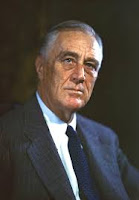
America of Democrat Franklin Delano Roosevelt. Roosevelt developed an unheard
of programme of government assistance called the New Deal. Sounds familiar?
The Welfare
State of Michael Joseph Savage
In New Zealand the Great Depression equally caused
great dislocation and as a result voters elected the First Labour Government
led by Michael Joseph Savage. Savage introduced extensive life saving welfare
provisions. In the UK Clement Atlee was
elected to replace war leader Winston Churchill and introduced similar reforms.
The
importance of the State to protect all citizens
The importance of the state, or central government,
worldwide was made more pertinent by World War Two by returning troops who,
along with their families, felt the need to develop a better fairer world.
Years of
rebuilding and prosperity
The years following the War lead to decades of
prosperity, led by the state, that provided social security for all.
Up until the 1970s all went well but with the
expensive oils shocks, and with an economy felt by many to be dictated by union
power, and added to this, the increasing costs of the welfare state, new ideas
were in the air (ideas not seen since the twenties).
The rise of
Neo Liberal politics
 |
| Reagan and Thatcher |
There were those who believed ‘big’ government was
limiting enterprise and creativity. This was best expressed by Republican
President Ronald Reagan whose stated ‘the government is no longer the solution,
it is the problem’. Social welfare politics worldwide were demonized as being a
‘nanny state’ and worse still ‘socialism’ - one step, for many, away from
communism.
The rise of
the self-interested individual
In the UK Conservative Margaret Thatcher was elected
saying, ‘there is no such thing as community only self-interned individuals and
their families’. Ironically, in New Zealand, it was a Labour Government, under
Prime Minister David Lange and Finance Minister Roger Douglas, who introduced
privatization politics known as ‘Rogernomics’
And so began
the introduction in Western countries of ‘market knows best ‘politics and that
brings us up to present day
- State assets were sold off, often at
low prices, to private enterprise to be made more efficient and profitable.
- The power of unions limited and the
idea of personal contracted workers introduced.
- The cult of privatization was
introduced and loosening up on regulations
- And the ‘big sell’, wealth created by
privatization would ‘trickle down ‘and benefit all.
- All of this was based on a disdain for the public sector and a reduced role for the state
The promise
of ‘trickle down ‘economics
The key phrase of ‘trickle down’ used by the supporters of ‘market forces' has failed to materialise and ,’ has resulted today's troubling list of social problems
along with housing problems and growth in personal debt
Beyond Covid
19 – Climate Change
The focus on economic growth at all costs has
contributed to the biggest issue facing us today – beyond the challenge of Covid 19 - – that of global warming and
sustainability of the environment and human civilization as we know it.
Apposing
politician views
The National Party is still wedded to Market Force
‘free market’ politics (sometimes called neo –liberal politics) if somewhat
watered down over the years.
As yet the Labour Coalition Government has not
made a dramatic shift from neo liberal politics, no doubt because to voting
public still support the previous conservative government. Up until now there
has been no real anger about the inequality – it has become ‘normal’.
This brings
up to ‘where we are now’ – and the challenge of the current pandemic or more to
the point, ‘where to from here’.
Returning to the old ‘normal’ no longer seems an
alternative except for hard line neo conservatives. Private enterprise word
wide has had to be supported by central governments – this is a return to
social welfare on a large scale. Some might call this state assisted socialism!
Beyond Covid
19
The Covid 19 Crisis provides an opportunity to face up
to the challenge of climate change and to develop push new ideas to encourage
new ideas of responsible regenerative systems of production and consumption.
Ideas that bring together the ‘well-being’ of people and our planet as we face
a bigger challenge of climate warming.
Where to from
here? What sort of country do we want to become?
To ensure transformation requires anger to be
expressed at the inequality and environmental despoliation that has been
created by the past three decades of growth at all costs - the basis of the
market forces and privatization policies implemented, with the false promise of
wealth ‘trickling down’ since the 1980s
There is now an alternative.
Those who implemented market policies convinced all
that ‘there was no alternative (TINA) and demonized the ‘nanny state’,
believing in less government, and to achieve privatization they demonized the
union movement.
A reason for
anger and need for change.
Up until this day all governments have implemented ‘market
force’s policies including Helen Clark, Bill Clinton and Tony Blair. In New
Zealand Helen Clark’s Labour Governments did their best ameliorate the worst
aspects by introducing policies like ‘working for families’ to assist those
most affected. Never the less inequality and despoliation of the environment
has been the result; the rich have got richer and the poor poorer.
For thirty-five years the corporate world has ruled
supreme. Particularly in the USA, but now ironically they are being rescued by
the state that they have seen as ineffective. Neo liberalism was all about individuals
deciding for themselves, based on self-interest, and by competing with each other.
Such an approach did not tap the power of community energy, communal
collaboration and cooperation and this is where we now need to turn.
The need for
change in a few dramatic weeks
Who would’ve thought in a few short weeks, as a result
of Covid 19, the world would change so dramatically providing challenges well
beyond ability ofself-interested private enterprises to cope with – all a sudden only the state can
assist in such dire situations. Greater social welfare and assistance is now
essential.
So time to demonize and discredit the ‘trickle down’
market forces politics to change the consciousness of people to be able to
envisage a better world. In times of crisis impossible ideas become possible. We cannot go
back to the ‘normal’ destructive road of market forces politics.
The Challenge
for the Coalition Government.
 The challenge for the Labour Coalition Government, as
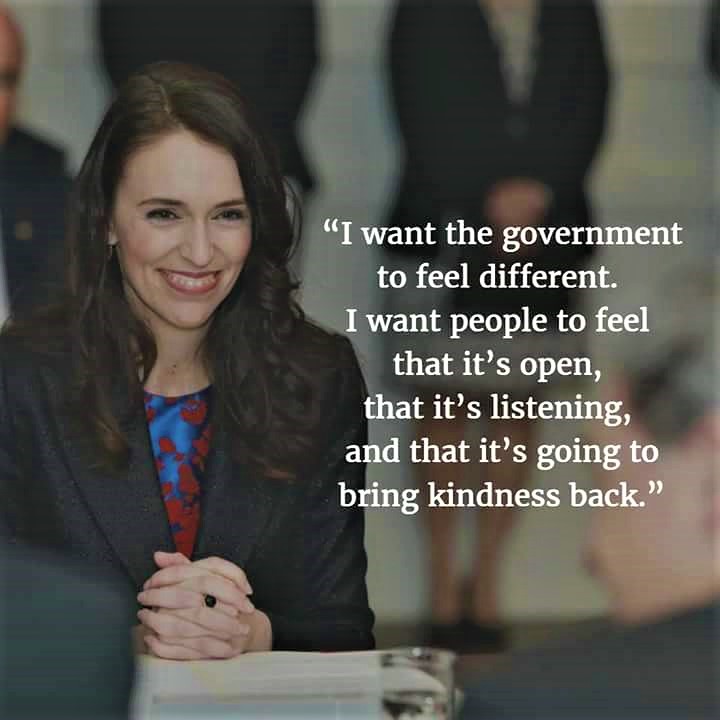
we move out of the Covid 19 crisis and under the leadership of Jacinda Ardern,
is develop a new vision or direction for our future based on the ideas of
‘well-being’ of all citizens and the sustainability of the environment.
The challenge for the Labour Coalition Government, as
we move out of the Covid 19 crisis and under the leadership of Jacinda Ardern,
is develop a new vision or direction for our future based on the ideas of
‘well-being’ of all citizens and the sustainability of the environment.
Labour is well placed to articulate such a people
centred community and environmentally sustainable vision. A government led by
Jacinda Ardern could see New Zealand being a world leader, something we could
all be proud of.
Need to rebalance state and private enterprise
What is required is to rebalance the influences of
state direction and private enterprise; to focus and reward private enterprises
who focus on developing a sustainable New Zealand.’ Let the market decide’ is
now a failed dogma.
There are a
number of ideas to consider, none original:
 ·
To
introduce a ‘Green New Deal; for state agencies to implement and
for private enterprises to be rewarded for positive actions. To encourage
investment in productive areas of the economy and not just for individual
reward This relates to the ideas introduced by Franklyn Delano Roosevelt
following the Great Depression as well as the policies of the First Labour
Government in New Zealand.
·
To
introduce a ‘Green New Deal; for state agencies to implement and
for private enterprises to be rewarded for positive actions. To encourage
investment in productive areas of the economy and not just for individual
reward This relates to the ideas introduced by Franklyn Delano Roosevelt
following the Great Depression as well as the policies of the First Labour
Government in New Zealand.
·
t To build on the ‘well-being’ philosophy underpinning
the Coalition Government and to move away from a narrow misleading emphasis on
GDP. A focus on GDP emphasizes the idea of infinite growth serving, first and
foremost, the richest 1% and says little about non material well-being such as
mental health and capturing the fullness of human flourishing.
·
To
upgrade infrastructure needs – the ‘shovel ready ‘projects.
Consider the possibility of the government buying into firms currently
struggling and to develop a Ministry of Works to coordinate projects.
· To continue developing a range of state
innovative low cost housing and accommodation including communal concepts.
·
To
build on the regional development being led by Minister Shane Jones.
 ·
It
might be time to consider rebalancing the central and local Government. There is a need to provide greater finance and
flexibility for local government making local government more attractive for
voters to be involved. This could also
more power sharing with local organizations and identifying steps to be taken
to build community and strengthen the local community.
·
It
might be time to consider rebalancing the central and local Government. There is a need to provide greater finance and
flexibility for local government making local government more attractive for
voters to be involved. This could also
more power sharing with local organizations and identifying steps to be taken
to build community and strengthen the local community.
·
As
part of the Green New Deal to encourage and assist land owners to develop
regenerative agricultural approaches.
·
To
come to terms with the possibility that unemployment (and under employment)
will become endemic with the continued application of automation and to
introduce a Universal Basic
Income. Not only would this simplify
the plethora of welfare benefits but it would remove any stigma that people
currently feel as well as providing a much needed sense of security. There are numerous article outlining benefits
and problematic issues to be taken into consideration. I believe a UBI would
encourage innovative creative activities for many creative individuals. An
extra payment could be given to people working as teacher aides or similar
worthwhile occupation such as working in rest homes or working with adults with
special needs
·
Even
with a UBI progressive tax required rising to a higher percentage of income
earned over a generous certain amount.
·
A
reconsideration of a Capital Gains Tax (needing
cross party agreement) as a lack of a Capital Gains Tax is a factor in
driving up house prices Wealth Tax
is another option although I’m not sure what this involves. Plus, raising taxes
on fossil fuel fertilizer to encourage regenerative agriculture.
 ·
Encouraging
renewable clean energy projects and to reduce extractive industries to move
New Zealand to a post carbon economy. Further subsidizing house insulation and
including solar panels.
·
Encouraging
renewable clean energy projects and to reduce extractive industries to move
New Zealand to a post carbon economy. Further subsidizing house insulation and
including solar panels.
·
A
greater focus on protecting New Zealand’s natural environment -
investment in preserving the environment would provide much needed jobs. A New Green Deal workforce. There is a
need to encourage ‘degrowth’ - a deliberate downscaling of segments of the
economy harmful to the ecosystem such as the fossil industry while at the same
time valuing people such as those working in the care industry.
·
Providing
greater Research and Development finance to encourage
an environment of innovation and to share and upscale successful projects.
·
Consider
the circular regenerative economy outlined by economist Kate Raworth in her
book The Doughnut Economy. The book sets out the minimum we
need to lead a good life and sustain the environment. It highlights boundaries
across which human kind should not go in contrast to current greed based
economics.
With Covid 19
and the Climate Change challenge provides motivation for transformational
change.
The free market promised to liberate the individual
from the supposedly restrictions of the ‘nanny state’ but instead it has
weakened safety nets, increased insecurity for far too many and put the entire
planet at risk
Covid 19 and
the Climate Warming crisis has given us an opportunity and the resolve to move
away from self-interested capitalism to a kinder, fairer and more creative
world – one we have a chance to hand on to future
generations.
It is possible to imagine a new world and a
different type of society with new values and behaviours. – where human
values of fairness, mutual aid and compassion are paramount. It Hs happened before after the Great
Depression and we can do it.
It must have
looked equally challenging in the days after WW2 when social democratic
governments, including our own led by Michael Joseph Savage and Peter Fraser
developed socially secure states leading to an era of unparalleled prosperity.