Showing posts with label Ministry NZCurric. Show all posts

Saturday, April 06, 2019

The need to identify and share teacher expertise


Educational Readings
6th April 2019

The need to identify and share teacher expertise

We’ve always believed that the real experts in education are those that actually do it. Obviously such teachers gain support from those distant from the classroom but if it doesn’t happen in the
classroom it doesn’t happen. And I also believe the further experts are away from the classroom the easier it is to give advice.

A long time ago, before the introduction of self-managing schools, there were plenty of opportunities for schools to collaborate. Teachers were chosen to attend and contribute to national and local in-service courses.

Today the focus in on our school not our schools. 

In the last year or so an attempt was made to introduce a community of schools approach but all too often this was simply a means to introduce Ministry dictates such as National Standards. It
was, at least, a start to move to more collaborative environment.

The Tomorrow’s School Review has at its core the idea of hubs which would introduce the idea of our schools rather than our school. Time will tell if this eventuates but one idea regional principals groups could do is to identify teachers with recognised, expertise in local schools and to share this expertise by means of a website with all schools in the area. There may be schools with beginning teachers coping well that other beginning
teachers could visit; there might be teachers with expertise in the creative arts, technology, physical education, mathematics science, inquiry learning, integrated studies, and play based approaches to learning etc.

There may be the need to select principals/teachers to act as an organising committee and a need also to employ a person with
website development skills.

Something along these lines would not only enable the sharing of ideas between schools but also to return teachers expertise central to educational development.

Bruce Hammonds
Allan Alach


Last week we shared readings both for and against the ideas included in the Tomorrows School Review.

Here is one more to consider

I’m a school principal – here’s why I support the Tomorrow’s Schools changes
‘The independent taskforce report on Tomorrow’s Schools recommends big changes to school governance, and a lot of principals are up in arms. Auckland high school principal Claire Amos explains why she’s not one of them.’

The Art of Looking: Eleven Ways of Viewing the Multiple Realities of Our Everyday Wonderland
An invitation to the art of observation: Together, we became investigators of the ordinary, considering the block — the street and everything on it—as a living being that could be observed.In this way, the familiar becomes unfamiliar, and the old the new.’

Drawing isn't just an art form, it's also a tool.
We often think of drawing as something that takes innate talent, but this kind of thinking stems from our misclassification of drawing as, primarily, an art form rather than a tool for learning.Researchers, teachers, and artists are starting to see how drawing can positively impact a wide variety of skills and disciplines.Drawing is not an innate gift; rather, it can be taught and developed. Doing so helps people to perceive the world more accurately, remember facts better, and understand their world from a new perspective.’

They Say There's No Such Thing As A Stupid Question
They say there's no such thing as a stupid question, but I beg to differ. We hear stupid questions almost every time adults and young children are together.’

High School Doesn’t Have to Be Boring
Debate, drama and other extracurriculars provide the excitement many classrooms lack. And they can help overhaul the system.’

How to Teach Students Historical Inquiry Through Media Literacy And Critical Thinking
Today, most people look up information they don’t know on the internet, including students. So it’s even more important that students have tools they can use to make educated decisions about what they trust online.’


How to unlock students’ internal drive for learning
One of the key components of engagement is students’ excitement about what they learn. Yet most schools extinguish that excitement.'

Learner Agency. What’s it about?
Learner agency is about having the power, combined with choices, to take meaningful action and see the results of your decisions. It can be thought of as a catalyst for change or transformation. Within a school context, Learner Agency is about shifting the ownership of learning from teachers to students, enabling students to have the understanding, ability, and opportunity to be part of the learning design and to take action to intervene in the learning process, to affect outcomes and become powerful lifelong learners.’

Learning Is Different Than Education
…all our problems tend to gather under two questions about knowledge: Having the ability and desire to know, how and what should we learn? And, having learned, how and for what should we use what we know?”

International Women's Day: What factors are at play when girls are excluded from mathematics?Jo Boaler:
‘In a recent survey National Numeracy asked a sample of adults
how they felt about maths. This showed that more than twice the proportion of women (30%) than men (14%) said that maths made them feel uneasy.  Why might this serious gender disparity exist – even in the 21st century?'

#3quotes from Holt Steve Wheeler:
Holt was best known for his progressive approach to education, and his criticisms of state-funded
school systems. I have drawn three quotes from his 1983 classic How Children Learn (first published in 1964) and have added some additional commentary.’

 A couple of Oldies

Tapping into the student's world
'Every student brings with them memories and ideas gained from the experiences they have had. All too   often this personal form of motivation is overlooked by teachers who seem to think they have better ideas to use - their own. It is as if students come to school as blank slates ( tabula rosa) when instead they come with a wealth of ideas to share but to do their ideas need to be valued.’

Importance of observation
Drawing is an ideal way to break through habitual ways of thinking. All too often our students see but they do not look. Observational drawing has long been an important means for some teachers to develop deeper consciousness in students - to assist students see through their habitual ways of seeing and to develop new awareness.’

Friday, September 21, 2018

The importance of curiosity / the need for play / Marae style teaching / the New Zealand Curriculum


Education Readings

By Allan Alach

Every week Bruce Hammonds and I collect articles to share with teachers to encourage a creative approach to teaching and learning. I welcome suggested articles, so if you come across a gem, email it to me at allanalach@inspire.net.nz


The Importance of Curiosity and Challenge in Education
‘Whether “school” is the direct reason why kids lose curiosity over time shouldn’t matter. What should matter is that school should become a place where curiosity is developed in individuals no matter what factors have led to its decline.’

Why are Americans so bad at math?
This is very relevant all over and not just restricted to the USA
‘Research shows that the way math is taught in schools and how its conceptualized as a subject is severely impairing American student's ability to learn and understand the material.’

The Global Search For Education: The Need to Play
“Giving children meaningful, quality, free play opportunities in this period of exponential brain growth is the best, most cost-effective way to prepare them with the skills required to live in our modern society.” — Marcus Veerman 

What if a bird went to flying school?
‘We all know how birds learn to fly.  The mother and daddy bird
feed and care for their young until they are developed enough to push them out of the nest.  Birds fly by nature and discover their wings in the space between the nest and the ground.  But what if we ignored the nature of birds and flight?  What if a bird went to flying school?'

Marae style teaching spaces – a good fit for tamariki
Newton Primary School is seeing fast progress in te reo Māori learning by its bilingual and full immersion students. The school has a new teaching block with flexible spaces for the students, and the school is taking the opportunity to explore what it means to have a Māori learning environment.’

The art of unlearning
‘We often talk about our learning, but how often do we give thought to how much we need to unlearn. As Russell Ackoff says, “the only thing that’s harder than starting something new, is stopping something old.”’

What makes a good school culture?
Most principals have an instinctive awareness that organizational culture is a key element of school success. But like many organizational leaders, principals may get stymied when they actually try to describe the elements that create a positive culture.’

Why this time is different – the big picture of educational change
‘It’s a question that we’ve all struggled with from time to time, however, I do think the answer becomes a lot clearer if we step back and look at the bigger picture, which tells the story of school reform over the past hundred years and highlights why this time is different. Most importantly, it also gives meaning to the work of those who have gone before.’

How curious are you?
‘I’m curious about curiosity. It’s not something we have talked enough about in the past, but in a
society that celebrates creativity and innovative thinking, I feel it will be a lot more prominent in the future. So when I hear someone say that it’s a pity their kids aren’t more curious. Surely you must learn to be curious because you need to be curious to learn. So what’s going on?'

Should we review the New Zealand Curriculum?
The Minister has invited us to have our say on Education as many aspects are up for review. Should the New Zealand Curriculum be one of them?There is ongoing debate about whether our curriculum really meets the aspirations of our tamariki to be active citizens now and in their future so that they are well prepared for the task of making this world the best they possibly can for all people.’

From Bruce’s ‘goldie oldies’ file:

Savants: beautiful minds
Savants are very special individuals that have one amazing passion. Possibly the most well known savant was featured in the film ‘Rain man’ portrayed by Dustin Hoffman. The programme made viewers wonder about the amazing potential that lies within us all.’

Natural born learners.
‘I had written, a while ago, that children, given the right conditions, had the attributes of young scientists. A comment, from the Netherlands, suggested I ought to read the book The 'Scientist in the Crib' because it provided up to date research about how children learn to back up what I had written.’
Great advice.


Tuesday, May 08, 2018

Message to Labour spokesperson on education Mr. Chris Hipkins


 Originally posted as a blog in 2014 but still relevant 2018......things are now happening

A creative education is the key for a positive future for all

Dear Mr Hipkins....

A few thoughts to consider if we are to develop a 21st Education System

 If Labour is to put the welfare of people ahead of economics (the current privatization winner/loser scenario of the National Party) then the creativity of all citizens must be the number one challenge if NZ is to develop  an inclusive and productive society.

Dr Beeby
Labour  needs to revisit Peter Fraser/Dr Beeby’s vision of providing all students with an‘education of the kind they are best fitted and to the fullest extent of theirpowers  This vision has never been fully realized. To become a truly creative country we need to premise our education system on  the challenge of developing the gifts and talents of all students.

Such a vision requires a move away from current standardisation, particularly the conformity of National Standards, towards the challenge of personalisation of learning

Place the  currently sidelined 2007 New Zealand Curriculum centre stage – appreciating that its full implementation requires more than current tinkering if all students are to succeed and be able to ‘seek, use and create their own knowledge’. ( NZC)

Reinterpret the so called ‘achievement gap’ as an 'opportunity gap’ – ensure these students gain experiences required to develop positive learning identities

While valuing literacy and numeracy are vitally important foundational skills they need to be ‘reframed’ to allow students to
New thinking needed
‘seek, use and create their own knowledge’ (NZC)

Question the destructive consequences of ability grouping, streaming and setting (struggling students need to be seen as lacking opportunities not intellect).

 Encourage schools to do fewer things well so as  to develop deep understanding and dispositions to learn.

Encourage innovative learning  integrated/collaborative organisations to engage students at the years 7-10 ages where student disengagement kicks in providing an environment for a

range of student talents and abilities to be developed.

Value the creativity of individual class teachers and explore ways to share their expertise to break down isolation that many teachers feel. Provide opportunities for schools/teachers to collaborate to share ideas.

Encourage all schools to develop innovative programmes to suit the needs of their communities (as suggested in the NZC).

Consider setting up an educational conference/ series of
conversations similar to the 1936 New Education Conference that contributed ideas to the Fraser /Beeby vision.  As in 1936 invite a range of innovative thinkers to contribute to such conversations. Make use of modern technology to share ideas.

See education as a process that begins before birth and continues throughout life    - at the very least track students to their first jobs/tertiary training.


Background reading - wrong directions and new opportunities
'In The Early World' by Elwyn Richardson recently reprinted by the NZCER -possibly the best book about the work of a creative teacher. The future lies with identifying and sharing the ideas of creative classroom teachers,
.

Friday, March 02, 2018

Social education / demands of social media / what is school about? / quality curriculums / developing responsible students / the 'hurried' generation


Education Readings


By Allan Alach

I welcome suggested articles, so if you come across a gem, email it to me at allanalach@inspire.net.nz

Better together

Social learning is one of the vital components of contemporary learning and development. None of us lives in a vacuum, and we are better, stronger and wiser when we learn and work together. Russian psychologist Lev Vygotsky (1978) argued that we learn best when we are immersed in a socially rich, culturally relevant environment.’


Secret Teacher: social media makes it impossible to switch off from work

Social media and messaging apps are a blessing and a curse for t
eachers. While it has broadened our horizons and inspired new ideas (thank you, Pinterest), it has also increased the intrusion of work into our personal lives. We are always contactable, and in many different ways. What starts off as a message containing a funny aside or lighthearted remark can quickly become a virtual planning meeting.’


What students know that experts don't: School is all about signaling, not skill-building

There is a massive gap between school and work, between learning and earning. While the labor market rewards good grades and fancy degrees, most of the subjects schools require simply aren't relevant on the job. Literacy and numeracy are vital, but few of us use history, poetry, higher mathematics or foreign languages after graduation. The main reason firms reward education is because it certifies (or "signals") brains, work ethic and conformity.


Storytelling - A way into writing

I have taught writing both ways...formally through modelling and experience, and informally t
hrough play and storytelling.  The marked difference between the two environments is the amount and type of writing and the level of engagement.  You know those reluctant boy writers everyone goes on about?  Well they don't exist in this environment.  They access writing at their own developmental stage, they do what they can and feel successful....even better after the initial teacher directed time (which feels more like a narrative) they are free to finish and move back to play.’


What Is a 'Quality' Curriculum?

‘Curriculum is a special case, however. Designing and delivering lessons—a.k.a. curriculum and
instruction—are what teachers do. Nothing is more central to being an effective teacher (and by that, I mean a teacher whose students are paying attention and learning) than control over the what and how of the work.

Once we've totally lost those, there is no profession left. Teachers will be technicians, dispensing pre-selected knowledge using pre-determined methods and materials. Autonomy, creativity and purpose? Gone.’


Contributed by Bruce Hammonds:

The New Zealand Curriculum (2007) - was lost but now is found.

With the end of national standards, it’s time to dig out those dusty copies of the New Zealand curriculum, as Bruce has done in this article.

‘I envisage classrooms as true learning communities of scientists and artists exploring their concerns, the local environment and the wider world past and present. Such classrooms I see as mini Te Papas ( or perpetual science, art, maths technology fair  type exhibits) with every available space covered with displays/exhibitions of quality research, art and language based on the themes, studies, topics and investigations.'


Personalized Learning: What It Really Is and Why It Really Matters

One size doesn't fit all
Let's be honest: as an academic term of art, personalized learning is horrible. It has almost no descriptive value. What does it mean to "personalize" learning? Isn't learning, which is done by individual learners, inherently personal? What would it mean to personalize learning? And who would want unpersonalized learning?’


The Six Must-Have Elements Of High Quality Project-Based Learning

'
The framework is built around six basic elements that the framers believe must be present: intellectual challenge and accomplishment, authenticity, public product, collaboration, project management and reflection.’


The Best Ways to Shift Learning Responsibilities to Our Students

Teachers are in the position to foster engagement and develop necessary skills and self-

 motivation. Alongside this they can model persistence in the face of challenges to achieve a desired goal. Let’s talk about how teachers can shift learning responsibilities from them selves to their learners.’


Setting pupils 'incompatible with social justice’

‘Research by the UCL Institute of Education finds that setting by 'ability' is a 'pernicious tool' that reinforces social hierarchies Grouping pupils into sets is "incompatible with social justice" as it entrenches the dominance of the middle classes at the expense of disadvantaged children, according to the latest findings from a major research project.’


From Bruce’s ‘goldie oldies’ file:

Kids from Chaos - our achievement tail?

‘I have always thought that it is the lack of authenticity about our programmes that all too often create the various categories of failing students in our society. Such students do not fit into 'our' preplanned programmes - success being assessed as students going along with what is offered. 'One size fits most of the students' - the rest are sacrificed; standardization only suits standard kids!’


'Superkids'; the hurried generation!

‘Two basic metaphors have underpinned learning but now we have third. The first (and oldest) is the idea of the blank slate, or tabular rosa.   Much of the current school curriculum developments, imposed on schools, continues this metaphor with its obsession on educational measurement and the need to demonstrate the ‘added value’ the students have gained
from their teachers. The second metaphor is that of a growing plant. This is seen best in junior schools. This metaphor is based on providing a stimulating and supportive environment to encourage the learner to grow and to develop their gifts and talents appropriately .The latest metaphor, and one with unhealthy consequences, is that of the ‘super kid’. This has resulted in what Elkind calls the ‘hurried child’. Arising out of an ideology of individualism and competition, this metaphor puts pressure on parents to hurry their children through childhood to give them an advantage in the future.’

Wednesday, February 28, 2018

The New Zealand Curriculum (2007) - was lost but now is found.


We now have a new government in New Zealand led by the dynamic Jacinda Ardern. Chris Hipkins
Chris Hipkins -reviewing education
i
s now the new Educational Minister
and, as promised, the National Standards have gone and there is to be a review of education signalling the biggest change since Tomorrows Schools (1986).
Schools now have a great opportunity to add their voice to the educational debate – a voice that had been side-lined by the previous government.

For those schools that seem unsure about what to do now that National Standards (and all the associated testing and accountability demands) this is the time to search out and dust off the 2007 New Zealand Curriculum and put it into practice. The focus the past years on literacy and numeracy has solved nothing. In the 70s New Zealand was at the top of the international tables in literacy and doing well in mathematics. Now we are 32nd in the international reading tables.
2007 and  earlier 93 Curriculum

The 2007 NZC provides a new direction – one encouraging creativity, diversity and imagination. An opportunity to return to the holistic education introduced  post WW2 by the then Director of Education Dr Clarence Beeby best represented by Elwyn Richardson inhis book In The Early World 1964 ( thankfully reprinted by the NZCER 2012). The forward is worth the read.

Possibly the best book to get an insight into the development of create teaching in New Zealand is Elwyn Richardson and the Early World of Creative Teaching in New Zealand Margaret MacDonald NZCER 2016
.
Available NZCER
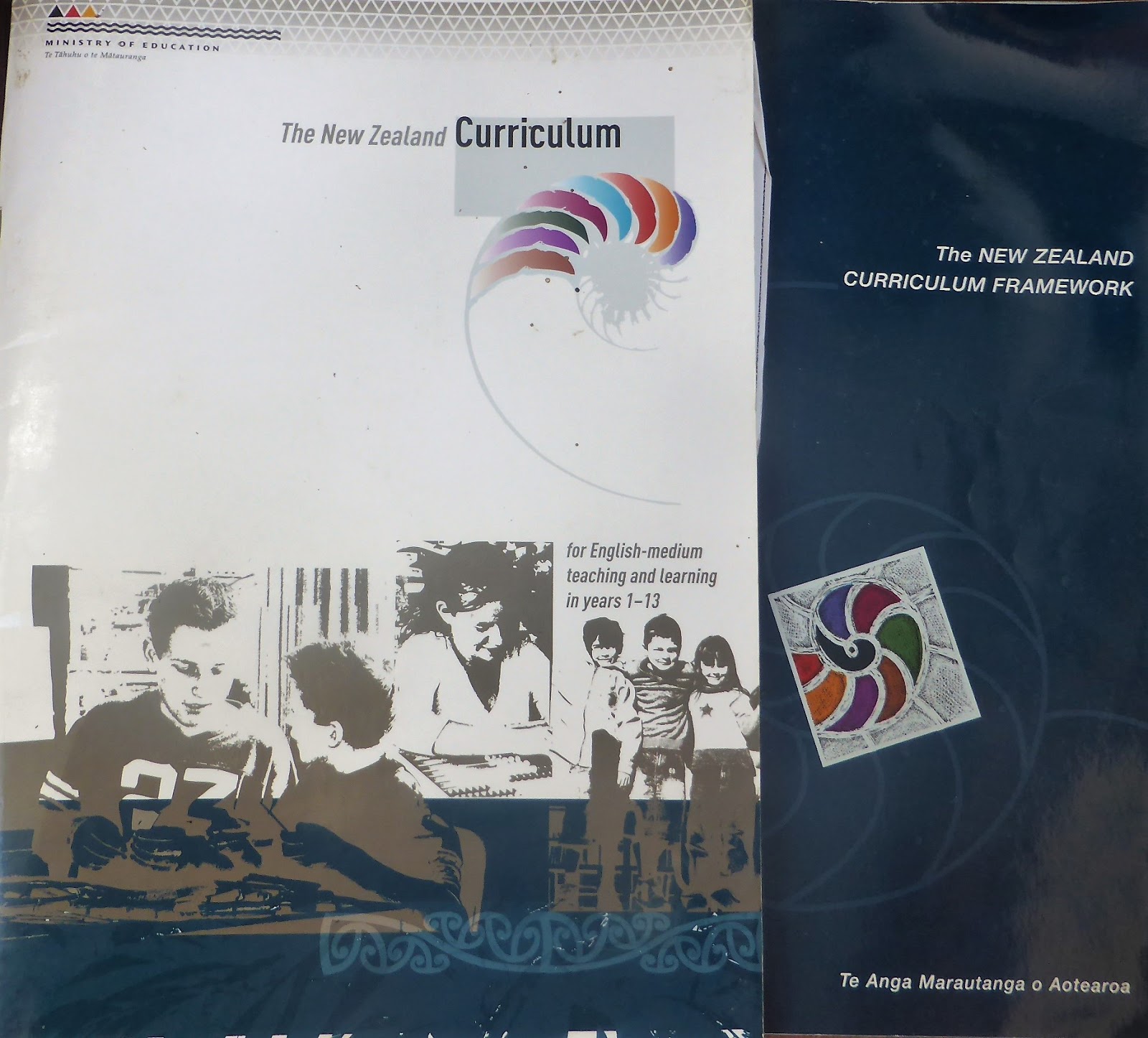
The 2007 NZC replaced the 1993 New Zealand Curriculum Framework which was the beginning of the end of creative teaching with its countless learning objectives to be assessed and reported on. As on commentator said a ‘mile wide and an inch deep’. National Standards were a politically inspired  attempt to focus on what the Ministry technocrats thought most important.  This emphasis on standardisation was enforced by the toxic surveillance of the Education Review Office.

Which brings us back to the 2007 New Zealand Curriculum.

A graphic metaphor, a nautilus shell, illustrates the document. This spiral image represents intellectual and spiritual growth; ‘one’s mind, once stretched by a new idea, never regains its original dimensions’, Oliver Wendell Holmes physician, writer and poet.

nautilus visual metaphor
The curriculum takes as its starting point ‘a vision of young people as lifelong learners who are confident and creative, connected and actively involved’ (p 4). The curriculum expands on this vision outlining the values, key competencies, learning area and principles (p 7/8/9).

There are key phrases that provide the direction schools should take to develop young people as creative and enterprising lifelong learners but one that stands out for me  is for students to be ‘active seekers, users, and creators of knowledge’ – a phrase that is repeated in various forms in all the learning areas.

Putting this phrase into action would change the programmes of many classrooms where the current programme is determined by teachers by an overuse of such formulaic ‘best practices’ as WALTS (we are learning to) success criteria , teaching intentions and heavy handed use of feedback and feedforward. These practices have resulted in conformist standardised learning even in such an
Quality work well displayed
open ended subject as art.

The curriculum’s principles (p9) puts ‘students at the centre of teaching and learning’ one of ‘high expectations’ and ‘personal excellence

. A curriculum that ‘ensures that the students’ identities, languages, abilities, and talents are recognised and affirmed’ and requires a ‘curriculum that has meaning for them’ one that ‘connects with their wider lives’ and ‘opens up pathways for further learning.’

Although not mentioned explicitly the curriculum (and recent research) by being ‘non-discriminatory’ it questions ability grouping. The National Standards encouraged the use of ability grouping, narrowed the curriculum and, in particular the creative arts.

The Values (p10) - to be ‘encouraged, modelled and explored’.

Republished by NZCER 2016
Every decision a school makes ‘reflects the values’ held individually and collectively and are expressed in the ‘everyday actions within the school’.  Once again not mentioned explicitly would be the use of ability grouping, streaming or fragmented timetables. Important values the document encourages are ‘innovation, inquiry, and curiosity, by thinking critically, creatively, and reflectively’. Ecological sustainability, empathy and respect for themselves, each other and the environment are included.

Key Competencies (p12) – ‘capabilities for Living and Lifelong Learning’.

The competencies listed are the key to lifelong learning and their development are seen as both an end and a means and are to be developed in authentic contexts; ‘they develop over time, shaped by interactions with people places, ideas, and things’.

The ‘Thinking Competency’ is about making sense of experiences, constructing their own
knowledge. ‘Intellectual curiosity is at the heart of this competency. Students as ‘problem solvers actively (able) to seek, use, and create knowledge. They reflect on their own learning, draw on personal knowledge and intuitions, ask questions, and challenge the basis of assumptions and perceptions.’

The Language Competency is about representing and communicating ideas in all forms.  Managing Self is associated with ‘self-motivation, a “can- do” attitude, and with students seeing themselves as capable learners’ – about having ‘strategies’ for learning. Relating to Others is ‘about interacting effectively with others’. Participating and Contributing is about students having ‘a sense of belonging and the confidence to participate within new contexts’.

The Learning Areas (p 16/34) that are important for a broad general education.

 Guide lines for each level of the Learning Area are expanded in the fold out appendix.

Eight learning areas are identified, all laying ‘a foundation for later specialisation’. Like the Key Competencies they are ‘both end and means’.  Although presented as distinct ‘all learning should make use of the natural connections that exist between learning areas, values and key competencies.

Each Learning Areas has its own special contribution and the essence of each if clearly defined on page 17.  English (p20) is about ‘making meaning’ and ‘creating meaning’. The Arts (p20/21) are a means to ‘transform people’s creative ideas into expressive works’. Arts are seen as an important means to encourage students to ‘take risks’; to ‘creators, presenters, viewers, and listener, able to participate in ,interpret, value, and enjoy the arts’. Dance, Drama, Music and
the Visual Arts are included. They are all about appreciating, making and creating. The Visual Arts begin with children’s curiosity and delight in their senses’ – about ’aesthetic awareness’ – experimenting, exploring and creating, bringing their own experiences, sharing their re4sonses, and generation multiple interpretations.

The above couldn’t be further away from the current standardisation seen in many schools.

The other Learning areas are Health and Physical Education (p22.23) which includes Home Economics. Learning Languages (p24/25) Mathematics and Statistics. Mathematics emphasizes the ‘exploration and use of patterns and relationships – about thinking and solving problems through investigating, interpreting, explaining and making sense.’ Implicit is the need to develop a positive
attitude towards maths. Science once again emphasizes the need to ‘investigate, understand and explain. It involves ‘generating and testing ideas, gathering evidence’ and communicating ideas.  Several strands are identifies including the important How Scientists work; the Living World, Planet Earth and Beyond; and the Physical and Material World.

The Social Sciences is about developing a feeling for other societies from the past, present within and beyond New Zealand. Once again the inquiry /creative approach is emphasized - asking questions, exploring, considering and reflecting. The final learning Area is Technology – is a practical form of design science. Information Technology needs a new inclusion and this might be part of any proposed review but ideally information technology is ideally integrated to assist inquiry across the curriculum E-learning (p36) (ICT) ‘assists  the making of connections of connections by enabling students to enter and explore new learning environments, overcoming barriers of distance and time.’

In a post National Standards classroom the class inquiry studies take central place with the foundation skills of literacy and numeracy integrated where possible. Over a two year programme Learning Area Strands ought to be covered – with the proviso that many studies will integrate several strands.

Effective Pedagogy (p34) – teacher actions promoting student learning.

Goethe
Effective pedagogy occurs in a ‘supportive learning environment’ ; ‘one that encourages reflective thought and action’; ‘makes connection to prior learning’ ; and provides ‘opportunities to learn’. ‘Students learn best when they feel accepted, when they enjoy positive relationship with their fellow students and teachers, and when they are active, visible members of the learning community’. Such environments are ‘non –discriminatory’ – once again questioning the use of ability grouping.

Reflective thought and action is to be encouraged when students are able to ‘relate learning to what they already know’ (their prior ideas) and where they are able ‘to think about their own thinking’. Learning has to be relevant. ‘Students learn most effectively when they understand what they are learning, why they are learning it, and how they will be able to use their new learning.’  Students need opportunity to transfer new learning’ - in reality it is only when students can transfer learning that knowledge has been gained. This is about ‘ownership’ or, in a more recent term, ‘student agency’.

Students - true scientists
One phrase that stands out for me is the ‘need to cover less but cover it in greater depth.

Teachers are to be encouraged to inquire into their own teaching (Teaching as Inquiry p35) best visualised as a cyclical process that goes on moment by moment (as teaching takes place) day by day and over a longer term. My own phrase for this is teacher artistry – teachers continually observing students to provide assistance as and when necessary.

The School Curriculum: Design and Review (p37/43)

The Curriculum requires schools to develop curriculum to suit the needs of their community. The curriculum provides the framework and gives schools the scope, flexibility and authority to design
A rich curriculum
and shape their curriculum’ to suit their community with the proviso that’ all students should experience a rich and balanced education’ something that has been lost with the emphasis on the now abandoned National Standards.

Various ways are suggested about how to organise the curriculum around values, learning areas or competencies or around central themes integrating all aspects. The latter is my preference and the curriculum does say that ‘schools should design their curriculum so that learning crosses apparent boundaries’; a challenge for traditional secondary schools but ideal for Modern Learning Environments.

Achievement objectives are found in the appendix and the various levels represent progress to deeper learning. Schools are expected to show what it is they want their students to learn and how their curriculum is designed to achieve it but it NZC says (p39) that ‘each student’s ultimate learning success is more important than the covering of particular achievement objectives’.

The curriculum is based on ‘the premise that all students can learn and succeed and should recognise that, as all students are individuals, their learning may call for different approaches.’ This could well be a good description of personalised learning?

Assessment.

‘The primary purpose of assessment is to improve learning and teacher’s teaching’.  It is ‘best seen as an ongoing process that arises out of the interaction between teaching and learning’. ‘Much of this evidence is “of the moment”. Analyses of and interpretation often takes place in the mind of the teacher, who then uses the insights gained to shape their actions’. In my terms the artistry of the teacher.

Effective assessment should benefit students; should involve students and support further learning/teaching. The idea that outcomes ought to be known in advance of any learning (WALTs
etc.) can, if overdone, lead to limiting student creativity. What is missing is evaluating students work, their personal growth through portfolios etc. might be the best way.

Learning in Years 1-6 (p41)

Teaching and learning programmes are developed through a wide range of experiences across all learning areas, with a focus on literacy and numeracy along with the development of values and key competencies. I would prefer seeing literacy and numeracy and ‘foundation skills’ integral to inquiry learning. Too often, today, literacy and numeracy take up a disproportionate amount of time in contrast to inquiry learning across the curriculum (authentic learning experiences – rich, real and relevant)

Learning in Years 7-10 (p41)

‘During these years, students have opportunities to achieve to the best of their abilities across the breadth and depth of the New Zealand Curriculum’ through authentic learning experiences’ associated with ‘ongoing development of literacy and numeracy skills’. ‘These continue to need focussed teaching’ (but not ability grouping or streaming!)

Learning in Years 11-13.

Enuf of formulaic teaching WALTs etc
‘The curriculum allows for greater choice and specialisation as students end their school years’.

Board of Trustees (p44)

The BOT, through the principal and staff are required to develop a curriculum consistent with the vision, values, principals competencies, learning areas as outlined in the NZC. Each BOT is required to gather information that is sufficiently comprehensive to enable evaluation of student progress and achievement, and to identify students at risk or have special needs.

The new Minister of Education Chris Hipkins has stated that he wants school to avoid over assessment (resulting from narrow targets set by National Standards of NZCEA).

Sign of Growth


I am aware of a number interesting current developments that are heading in a creative/holistic
direction. Such things as ‘play based education ‘, ‘project based learning’, ‘passion based learning’ and ‘personalised learning’ that link back to earlier ‘developmental teaching’ and ‘holistic learning’. Approaches such as ‘related arts’ and ‘language experience teaching’, ‘centres of interests’, and ‘whole language’. I would be happy to rename ‘literacy time’ with ‘language arts’ blocks.

Final thoughts.

One quote comes to mind for me is from Jerome Bruner who said that, ‘teaching is the canny art of intellectual temptation’. Students’ have a genetic need to learn and make sense of their
Jerome Bruner
experiences. Nothing a school does should dent this need to learn – 'all students can learn', the NZC states, so it up to teachers to create learning environments that ‘tempt’ all learners.

Students’ altitudes to the learning experiences provided are all important rather than achieving doubtful standards. The emphasis ought to be on personal growth – personal best.

Finally the message about what is important is how the day is organised - -this link will provide ideas. The current emphasis on literacy and numeracy (and ability grouping) needs to be replaced by a focus on the studies being undertaken – integrating literacy and numeracy where possible.

I envisage classrooms as true learning communities of scientists and artists exploring their concerns, the local environment and the wider world past and present. Such classrooms I see as mini Te Papas ( or perpetual science, art, maths technology fair  type exhibits) with every available space covered with displays/exhibitions of quality research, art and language based on the themes, studies, topics and investigations.


Art work based on research into the lives of people in Medieval times Year5/6