Monday, June 26, 2006

What is this thing called learning?

 It seems simple enough. So why do so many 'learners' fail at school? Dysfunctional schools or dysfunctional learners? Posted by Picasa

Children go to school to learn.

It seems simple enough.

However when they enter school children find what they and their parents have experienced as learning does not always match what the teachers think

At home learning is shaped by responses to experience often mediated through conversation. The responses are shaped by the queries and questions about things that surprise the young child, or don’t seem to ‘fit’ what they have come to expect.

At school ‘learning’ is organized and shaped by the teacher who in turn is influenced by curriculums devised by others outside of the classroom. What happens in school should enhance student’s capacities to learn. If this happens, and students feel the ‘power’ of success, then they are on their way to becoming ‘life long learners’.

When it does not, students pay a personal and social price.

So learning is not as simple as it seems.

Many teachers draw on their experience, common sense, and professional knowledge as the basis for their teaching. What is sometimes missing is a ‘shared language’ of what learning is across a school so teachers can, talk to each other, their student’s parents, and also to hold themselves accountable.

This must be the ‘heart’, or the ‘art’, of teaching.

So ‘learning’ can mean many things.

Some teachers see ‘learning’ as transmitting knowledge or skills to students for them to memorize, or use, while other teachers spend time finding out what students bring to the learning situation and then build on and challenge their ideas. Some teachers determine what students ought to know and plan accordingly while other value students personal ‘voice’ and concerns as the beginning of learning.

The teachers ‘stance’ makes a difference!

And then there are those who see ‘learning’ as ‘achieving targets’ in literacy and numeracy, happily leaving to one side other important attributes, or subjects like the arts, that are harder to measure.

At a time when ‘experts’ now say that the individual teachers skill is the vital variable in child learning (up to 60%) it would be important for a school to clarify the core beliefs about teaching that all teachers should share –and that these beliefs should be mix of successful teacher practice and what research tells us about how students learn.

So it is not just about ‘learning’ (something) it is also learning ‘how to learn’ and also being ‘aware of how one learns’ – called metacognition.

Teachers need to be able to articulate what their beliefs are about teaching and learning and to be continually expanding their repertoire of teaching and learning strategies.

So ‘learning’ is a process that involves both teachers and students. When all members of the school are engrossed in learning then you have ‘learning community’.

Not all schools are ‘learning communities’ because too many students are failing..

Next time you see a teacher ask them what beliefs they base their teaching on?

You can’t take it for granted that all teachers will be able to answer the question.

See Te Ara Vision on our site for five core beliefs.

Wednesday, June 21, 2006

More from Mr Beane! Democratic Schools

  Posted by Picasa A bit more from Mr. Beane!

Beane is interested in what a curriculum would look like that transcends the current standardized ones – you know the ones with all those strands, levels and learning objectives.

He wants to know what a democratic curriculum would look like – one that provides ‘common good’ to all students; one that sees students as creators rather than ‘consumers’ or ‘customers’ – and most of all one that treats teachers as professionals.

Beane believes students need to be brought together to develop their own curriculum by combining their concerns and self interest with 'common good' in a collaborative and democratic way. For such a curriculum to be worthwhile he believes it must both address significant issues and engage students in an active and meaningful way.

After the two key questions have been asked (1. ‘What question or concerns do you have about yourself?’ and 2.‘What questions or concerns you have about the world?’) students gather in groups to discuss the questions and then work with their teachers to help them group common concerns into themes.

This would also allow the current curriculums ‘big ideas’, or strands, to be covered if this was felt important. The themes that the student's develop also cover over time the main strands that are included in the 'official' curriculums.

For example a set of questions framed a theme called’ Living in the Future’ which included, health issues, aging, planning healthy life styles, environmental concerns, study trends and graphs, looking at past trends ,the role of technology, future problems, and the need to get along and live with different cultures.

Another theme that was developed was ‘Show Me the Money’ arising out of questions about where money came from, history of money, ancient civilizations and money, budgeting, wealth distribution, poverty, and so on.

Other themes developed from students questions were: ‘Conflict and Violence’, ‘Outer Space’, ‘Isms and Prejudice’ - the possibilities are infinite.

After the theme has been selected students research their own questions, share and debate findings, prepare reports, interview community members and develop a parent evening presentation night to share findings with the wider community.

A full range of information technology and creative arts are naturally integrated into the learning experience as are a full range of appropriate thinking strategies – anything that allows the student to inquire deeply and express their ideas with imagination. It is essentially a problem solving approach.

The themes involve real work by the students often with no correct answers. Students have to come to consensus, handle differences, respect each other views, make decisions, contribute to group tasks, and find resources ( although teachers assist in this).

All this activity demands more time and intellectual energy that is usually expected. Students in this rigorous process pick extensive meaningful content knowledge as well as using higher order thinking skills- all qualities that will be useful if they are to live and contribute to a democratic society.

At the school I visit, which uses this approach across all children from year 1 to 8, the parent sharing evening have become a major highlight attracting a large number of enthusiastic parents.

It is important, according to Beane, not to ask the children simply what they are interested in and what they want to study. The broader based questions asked are concerns about themselves and the wider world and relate the studies to the 'common good'. Broader questions usually raise questions of wider social and worldwide issues .It has been found that students in widely different communities raise similar issues.

Perhaps the simpler questions might be the basis for work in the younger classes?

The deeper themes developed often involve issues of race, gender, class and wider society issues that encourage students to tackle more meaningful ideas.

Although the entire class decides on the theme the school I visits involves the entire school in this theme development using cooperative learning strategies – the older working with younger children. As the theme develops there is time for small groups, or individuals, to follow topics they feel important and that need not concern the whole group. If the whole school is involved the theme moves from family group to the class and individual levels but everyone contributes to the school wide presentation day.

Such a learning approach creates the school as a true 'learning community' where all work together to create what individuality they could not do alone, and where every persons individuals creativity is valued if it adds to the total picture of learning.

At the school I visit it has made a real difference, not only to the students, but their teachers who now work together for a common cause, and to the parents and the wider community who are as exited as the childrenare with what is being achieved.

Exciting stuff!

Developing a democratic curriculum.

  Posted by Picasa Education and Democracy: James Beane

I visit a wonderful school that makes use of an integrated learning approach based on the ideas of James Beane.

Beane's (and others) ideas fits into current talk of personalizing learning but within an environment based on democratic ideals.

Relating back to the ideas of John Dewey he believes that if people are to live democratic lives they must have the opportunity to learn what that way of life means. His ideas are based on the ability of students to participate in their own education. Democratic schools share a child centred approach but their larger goal is to change the undemocratic conditions of school themselves and in turn to reach out to the wider community.

Beane believes that teachers have an obligation to help young people seek out a range of ideas and to ‘voice’ their own. Beane believes that imposed standardized curriculums actually ‘deskill’ teachers as they are forced to follow approaches imposed on the school.

In Beane’s school teachers live with the creative tension of continually seeking a more significant education for their students while still attending to the knowledge and skills that will require continuing learning.

I believe it is an approach that has real relevance for teachers and students in the middle school where fragmented specialists teaching seems unable to cater for all students. At this level there is a real need to develop more coherent, and engaging learning challenges. This is all the more important for students who are currently failing school – or in Beane’s philosophy where schools are failing their students.

Beane defines several approaches to integrated learning to replace traditional separate subject teaching. Multi-disciplinary where two or more subjects are organized around a theme – in this approach subjects can still retain their separate time slots. Curriculum Integration without regard to subject areas lines. This project based education can involve students selecting/negotiating their own tasks and content.

Beane however takes integration one step further.

In this variation teachers and students plan together through a carefully guided process to create thematic curriculum based on questions and concerns students have about themselves and their world. Student questions are clustered into themes and teachers collaboratively plan activities which are designed for students to take a greater responsibility for their own learning in the context of democratic community.

In this way a school, with student input, develops its own curriculum based on two question asked at the beginning of the year.

What questions or concerns do you have about yourself?

What questions do you have about yourself?

Beane calls this a democratic curriculum. Although the class, team, or even the whole school decides on the themes there is plenty of time for small groups and individuals to create their own projects around the themes.

It is works wonderfully at the school I visit - more about that school later!

Tuesday, June 20, 2006

Personalising learning and the 'new' curriculum

  Posted by Picasa Reading the latest speech from the Minister of Education Mr. Maharey it seems that new directions are being introduced in education that will, in his words, ‘re-orientate the system to put the learner at the heart.’
For student centred teachers this is nothing new but for others, as the Minister says, ‘it will mean ‘looking hard at how we teach, what we teach, and how we assess’.

There will be a strong focus on classroom teachers as it seems research indicates that up to 59% of the variance in student achievement can be explained by effective teaching. It probably sounds mean but I wonder what this measure of achievement is – love of learning or marks for literacy and numeracy?

The Ministry now realizes that the best way to ensure quality learning is to engage students in their own learning. It is great that this idea has emerged after years of believing Ministry imposed curriculums would do the trick. No matter it is a good idea.

Along with the above there is the realization that high expectation of teachers is also a key variable. Isn’t research wonderful?

Following the ‘successful primary and numeracy initiatives', they are being extended into secondary schools. I would’ve liked to have seen a ‘learnacy initiative’ developed but that would be too much to hope for! 'Secondary school teachers need to see all students as successful learners and acknowledge that a better understanding of student’s lives outside school, their aspirations and what they bring to the classroom is vital', the Minister says. This would make a change from the rampant ‘deficit theory’ thinking that is held by many secondary teachers of too many failing students. The Ministers emphasis on personalization will challenge this demeaning point of view.

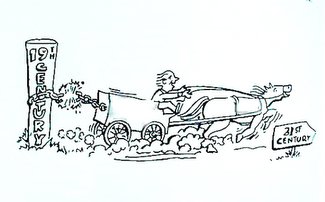
He says that if these ideas were achieved it would certainly make a difference to the chances of students currently exclude and that ICT, combined with a personalized approach, has the power to transform teaching. Currently ICT is over-promised and under delivered; 21stC tools trying to fit into 19thC structures.

As for what we teach the Minister says, ‘we need to provide every student with the key skills for learning and life. Skills we hope will enable them to reach their full potential as individuals.’

The current NZ Curriculum has been revised and simplified and will allow schools the freedom flexibility to focus on individual learners. The curriculum will:

• Combine the seven Learning Areas into one document
• Focus on effective teaching as the most important thing to cater for the needs of all students
• Strengthen school ownership of curriculum
• Encourage home and school cooperation and communication.

Assessment will be focused on providing high quality information to parents, students and teachers. Sounds like there could well be a few ‘fishhooks’ hidden in this simple statement?

As for the future the Minister says the Government has two developments:

1. The School Strategy which focuses on effective teaching and engaging families and whanau informed by ‘evidence based teaching’. Let’s just hope that not too much of this evidence has to be on paper. It is what the learner can do, perform, and demonstrate that ought to count. I prefer ‘evidence informed’.

2. Secondary School Futures to encourage debate about the purpose of secondary education twenty years from now. All a bit late I would have thought. We already know enough about learning organizations and teaching and learning for all students to succeed – why wait so long. A bit like Nero fiddling while Rome burns!

The first of the two is obvious the second urgent. If we want to ‘retain’ and ‘engage’ learners we can’t make the 21st C with schools designed in the 19th.

Let’s hope these changes are made by the Ministry supporting and sharing the ideas, expertise and wisdom currently in the schools and not through the idealistic eyes of distant researchers. ‘Best research informed practice’ is preferable to ‘research led’ change.

All these changes will become increasingly difficult to achieve the further up the school system one goes. They are already in place in many junior rooms!

It will take some courage by all involved – none the least the Minister and the Ministry to combat the entrenched power of the so called 'successful' secondary schools with their self centred middle class parents who might think they might have to lose or share some of their ‘social capital’ and power!

Sunday, June 18, 2006

Minister Maharey's Agenda

A week or so ago our Minister of Education Steve Maharey presented his future agenda at a Middle School Principals meeting.

It signals the direction the government intends to take in education the next few years – well at least to the next election!

His eight points make interesting reading and possibly signs of better times for teachers and principals who have had to sufer the technocratic incoherent curriculums of the past decades?

His points were (with a few comments from me):

1. An emphasis on effective teaching based on NZ research (‘best practices’). I think I would prefer based on effective teaching taking place in our schools informed by current research. It is great that it has been ‘discovered’ that the teacher is the most important influence in any classroom along with high expectations.

2. An emphasis on developing leadership in schools (and within and between schools I would hope). This will be a change from all the managerial compliance requirements of the past years – imposed by his own bureaucrats. Many principals have been too busy with paper work to focus on leadership.

3. The provision of resources to schools .This could well be the Ministry's main role along with creating networks to spread the good ideas being developed in schools. The Minister needs to develop a ‘high trust’ rather than a 'low trust' audit culture – now that would be something.

4. A focus on behavior issues. Student behavior is a symptom of wider society issues but schools have not been able to provide challenging enough programmes to ensure students are gaining attention through positive actions. An emphasis on ‘designing’ programmes to suit individuals, rather than ‘delivering’ ‘one size fits all’ programmes, may be the real solution.

5. Retaining students until 16.This links in with all the above. It is pretty easy to work out witch students are not being retained (or ‘engaged’) and it wouldn’t be brain surgery to do something about it except for dysfunctional industrial aged secondary schools.

6. Reviewing Secondary education and teaching. Now there is a real challenge and one that has within it the seeds of success for all students. We know enough now that all students can gain success but we suffer from a ‘knowing action’ gap.

7. Engaging families and whanau. This of course means ‘inviting’ the very families that have had bad experience themselves when at school. The old pass/fail School Certificate ensures that this includes 50% of parents. A lot of ‘mindsets’ to change here both within and outside schools.

8. Ensuring sound foundations of literacy and numeracy. No argument here but lets see them as ‘foundations’ to ensure that the interests, passions, talents and dreams of all students are the number one priority! Schools are too often ‘dream killer’ not ‘dream weavers’. ‘Learnacy’ is more important than either literacy or numeracy.

His final challenge to the Middle School principals was to ‘personalized the learning for the children in front of you’ and for them to ‘lead the debate’.

Personalization will be the word we will all be talking about the next decade as the 'mass' education 'dream' has turned into a 'nightmare' for too many student (and teachers).

Nothing new in personalization, it has just taken along time to reach the heady heights of the Ministry officials in their distant ivory towers,

School to need to be treated personally as well - that will be the Ministry's challenge!

21stC: Personalised Learning!

The Minister of Education recently gave what I consider to be an important address about the future of education called from ‘Hope to Reality: Making a Difference for All Learners’.

The full address can be found on the NZ Labour Party website.

In his address Minister Maharey referred back to a past dramatic turning point, the 1939 Peter Frazer vision ; a speech written in part by the then Director of Education Dr Clarence Beeby. This was the beginning of mass education up until the age of 15 for all students – each learner was to receive and education ‘suited to the fullest extent of his powers’. In its day this was seen by many as controversial, particularly business groups, who felt that certain children would not benefit from the opportunity!

By 1980 it had become obvious that this vision was not delivering – especially for Maori, girls, and working class students. This ‘failing system’ was fair game for ‘market forces’ thinking of the 80s which believed schools ought to be more efficient, accountable and competitive. Introduced,under ironically a Labour Government, a 'market forces ideology' turned education into a private commodity rather than a public good; students to be seen as 'customers'; and schools were to compete with each other. The 'free market' was seen as the best way to provide services and contracts were put out to tender for those who won them to ‘deliver’!

Maharey now believes that the ‘high tide of free markets has now passed’ and that the ‘market model made things worse’. Today, he believes that, ‘the Beeby /Fraser vision is still alive and relevant’.

He has to thank creative teachers for keeping the spirit of the vision alive in an ‘audit low trust compliance culture’ ; such teachers, and schools, have been through hard times at the hand of Government authorities.

Discussing, ‘where we need to go from here’, Maharey stated that the Beeby/Fraser, ‘vision did not meet the needs of all learners’ – it was not really, ‘focused on the needs of the individual’. Instead it succeeded in giving students an ‘opportunity’ but it was, ‘delivered in away similar to mass production –standardization, central control, large scale organizational hierarchy.’

‘In other words’, he continues, ‘the student had to fit in with the system. In the light if what we now know such an education was unlikely to meet the needs of many learners, never mind the Maori, the working class and woman.’

The answer he believes ‘lies in another reorientation of the system’ This time, ‘the system will become learner –centered. Our aim now must be to provide personalized learning’.

This he says will, ‘demand a change in our approach’, and that, ‘we need to re-orient the system so that the leaner is at the heart of it’. Personalization is, ‘the approach that Labour is following’.

Concluding Maharey stated:

1. ‘The Beeby/Fraser represents an educational tradition that continues to serve us well’.
2. ‘The market argument is now dead’
3. ‘Placing the learners at the centre of the system (personalization) is as radical a notion as that conceived by Beeby/Fraser’.

‘Transforming our society requires transforming our education system.’ ‘It will require a culture of continuous inquiry, innovation and improvement, risk taking and entrepreneurship. This can only come from the education system.’

This, Maharey states, (and I have to agree) is a, ‘radical vision. If it is to work it will take real leadership.’ Principals, he says, need an, ‘optimistic view of what NZers can achieve, and make a difference for all students.’

‘We stand now at a beginning of a new century seeking to transform our nation. The power of education to drive that transformation is as potent as ever. But it can only exercise that power if education itself is transformed’

It seems we have a vision for our country at last; a just and equitable creative country dependent on the new ‘capital’ of the future – the curiosity, intellectual power and inventiveness of all its citizens – and with education its centre.

And as for ‘personalization of learning’ there are those among us who never lost the dream of it being achieved. Up until recently our politicians have been transfixed by the false promise of ‘market forces’. Maharey’s words offer hope for those who kept the Beeby vision of creative education alive these past decades.

For information on personalization of education.

Monday, June 12, 2006

We all need interests

  Posted by Picasa It was great to read an interview with Joy Cullen, Professor of Early Years at Massey University College, in which she said:

‘I think we all need interests. We need to be encouraged to pursue our interests. We need people who are interested in us. We need faith in ourselves that we can do things. And all learners, be they gifted and talented, or children with major disabilities, need the support that helps them to have some sort of understanding of themselves as learners.’

She goes on to say she believes in people, the power of learning and that central to her learning is the ability to tackle new challenges and as a teacher to pave the way for others.

What she wants for young learners is for them to develop a love of learning and the ability to pursue their interests. As educators she wants uS to ensure that all learners can get a sense of themselves and a belief That they can learn.

Joy has previously studied ‘learned helplessness’.

Talking about her childhood she said she was encouraged to show initiative, to be reflective, and to enjoy the outdoor environment, and to have aesthetic interests. It was all about learning resiliency and self sufficiency.

To Joy, the learner is central to the learning process and the issue is about how teachers can support learning for the child and that it is important not to give up on any child.

She goes on to say that she has learnt that:

‘Everyone one can learn something at whatever level. So, you don’t give up on children. We work with children with the skills and competencies they bring, and yes, it is worthwhile to do that in itself.’


Teachers, she says:

‘They’re looking at what has captured the child’s interests…what happening here? Then they’re looking at their own strategies and what is the next step from there.’


There are two ways of looking at children’s interest. One, in which you’re really working and extending them into developing projects, and the teacher is involved in that co-constructivist style of learning. Or there is a much softer sense, if you like, of children’s interests where children are just able to choose what they do. The old fashioned free choice, self section sort of programme. That type of programme…can be very low-level play and its not extending anyone.’

In the 1960s this was called creative expression and it is still important. The sixties were:

‘A great era of creative expression in primary schools. It was at that time when Elwyn Richardson had published his book ‘In the Early World’. It was very influential particularly in the junior primary classrooms,’


‘I was a wonderful era when era for people who were interested in working with young children because there were not the same constraints in terms of what you had to fit into the curriculum. You could use large blocks of the day allowing children to explore and create’


‘I can remember going for walks up the road and picking blackberries, coming back to make Blackberry jam..not very successfully! But doing wonderful paintings about the blackberries, looking at the colours…and it was an era, the 60s, that promoted that sort of creativity'.

It is this sort of experiential learning that we need to recover in this new creative era and we need to develop personalized programmes to uncover and develop the talents of every learner. Every student needs their own curriculum – their own Individual Learning Plan.

Joy concludes her interview with:

If as educators we don’t believe that we can make a difference, why are we here?


Lots of ideas to use the environment and to develop students interests on our site.

Slow learning needed for fast times!

  Posted by Picasa

Dean Fink and Andy Hargreaves, in their 2006 book ‘Sustainable Leadership’ introduce the important idea of ‘slow learning’. They draw on the ideas in psychologist Guy Claxton’s books ‘Hare Brain Tortoise Mind'; and ‘Wise Up’. Claxton is concerned with developing students 'learning power'.

Slow learning they believe is essential for our lives and learning by giving depth to our experiences and providing insight for creativity and ingenuity. All too often, in contrast, students are rushed through learning to cover curriculum material. First finished is best seems to be the order of the day!

As a result ‘slow learning’ is neglected in schools.

Those who appreciate ‘slow learning’ develop important future attributes:

• They are tolerant of fleeting and ambiguous ideas
• Are relaxed, leisurely and playful
• Are willing to explore without knowing what they are looking for.
• See ignorance and confusion as the beginning of learning
• Are receptive to spontaneous ideas
• Treat ideas that come ‘out of the blue’ seriously.

This is in contrast with recent suggestion to use precision ‘intentional teaching’ and achieving pre-set goals. When students are 'hurried' by teachers not enough time is allowed for ideas to incubate, or develop serendipitous connections with other areas of learning.

Claxton believes that an emphasis on current problem solving may be OK for problems that have answers but of little use with difficult problem with no clear answers. Such 'wicked' or 'messy' problems need time and often result in unforeseen solutions. Slow learning values intuition and imagination and avoids rushing into 'premature judgments'. Schools in contrast currently place a premium on rational criteria based thinking.

Ironically the other kind of thinking that is neglected is 'very quick' thinking. According to Malcolm Gladwell, in his book ‘Blink’, many important decision are made in the 'blink of an eye' without time to gather information to consider. To be able to use such insightful, or intuitive thinking, deep prior experience is required. For example a fireman knows in a ‘flash’ what to do as does an expert teacher helping a learner. Both call on wisdom slowly accumulated from hard earned previous experiences.

It seems creative thinking is paradoxical. Some of the best thinking is really slow while in other situation acting quickly is vital. Quick and slow thinking depend on each other.

The trouble is, it seems, is that schools use neither. All too often school learning is about producing something and is neither deep nor better just faster. Real learning is more than achieving teacher designed intentions or achievement targets.

Another author, Maurice Holt, is an advocate for the ‘slow school’ movement saying, ‘you can’t go on force feeding pupils and expect to get foie gras.’ Less, it seems done well, is definitely more.

The message for schools from all this is to 'do fewer things well'. To study topics in depth. Slower schooling means deep rigorous learning to challenge learners prior ideas and assumptions. Some learning, of course, needs to be fast and snappy but not all of it.

As Mae West put it best, ‘Anything worth doing is worth doing slowly’.

Good advice. Let’s slow down learning, do it in depth, and enjoy the experience.

On our site we have lots of good ideas to develop such quality learning.

Monday, June 05, 2006

Principals suffering from HAS Syndrome?

  HAS - Hyper Active Superficial Syndrome Thanks to Jackson Pollock for the painting. Posted by Picasa

For the past fifteen years or so schools have been flooded with endless curriculum, assessment, and compliance requirements and as a result many principals are under pressure to know exactly what is it that is expected of them. No wonder many are feeling somewhat stressed even if the macho and stoic amongst them pretend all is well.

During this time of trying to guess what is expected of them many principals suffer from, what change management expert Eric Abrahamson calls, 'RCS' – Repetitive Change Syndrome. He also says when organisations are asked to implement more change initiatives than they can reasonably handle 'Change related Chaos’ occurs.Other writers call it an 'implementation dip'. One business writer calls the problem ‘corrosion of character’ because in the attempt to guess what is expected of them ‘leaders’ lose sight of what it is that is important to them causing depresssion and feelings of lack of integrity.

School now suffer from the label they give to their their students 'ADD' – 'Attention Deficit Disorder' unable to focus on what is important to them – or, more importantly, what is important to the wider community if we want to develop a sustainable creative country. All too often schools have become inward looking and competitive, turning themselves in to ‘Christmas Tree – look at me schools' with fancy brochures and doubtful narrow success achievement graphs.

Worse still, after years of being in this low trust audit culture, principals start to believe that what they have been asked to comply with is actually the 'right thing' to do and, as a result, ‘schools become over-managed and under led’.

For far too long schools have put up with Ministry‘CRAP’. This stands for the Ministry 'Continually Changing All Procedures’! No wonder many teachers and principals are suffering from degrees of stress, burnout and cynicism.

A good friend of mine used to say that, ‘Teachers have two important things they must protect at all costs – their energy and their time .If they waste it on bullshit they will have no time to teach’. We are at this point now!

Now, as the world wide ‘market forces’ public choice efficiency approach falters, there is a move towards placing greater trust in the collective wisdom within organizations and communities .

The Ministry, obviously aware of this trend, has moved away from its technocratic curriculums and a 'new' Curriculum Framework will soon offer schools the freedom and flexibility that is long overdue. Ironically schools will now have to throw out, or unlearn, what they have had to develop to take advantage of this change of direction.

'New' answers are for schools to 'transform' themselves into ‘professional learning communities’ based on shared visions and values. And now schools are being asked to work together to share their collective expertise. Teachers expertise is now seen the key factor rather than the distant ‘experts’ curriculums. High teacher expectations and ‘learning how to learn’ (‘key competencies) now 'trump' learning objectives. The new draft even exhumes an old, but important, word pedagogy – the ‘art of teaching’ and even goes as far to state that developing a ‘love of learning ‘is important.

This is a real change of direction.

The new ‘curriculum’ will be ‘Deju vu’ for long suffering creative teachers and principals but it least will be a welcome antidote to all the nonsense that has passed for education the past decades. Principals will now need a good dose of 'ODD' – ‘Opposition Defiance Disorder’ so as to place a greater emphasis on what they, and their communities, think important. Innovative principals have always had the courage to say no to ensure what is valuable is protected and done well.

As we enter an age of creativity schools need to focus on ensuring that all students have the opportunity to develop all their talents and not just be restricted to a narrow diet of literacy and numeracy; we now need ‘new basics’ and ‘new literacies’ for this new ‘post modern’ world.

One needs to ask why we have had to wait so long for those in power to face up to the obvious, that things have not been working and are beyond ‘tinkering’. There must be a syndrome which covers being blinded by ones own outdated views? Lack of reality ‘gap’ or the ability to self delude come to mind.

At least we all now know the Emperor has no clothes; the ‘Emperor Has No Clothes Syndrome’ - EHNCS ?

Thursday, June 01, 2006

A new Era of Creativity for schools.

  Posted by Picasa A dramatic world wide change is now occurring as the world slides out of the Industrial Age into what some call a ‘post modern’ era .Others call it the ‘Information Age’ (led by new technology) or the Age of Ideas or even the ‘Second Renaissance’.

Whatever it is called thing are going to change – and quickly. The question is, can societies and their institutions, with their genesis in the Industrial or Modern age, change quickly enough, or will new forms emerge or evolve. The latter has been the story of history.

By 2020 will we recognize our world?

The trouble with change it is like being caught in the rain without enough information to see the weather .To see patterns this you need the distance of space or time, or at least an understanding of the ‘big picture’.

The future survival of any country, in this new dynamic evolutionary era, will require their citizens to be creative risk takers with a ‘can do’ attitude able to make decisions with partial information. And, if they are wise, they will see that education is the key to their future prosperity and survival.

A short history of the patterns of the last half century both indicates hopefulness and despair in regard to education.

Following the massive industrialization during and after World War Two Western societies settled into a conservative and security conscious decade. In schools it was the ‘Three Rs’ and straight rows and teachers ‘transmitted’ agreed prescribed knowledge to learners. There were pioneer teachers with alternative ideas but they acted as ‘sleepers’ for future change; the time was definitely not right!

Almost without warning the sixties introduced freedom and experimentation and 'love was in the air' as was disrespect for traditional values and institutions. It is said, 'if you remember the sixties you weren’t there'! By the seventies the world had changed – or so it seemed. Schools changed dramatically ( well perhaps only primary schools - secondary schools were and remain far more impervious to change). ‘Child centred' activity methods were introduced- out went the straight rows (and the strap) and in came group work and developmental programmes. Teachers in this period gained a high degree of autonomy and discretion. A ‘1000 flowers bloomed’ but not all were to last.

By the late 70s, after it seemed all teacher had ‘jumped onto the bandwagon’, things were not well and the time was right for more changes. As well, in this era of social conscience, all sorts of programmes were dropped on school to solve. All of a sudden teacher autonomy was replaced by imposed curriculums and only the dedicated few creative teachers remained true to their child centred principles.

By the 80s the time was right worldwide for a dramatic change of direction – the ideology of ‘market forces’. Competition, individuality, efficiency, accountability and choice were the new buzz words. And eventually this reached down to schools where in NZ ‘Tomorrows Schools’ were made ‘self managing’ and competitive. Ironically schools could manage everything (like a ‘business’) except the curriculum which was imposed and to which all schools had to comply with and be held accountable to. The curriculums, with their endless strands, levels and learning objectives, turned teachers in to ‘deliverers’ of other people ideas. Technocratic ‘mindsets’ were in control.

These were difficult times for creative teachers or leaders in this era of ‘managerialism’ and measured outcomes. Schools became ( and still are) ‘over managed and under led’. The 'market forces' ideology led to 'winner and loser' school that matched the growing gap between the ‘have and have nots’ of the wider society. This was to be the Industrial, or Modern Efficiency Age, at its worst.

But thingS are changing world wide once again and, once again, new patterns of thought will reach down to the schools. This time, with leadership, schools could lead the changes and not simply respond to idea 'delivered from on high' by people who have little understanding of the realities of the classroom.

The ‘new’ cuuricum, due in June, fits in well with this new conception or ‘mindset’. Schools will at last be given greater freedom and flexibility to ‘design’ (not ‘deliver’) programmes according to local needs. The now incoherent so called rational curriculums have now been reduced to essentials that will still provide the necessary unity and consistency within, and between, schools. ‘How to learn’ is now more important but this needs to be as a result of in-depth integrated learning. Pedagogy has been ‘dug up, dusted down’ and is now to be central.

Schools will now be able to develop themselves as ‘professional learning communities’ and will need to focus on creating the conditions to tap into the creativity and shared wisdom of their teachers so as to develop the citizens of the future on whose creativity we will depend on.

For many creative teachers who have had to keep their heads down the last decade or so, this will be affirmation of their beliefs and for those who taught in the 60s a case of ‘deju vu’.

I wonder if we still have the leaders to lead such a change?

In 1986 the then Minister of Education introduced an ‘Education Review’. This was nation wide conversation based around key questions to do with the future of education. Perhaps the time is right again for another nation wide dialogue to tap into the wisdom of all.

At the very least this is a conversation that every school ought to have with its community.

Monday, May 29, 2006

The protection of a clear Vision

  Posted by Picasa The most important question that should be asked of anyone who works in a school is what does the school stand for? What are the learning beliefs that are the basis for all actions and decisions?

If they can’t answer such queries instantly I would start to worry.

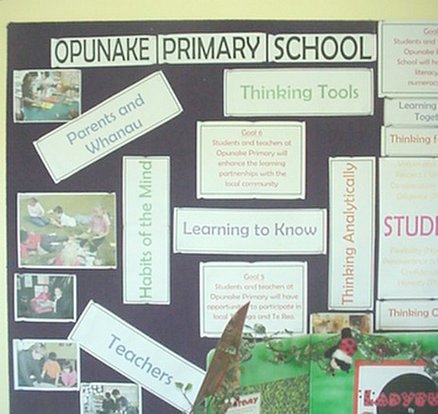
Strangely enough many schools do not have a simple learning policy, or set of teaching and learning beliefs, that underpins their school. Traditional schools rely on tradition and rarely have their assumptions challenged. Many schools can show you endless clear folders about all sort of procedures but not a simple learning statement of beliefs. All too often every one is to busy getting on with the job to stop and consider where they are going.

The answer to this dilemma is a simple School Vision , a summary of important Values and no more than six teaching / Learning Beliefs that all teaching is to be aligned behind. Visions however are of little use if they are not imbedded into every action and as such they need constant reflection and monitoring to be kept alive.

With a clear vision, and agreed way of working, you have an aligned and powerful school.

When this is written in powerful, often metaphorical language, it will provide simple ‘story’ for staff to tell to any visitor and, more importantly, to self assess how well they are doing individually or as a team.

Schools ought to be able to justify their beliefs – better still they need to celebrate them through how people relate to each other and by what the student’s can demonstrate, perform show or tell;the whole school should reflect the vision.

Visiting such school is a powerful experience. Excellent schools combine both consistency and coherence as well as individuality and creativity. They illustrate the creative tension between the common good and creative difference and it is from this tension that new ideas arise and are eventually accepted into the school.

In such schools it is appreciated that teachers and students will be at different points on any continuum but all will be helped to work toward improving their performance and contribution. Growth is not optional; quality is the goal.

Leadership is vital and needs to be shared depending on expertise of each individual and all important decisions need to be made collaboratively and democratically. The Principal still retains the most important leadership role of all – making sure that the vision, values and beliefs remain in the forefront of everyone’s minds. He, or she, is the ‘first amongst equals’.

Such vision breaks down the isolation that can too easily occur, either by neglect or avoidance. A vision makes it clear to all what the school stands for and provides a touchstone for staff to align their actions against and to see what professional development each staff member needs to gain to become a more valuable member of the school .In such schools bad habits are hard to hide - the vision depends on the combined actions of all.

Such a culture of inquiry is wonderful place to teach and learn in, and to visit. Creative people open to each other, always on the search for ideas make an exciting environment. Such community grows organically like a living thing always reacting to new situations, continually growing and changing. Within all this growth but basic principals and values remain consistent providing the necessary security for all to take the risks involved in learning.


There is an example of such a vision on our site and lots of idea of how to develop one.

At its simplist – what is you want your school to be (an ideal Vision to be realized in the future)? ; How do you want to operate, or behave, with each other – your Values? A Mission is the purpose defined for your staff to realize based on a set of about five Teachings Beliefs.

For excellent Learner-Centred Beliefs

And keep it simple and. if possible include graphics;it is the most important document you will develop.

Sunday, May 28, 2006

Metaphors for the future

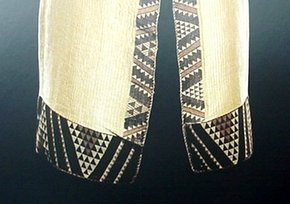
  The protective cloak of shared beliefs and vision; the whakahuia(treasure box) of important values and actions; the spiral to represent energy, growth and people held together; the poutama tuku tuku pattern (steps to learning) to represent teaching beliefs to achieve the vision.

Shared beliefs are stronger than contractual agreements - when beliefs are shared you have strong responsive and inclusive culture.

A true shared vision determines all actions; it is a moral covenent. Posted by Picasa

Monday, May 22, 2006

Driving into an exciting future!

  Posted by Picasa Last century most organizations, including schools, had a simple linear view of the future; they were happy driving their big luxury cars along the wide open highway. The future, it seemed, belonged to them; tomorrow will be like today but only better.

Nothing, it has turned out, could be further from the truth. Many once invincible organizations have now gone, replaced by more innovative companies who have taken advantage of new technologies. In the business world it has been adapt or die but not so it seems our big traditional secondary schools – not yet anyway, but times they are ‘achanging’ to quote Bob Dylan.

Today there is now, less certainty about the future, about where are going, and how we are going to get there. Rather than a straight motorway we now face the end of the road; the end of the traditional industrial age organization and mindsets.

What lies beyond the end of the road where there are not even tracks to follow? According to Alvin Toffler it is ‘terra incognito – the uncharted landscape of tomorrow’; a world of complexity, chaos and uncertainty - of accelerating change.

Eventually schools will catch up with the urgency to change to ensure students have the attributes to thrive in such times. It is hard to imagine our complacent big secondary schools being able to transform themselves, staffed as they are by industrial aged specialists teaching in structures designed for a past era.

In a future will demand collaborative teamwork, networking, individual initiative and creativity and to prove such qualities we need to urgently ‘re-imagine our schools. We will need a new 'educational vehicle, new driving skills' and a whole new sense of direction. The key will be for schools to see future discontinuity as opportunity and to develop new flexible educational organizations to thrive in such times.

According to futurist Rowan Gibson there are three main messages that will require us to change our ‘mindsets’ if we want to explore ‘terra incognito’.

1. The road stops here – the future will be different and, as obvious as it sounds, we behave as if it were not. Too often we prefer to repair our old cars when tomorrow will definitely be an off road experience. This is delusionary. The past has gone!

2. New times call for new organizations – we can’t drive our old cars into the future! We need a totally new kind of organizational vehicle that can handle the tough and uncertain times of this new landscape. One that reflects the information age -innovative ideas and creativity are the new capital of the future. Schools ought to be ideally placed to provide such future citizens but all too often they are facing the path back to lost certainty.

3. Where to next? With such an uncertain journey ahead organizations are going to find it hard to make confident strategic decisions. Everyone, from individuals to leaders of countries, needs to a vision, a destination, a point of view, about the future. As there are no maps of ‘terra incognito’ all that can be done is to explore and create our own maps through intuition and enlightened trial and error. The best stratgey will be for all involved to have the right 'mindset' to be able to take advantage of future opportunities.

According to Rowan Gibson every individual, organization, or country, faces a simple choice ‘rethink the future or be forced to rethink the future’. Those who choose the first option will have the best chance to spot emerging opportunities in time to take action; the others will find themselves overtaken. Gibson’s advice is for us all to rethink our basic assumptions about the future and harness the forces of discontinuous change to shape our own future before it shapes us.

Putting aside the mechanical metaphor of vehicles, Gibson believes it is better to imagine organizations( including schools) as a living organism based on networks of minds working and learning together fueled by ‘human imagination’. Such a ‘living organization’, based on a shared vision and beliefs, can only be created by radical change. An 'organic learning community' is able to continually evolve and adapt – but to create it will require a radical metamorphosis.

Schools ought to be leading the way into the future by developing in all students the attributes to thrive in what will be for them exciting times. The trouble is the large, backward looking, traditional industrial aged secondary schools, have so much to ‘unlearn’. Thankfully there are education models to gain insight from – in particular the early education classrooms where the joy of learning is still par for the course.

These young students are questioners and trail blazers, driven by their curiosity and desire to make meaning of their experiences – they ‘have the future in their bones’. If we had the wit and imagination we could learn off them!

On the right track at last!

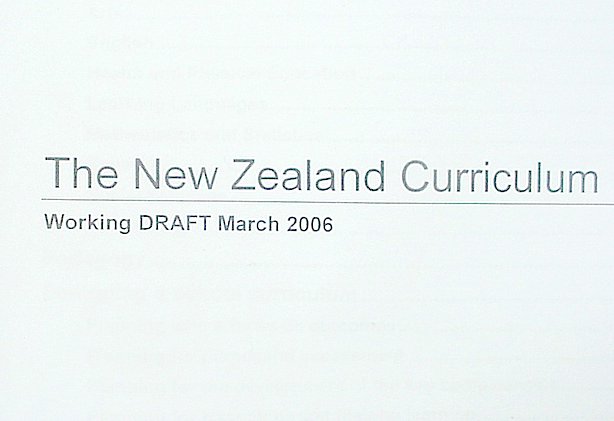
  Posted by Picasa The revised New Zealand Curriculum will be coming to your school soon; June I believe! In the meantime I have acquired a ‘leaked’ (or is it ‘drip fed’) draft document so I thought I would give it a preview!

For those, old enough to remember, it will be a case of ‘back to the future’ or ‘deja vu’

It will be welcomed by all who are sick and tired of not quite knowing where they stand about assessing learning objectives and for those who have long felt uncomfortable with the ‘top down’ compliance ‘define and measure’ concept behind the original New Zealand Curriculum. In the future, it seems, we will no longer have to ‘deliver’ curriculums but instead ‘design’ them to suit the particular circumstances of the school.

And, of course, the ‘old’ NZCF was hardly original, as anybody who has seen any number of similar documents from other countries or states, would know. It bears the closest resemblance to the English National Curriculum but, thank goodness, we never took it as far as they did in the UK and we have avoided the creativity killing national testing and associated ‘league tables’.

I have been a long time critic of the structure and mindset behind such curriculums but am now pleased to be able to support the ‘new’ document; it will make a pleasant change. I don’t even mind if they don’t apologize for sending us down the wrong trail for the last fifteen or so years. No doubt the Ministry will call it natural evolution but to me it is a bit like big clumsy dinosaurs changing into flexible new mammals overnight; I would call it the Ministry catching up with the reality of innovative schools.

The ‘new’ document opens the way for greater school freedom and flexibility for schools while still retaining basic core understandings. All the incoherent objectives, levels and strands for each learning area have been reduced to a single A3 piece of paper to cover all learning areas. The remaining ‘core’ will provide important national consistency while freeing up teacher and school initiative and enterprise.

The main thing is it will provide a clear sense of direction without all the complicated roadmaps to follow of the past. It is based more on profession trust than compliance.

It is all about teaching and learning these days (one wonders why this common sense idea a needs to be revived). All of a sudden those in their ‘ivory towers’ now understand that it is the quality of each individual teacher that is the key factor in a child’s growth; the power of relationship and high expectations. I have recently heard the Minister talking about ‘personalizing education to fit the curriculum to students’ rather than vice versa! The old pioneer creative teachers will ‘spinning in the graves’. The managerial education factory system of Henry Ford may finally be replaced by the democratic learning communities of John Dewey! Better late than never. Mind you it will take lot to shake up traditional secondary school structures and ‘mindsets’ with their genesis in the 19th C but, who knows, the power of ICT might simply pass them by.

Mind you I have few concerns. The foreword starts with the importance of literacy and numeracy – I would have thought it might’ve started with the need to develop the creativity and talents of all students as the number one priority. ‘All our students will stand tall as New Zealanders’, confident, connected, lifelong learners who are actively involved in a range of life concerns. These ideas, expressed in the draft, as a vision for our young people, I would have put first.

I guess we will have to live with the clumsy ‘key competency’ phrase but in reality it is all about the attributes required of a future citizen – the ‘new basics’. It is the development of such competencies, plus ensuring important key understandings are in place, that will eventfully provide the missing element, allowing ease of transition between the various schools levels for our students that is currently missing. It is great to see values rising through the ranks as developing appropriate democratic values will be a growing concern in a multicultural and rapidly changing world. And it is also great to see environmental sustainability included – it is after all a world priority!

A phrase I loved was ‘intellectual curiosity’ and students who are ‘active seekers, users and creators of knowledge’. Pedagogy is strangely defined (‘the art and science creating the conditions for effective learning’) but a ‘co- constructivist’ philosophy strongly underpins this draft. The draft mentions that, ‘effective teaching practice should encourage a love of learning’. You would never have seen ‘love’ mentioned in earlier technocratic documents – it would not be possible to measure. I also liked a simple phrase, ‘success breeds success! An emphasis on doing fewer things well will lead to excellence one of the principles mentioned in the draft.

The various learning areas are represented by ‘essence’ statements which focus on the ‘key ideas’ students should gain through experiencing them. Schools are encouraged to develop their own programmes which could start, ‘with the shared values and beliefs of the community’, or the ‘learning needs of the students’. And integrating learning areas around realistic contexts studies is strongly suggested as subject, ‘boundaries are more apparent than real’.

Assessment includes all the ideas most schools now use; it primary purpose is to improve students learning and teachers teaching. All those check lists and tracking sheets are now truly history! I really liked the idea that assessment is ‘ongoing process between the teacher and students’ and that much of it takes ‘place in the mind of the teacher’. Profession judgment is being given its rightful place again.

Not a lot is new but nothing wrong with that; but it does look good.

It is about teaching and about time!It may spark a new creative teaching revolution. Who knows?

The document I have is only a draft; the real thing will be coming to your school soon! Worth reading!

Friday, May 19, 2006

Tapping the wisdom of the crowd.

  Posted by Picasa Three times the last week or so I have heard, or read, references to a book called the ‘Wisdom Of Crowds' and so I was tempted to have a look about what it was all about on Amazon.

In our culture we have developed a default position that ‘experts know best’ and as a result we have learnt to distrust our own intuition.

In education, for example, we always await the next ‘silver bullet’ to be delivered by those who inhabit the Ivory Towers at the Ministry of Education. Who are we, we ask ourselves, to question their lofty deliberations? And in schools principal’s who know best ‘lead’ the teachers and the teachers, who know best, ‘teach’ the students what do. In between times we sit back and grumble and act like victims and blaming everyone else for the predicament we are all in. As Ronald Reagan said, ‘the ‘status quo, you know, is Latin for the mess we are in.’

There is no point in waiting for the 'experts' – if we want real change we have to make our collective ‘voices’ heard and do something ourselves.

And, it seems, we would be more often right than wrong if we do, according to New Yorker business writer Surowiecki, author or ‘The Wisdom of Crowds’. All we need is the right conditions and groups are more remarkably intelligent - more so than even the most intelligent members of them! To be more intelligent though we have to work in collaboration with others putting self interest to one side.

This is counterintuitive to us – that we actually know best and don’t have to wait around for distant experts to show us the way. Birds and fish can work together for their common good so why can’t we? We must have some residual collective intelligence left!

There are four basic conditions that need to be in place to ensure ‘wise crowds’ need:

1. A diversity of opinions
2. Independence of members from one another
3. Decentralization
4. A good method of aggregating opinion.

Diversity brings in differences and keeps people being swayed by a singe opinion leaders and it also brings in different information; peoples' errors balance each other out and, including all opinions, guarantees that the results are ‘smarter’ than if a single expert had been in charge.

One example is guessing the weight of a pig to be killed and dressed. Hundreds of citizens (some uniformed) guessed the weight of a live pig to be dressed as did an expert .The average of the ‘crowd’ was more accurate than the expert.

So we do count!

For example ask a group of teachers, who receive students from previous teacher, what they want from them and then negotiate with the teacher currently teaching the group – the decisions will be just as powerful (and more ‘doable’) than those of distant curriculum experts. The certainly won’t be as complicated!

Common sense it seems.

Schools need to develop their own visions, values, beliefs and curriculums; the experts have 'got us into a fine mess.'

Let’s start believing in ourselves - we coudn't do worse!.

Thursday, May 18, 2006

'Personalization' - the new buzz word?

  Posted by Picasa I recently heard our Minister of Education use the word ‘personalization’ in a radio debate. It is a word that as been used a lot in recent times but it the first time I have heard it from the Minister. I wonder if it is to become anew buzz word.

It was used a couple of years by David Milbrand, the UK Minister of Education, at conference in Birmingham organized by the National College for School Leadership. There are a number of excellent publications anyone interested in the idea can download.

Personalized learning is not new according to Dean Fink, who attended Milbrand’s address. 'No matter how you dress it up', he writes, 'it basically means adapting the school to the unique needs of the students as opposed to the traditional practice of making students conform to school'.

He continues that it is a revolutionary and exiting idea but, he repeats, it is not a new concept. It was the basis of much of the innovative thinking in the late 60s and 70s and, for a while, the idea of helping each learner realize their unique needs ‘shone brightly’. But, he continues, it was extinguished by political ineptitude, the power of the traditional model, and attrition. In Canada, in particular Ontario, a similar movement at the same time for a while seemed to point the way to exciting new thinking but suffered a similar fate.

For those who have been around long enough a similar scenario was played out in New Zealand. The first Labour Government influenced by the late Dr Beeby led the way. The sixties and seventies were exciting times to be a creative teacher. Unfortunately creativity was eventfully rejected by politicians in favour of a measurable accountable 'top down' standardized curriculum. And, anyway, little of the personalized philosophy ever reached the secondary schools which, to this day, remain locked in their Industrial Aged ‘mindsets’. It was, at best, a half finished revolution.

What are the chances of personalization being a significant movement in the first decades of the 21stC? Fink believes it is an opportunity worth seizing and a ‘chance to shake off the shackles of conformity and compliance, and imagine, create, innovate, do something'. But he has his doubts, there are he believes ‘four bumps on the road’ to get past we are to achieve the dream of personalizing learning.

His first concern is that we need principals who are ‘leaders of learning’. Up to now principals have become distracted with managerial concerns. Achieving personalized learning will be impossible unless something goes and Fink view is that it ‘should be most things that get in the way of heads being ‘leaders of learning.’’

The second ‘bump on the road’ is that for many principals the idea of personalized learning is rather scary , because they have been trained to be efficient managers’ and will now have to become expert at teaching and learning.

The third ‘bump’ is the standardized curriculum forced on schools by ‘brute sanity’ that schools have had the greatest difficulty applying to ‘non standard kids’. A personalized approach will have to work, at least for while, in this standardized 'compliance' environment.

The last ‘bump’ is most difficult of all. Is the community ready for personalized learning? ‘Good schools’ are seen by middle parents as those schools that are successful for their children. Most middle class parents like schools exactly as they are and, Fink says, ‘it will be a huge sales job to overcome the inertia of the smugly satisfied elites’. And this includes the powerful traditional schools as well!

So the promise of personalization will be challenge to implement but with 20% of all students currently failing, and with a growing issue of disengaged students at the early secondary level, the time is right to at least develop some innovative personalized alternatives in every community.

This would be an excellent challenge for a transformational government, a Minister of Education, and all educationalists to lead, if we really want to develop our country as a creative 21stC society. The new NZ Curriculum, to be delivered next month, provides the opportunity and freedom to develop such flexibility.

The question is, do we have the wit and imagination as a country, as politicians and as educational leaders, to take up the challenge?

Personalisation will have to become more than a 'buzz word' if we do!

Saturday, May 13, 2006

What's your 'mental model' about teaching?

  Posted by Picasa Over the years I have become increasingly aware of the different ideas people hold about teaching; in today’s terminology ‘mindsets’.
It is also obvious that many teachers hold these ‘mindsets’ unconsciously – it is just the way they have learnt to do things. When asked about the beliefs that underpin their teaching many such teachers find it hard to move beyond platitudes or clichés. And when they can, all too often, their actions do not match their words. You only have to look at school philosophy statements – what they say and what students experience are two different things. No wonder many students find school confusing places. The only School Review that ought to count is how well the school reflects its beliefs.

It is important for teachers and schools to be able to articulate what they believe so that they can provide consistent learning for their students. There are two basic ‘mindsets’ to consider, each with extreme versions, and all too often they are either seen to be in conflict with each other, or teachers unconsciously ‘pick and mix’.

The first model, or 'mindset', is the traditional teacher centred approach where teachers ‘transmit’ predetermined knowledge to their students. Learning is assessed by the knowledge students retain, by means of tests, and students pass and fail accordingly.

In this traditional model the system defines the scope and sequence and standardized curriculums are developed for teachers to ‘deliver’. The most recent technocratic version involves defining all learning around learning areas, strands, levels and learning objectives. Teachers are expected to assess and record what objectives students have learned. The perennial ‘back to basics’ cry ( literacy and numeracy) has long been part of this ‘mindset’.

Discipline, control and order are issues that concern teachers in such schools
School subjects are timetabled and taught separately by specialists. Little value is placed on individual students, questions, culture or views. It is essentially a ‘one size fit all’ approach. This approach is commonly seen in secondary schools.

The second mindset might be called ‘progressive’, or child-centred, and relates to such educationalists as John Dewey. Teachers who hold this view see themselves as learning coaches or advisers, guides or mentors, who help students ‘learn by doing’.

Programmes in such schools are centred around student questions, project and group work and learning area are integrated as required. Teachers with this 'mindset' 'design' curriculum with students to help them ‘construct’ their own understandings.

In the early years ( the sixties) the work of Piaget underpinned an individualized 'child centred' approach but more recently it has been the writings of Lev Vygotsky that has had more influence. Vygotsky believed that, ‘what a child can learn with help today she can do by herself tomorrow’. Modern 'constructivism' is better called 'co-constructivism' to emphasize the teacher's role in helping students ‘construct’ their own learning. Such teachers base their teaching on, and then challenge, student's ‘prior learning’, or 'constructs'. Constructivist classrooms are based on real problems, student’s questions, and lots of focused interaction and feedback from teachers. Co-constructivism places requiresa vital role for teachers to have the skill and knowledge to ensure students both improve their understandings and gain appropriate learning/thinking strategies; pedagogy is thus vital.

Extreme student centred approaches see traditional education as oppressive ( Paulo Friere) and believe that schools should be the centre of social reform and justice. Other approaches believe that students should control their own learning but these extremes are rarely to be found in schools.

Currently school curriculums are an unhappy mix of traditional and constructivist approaches. We need schools that are 'learning' rather than 'teacher' or 'child centred'.

The answer to the dilemma of two seemingly opposed ‘mindsets’ is to develop a ‘More Informed Vision’ that take the best from both. Combining the rigor, discipline (belief in effort/perseverance) and content knowledge of the ‘traditional mindset’ with the initiative, enterprise and learning strategies of the ‘constructivists’. 'Co- constructivism seems to be an ideal 'mental model'.

Currently primary school programmes reflect a co-constructivist ‘mental model’ while secondary schools a more traditional ‘transmission approach’. Students caught between the two are often called the 'muddle in the middle’.

If teachers were to spend time uncovering their basic ‘mental model’ and, through dialogue, develop an agreed set of teaching learning beliefs, they might be able to develop an inclusive approach that reflects the 'best of both worlds'. This would be preferable student success being pre-determined by unquestioned ‘mental models’, structures and curriculum approaches.

Our students deserve better.

Our website is dedicated to assisting school develop such a More Informed Vision.

What's your 'mental model' about behaviour?

  Posted by Picasa Sometimes it hard to understand why, as teachers, we handle student behavior in different ways? It seems it depends on something called our ‘mental models’ or theories in our heads.

At a professional development day one of the presenters said that, ‘the key to student behavior is you’ and that most school are so inconstant when it comes to dealing with student behavior. This is because we have different mental models about behavior. There are three basic models and we all need to aware of them and decide which model best suits you and your school.

The first is Rules Rewards and Punishment. This is ‘behaviorism’ where the only observable behavior is important and that the teacher’s role is to change or condition this; B F Skinner is the researcher who developed this model. Teachers reward student behavior with ‘tokens’, or other rewards, or punishment – the 'carrot or the stick'.

The second model is called Humanist and is based on relationships and listening to students. People who follow this model (Carl Rogers) who believe all students have a potential for growth under suitable conditions. The key is to help students take responsibity for their own actions. The teacher’s role is to provide a facilitating environment and help students come to terms with their feelings.

The third model is Cognitive Development building on the idea of J Bruner and William Glasser. In this model a learner can only be understood by all the relationship in the environment and growth is seen as a constant interplay between the learner and society. The teacher’s role is to create with the class acceptable behaviors and to interact with the students as required providing options and alternatives to build up positive 'learning power'. The teacher allows freedom of behavior up to circumscribed point and, at this point, the teacher intervenes to negotiate a mutually acceptable solution.

The presenter said, ‘no way could he be a behaviorists’!

Teachers need to appreciate their basic 'mental model' and if the school model is in conflict with the individual such a teacher will need 'coaching'.

Students need a consistent and predictable school wide behavior programme that they ‘know’ and that reflects the core values or culture of the school. Such programmes can never be fully consistent due to the power of mental models; ‘behaviorist’ teachers will need to control their ‘normal responses’. A plan is required with clear and fair consequences; students need to know what is going to happen and be helped to consider a appropriate action ‘next time’.

The best to ensure positive student behavior, is to negotiate with students ‘rich real and relevant’ curriculum projects; and education that values their ideas and actions. The best reward for us all is the pride of achievement mutually achieved in the company of others.

Perhaps this is why some teachers (and schools) have few behavior problems?

Friday, May 05, 2006

Great things happening in Taranaki Schools!

  Posted by Picasa Now and again I get the opportunity to visit a number of local schools to show visitors some of the exciting things that are happening in our part of the country.

The hardest thing is to decide which schools to visit as any number of schools would be ideal but I try to include schools that stand out for particular ideas they are known for. And, of course, I can only visit schools I personally know about because it is no use taking visitors to see what they might see in their own area.

I have always believed that visiting other teachers (even in one’s own school) is the best way to gain ideas that might be of use back in a teacher own class or school. Seeing is believing; most people see and ‘feel’ their way into new ideas rather by being told, reading about, or watching a PowerPoint!

One idea to keep in mind when visiting schools is its ‘CC Rating’ .The first ‘C’ stands for consistency of the school culture. When visiting a school what common elements can be observed in every classroom? Is there a ‘common language’ that all teachers use to talk about their teaching?

Developing a consistency of approach is the role of the leader – ‘keeping the herd roughly pointed West!’

The second ‘C’ stands for creativity. Consistency is important but it can also be overpowering and limit teacher individuality, resulting in a ‘clone like’ approach to teaching. When searching for the second ‘C’ look out for differences/ individual creativity in any classroom?

The balance between the two ‘C’s depends on many factors: the history of the school, the experience of the teachers, the confidence of individual teachers in any learning areas, and the make up of the class.

The balance of the two ‘C’ also brings up the age old dilemma of individual creativity versus community expectations but it is important to appreciate that any points of conflict are often where new ideas are created.

All schools we visited reflected, in their own ways, the balance between the two C’s. All schools had high expectation of their students and all were working to help students to be able to articulate what they were doing and what they need to do next time.

The five schools provided a range of insights to my visitor but I have no idea what he took away with him except that he enjoyed the experience.

All schools we visited were ‘attractive’. They all expressed the feeling that they were exciting places to teach and learn in.

All schools strongly focused on the idea of developing caring, skilled, independent learners. All the teachers, in all the schools, could be summed up as ‘learning advisers’ or guides. All schools were doing their best to ‘personalize ‘ learning so that all students could feel the pride that comes from doing ones ‘personal best’.

The things I particularly noticed were the enthusiasm of the teachers, the displays of quality thinking on the walls and in the student’s books, the importance of in depth studies and, most important of all, classrooms that reflected an aesthetic, sense reflecting the high expectations of the teachers.

To a greater or lesser degree all schools made use of cognitive teaching ideas such as Art Costa’s Intelligent Behaviors, Graphic Organizers, Blooms’ taxonomy etc but always with the point of encouraging students to achieve quality work and in-depth thinking. ‘Doing fewer things well’ was an obvious feature in most classrooms.

One school believed strongly in a collaborative and cooperative integrated approach across the whole school (and involving the wider community) based on student’s questions. In this school, where thing were at a low ebb a few years ago, the difference was spectacular. A key to involving the wider community were open days where parents and the wider community were invited to experience culminating activities.

All schools visited reflected strong teaching and learning philosophies.

All teachers in all schools obviously cared deeply about the progress of all students and had high expectations, and all were doing their best to ‘personalize learning’ to suit the needs of each individual.

All schools were true supportive ‘learning communities’ that knew what they stood for and who valued and respected both their teachers and their learners.

The answer to transforming education lies in sharing the expertise that lies within schools themselves. All teachers should have the opportunity to visit other school to share and spread the excitement.

The real basics of learning!

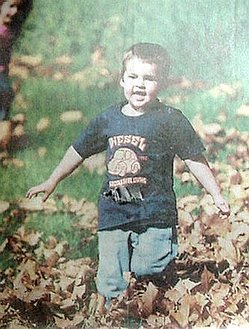
  Posted by Picasa Just a chance seasonal photo in our local paper but a real learning experience for the young boy.

Learning through experience is the basis of all learning but all too quickly it is replaced by second hand learning through books and teacher led discussion about teacher topics at school.

Not that such an experience by itself is enough. Rachel Carson wrote many years ago, in her book ‘A sense Of Wonder’, that every child needs at least one adult to share experiences with young learners to keep the sense of wonder alive. And the ultimate scientist Einstein also wrote that, ‘Joy in looking and comprehending is nature’s most beautiful gift’. Understanding, comprehending and expressing ideas are important to make learning stick!

From such simple experiences arise questions that, with sensitive teachers, can lead to investigations, the development of poetic language, and inspiration to express ideas through art, music and dance.

Too many young children enter our schools with their sensory awareness deadened and, if this situation is not remedied, their innate sense of curiosity is dulled and their oral language limited. And worse still students learn not to appreciate that learning through the senses is their most basic way of learning and one that they will be using throughout their lives. And school life starts the strange journey of fragmenting what ought to be an integrated experience.

It would be great to see more sensory experiences featured in our schools to ensure children are not only made more aware of the fascinating often overlooked details of their environment. With sensitive teaching these experiences could form the inspiration for much of the class investigations. And the thoughts, arising from such experiences (scribed out by adults), ought to become the beginning of the early reading programme.

Sometimes we to quickly rush into books and in the process bi pass the very experiences young children need; ‘before the book the experience’ ought to be kept in mind!

The young boy pictured is on full learning alert. Kicking the leaves, hearing the sounds, wondering where they all come from and why they are all different colours. This is the beginning of science, art and an understanding of seasonal change and life and death.

The senses need to be recognised and sharpened by sensitive teachers - and when imagination is added learning will result.

Simple stuff.

Basic!

See articles on our website

Monday, May 01, 2006

How do we want to see NZ?

  Posted by Picasa It must be about now that political parties start to consider the next election and hopefully start to begin conversations about what kind of country we need to become. There was little vision to be seen during the final days of the last election as the two major parties appealed to self interest for their survival.

New Zealand has the potential to be a world leader in the future, according to Rod Oram’s in last Sunday paper, but only if we if we as a country develop a positive future image of ourselves.

We were once seen as a social laboratory in the early 1900s and again in the thirties following the great depression - a nation that looked after the needs of all its citizens and not just the wealthy. We have always been seen as a small country that ‘fights above its weight’.

Late last century we led the world in an unfortunate ‘market forces’ experiment that has created a ‘winner and losers’ society that we are only just recovering from.

What we need now is a national conversation about what kind of country we might become and we also need to face up the reality that many of our organizations and industries ( including schools), developed in an industrial age, are not able to cope with the demands of a fast changing interconnected complex world. The new ‘capital’ required will be the creativity and entrepreneurial ideas of all its citizens and not just a wealthy few.

To survive we need new thinking. As well our interconnected world will require an appreciation and valuing of cultural diversity.

We could lead the world in developing a sustainable economy living from our natural environment through ‘clever’ tourism and entrepreneurial industries. But to do this we have to value the gifts and creativity of all citizens.

We are a country at the 'edge' of the world and we ought to be developing ourselves as a country at the 'learning' or 'cutting edge' of new ideas. We are well a way from the limiting traditions of the old world and the conformist corporate conservatism of America and, as nation, we have always been seen as creative- and creativity will be required to thrive in a world increasingly dominated by a mass produced low cost goods from Asia.

But so far we see little of this need to face up to the new realities and challenges. Rod Oram’s in his article believes we are ‘running on empty’ and we have much to learn about both protecting and sustaining our natural environment and in developing the innovative talents of our citizens.

Real transformation will be needed – the ‘status quo’ is no longer an option.

So what kind of country do we want to be Oram asks? We don’t want to 'be a pale imitation of other countries'. Our remoteness and particular history and mix of people, plus out world renowned natural environment, has developed us into a distinctive culture. These qualities need to be used to our advantage. Oram writes that we need to make full use of our uniqueness and enterprising nature but to do this, he says, we need to promote new business and organizational models

Once such a national 'conversation' has been held then responsive infrastructures and conditions need to be established by our elected government. And whatever vision is developed needs to be based on inclusive values so that all citizens can feel part of, and gain benefit from, whatever eventuates. Common purpose must underpin all actions and include all communities and cultures.

Transformation of all aspects of our current organizations will be required. We need focused flexible and interconnected organizations to replace the fragmented ‘top down’ hierarchical bureaucracies – both in industry and government departments

As Oram’s writes, ‘in a very real sense we are running on empty.’

Education will need to play a key role to develop the talents and passions of all students by personalizing learning so as to ‘weave this dream into a rich future tapestry’.

Our next Government must be one of vision! A government that can identity and articulate the needs of its citizens and to inspire us all to all work together for the common good of all - creating New Zealand as a world leader in the process.