Friday, August 24, 2012

Educational Readings; Martin Thrupp, Finland, Joel Klien,


By Allan Alach


A potpourri of articles this week, concluding with a couple of more positive ones on the way education should be developing. However as the first article shows, there is little immediate hope while governments play the corporate agenda. The biggest puzzle, to me, is why it is a supposedly more left leaning Labor Government in Australia who are in cahoots with the corporates. A secondary puzzle concerns the Australian Minister of Education Peter Garrett. For those who don’t recognise the name, remember the Australian rock band Midnight Oil, and their protest songs about Aboriginal land rights (Beds are Burning) and uranium mining (Blue Sky Mining) ? Garrett was the singer. Some inconsistencies here, Pete. For more, read Kelvin Smythe’s satirical posting.


I welcome suggested articles, so if you come across a gem, email it to me at allan.alach@ihug.co.nz.


This week’s homework!

Joel Klein Comes Clean

Seems Common Core Standards is all about enabling businesses to profit from education. What a surprise.


Why Creative Geniuses Hated School

Three creative geniuses explain why they hated formal education. Never mind, we’re busy creating another generation who will also hate formal education.


15 Reasons Reformers Are Looking to Finland

Yet another article on Finland and its educational success. Those who want to deform schools in the opposite direction clearly failed their own schooling.


Standardization Will Destroy Our Education System, If It Hasn't Already

Title says it all...


Release of Primary School Data Disingenuous & Deluded

Waikato University Professor of Education Martin Thrupp has released this opinion piece on the New Zealand government’s processes towards joining the international GERM movement. Shambolic. Deceitful.

How to Turn Your Classroom into an Idea Factory

Nothing to do with GERM….

“How can we prepare today’s students to become tomorrow’s innovators? It’s an urgent challenge, repeated by President Obama, corporate CEOs, and global education experts like Yong Zhao and Tony Wagner. Virtually every discussion of 21st-century learning puts innovation and its close cousin, creativity, atop the list of skills students must have for the future.”


This beautiful video about parabolas will 100% blow your mind

Robert T. Gonzalez

I know, I know. You're probably wondering how exciting parabolas can actually be, right? Well, it turns out that, in the remarkably capable hands of mathematical rambler/artist/stream-of-conscious-doodle-wizard Vi Hart, the answer is: pretty damn interesting.’

Apart from blowing minds, it also demonstrates why standards based, tick the right box/supply the right answer approach doesn’t work. We’ll just have to overlook the fact that the producer of this works for Khan Academy!

Wednesday, August 22, 2012

New Zealand Teachers –to be creative make use of outsiders.


New Zealand - we ought to be at the cutting edge of change.


I  chose the title with great thought for a number of reasons.
Society is at the edge of new creative age – an age of ideas that will replace the current information age – which in turn replaced an industrial age. Ironically many organisations still have their genesis in this industrial top down era; one premised on predictability and measurement. In the school situation this is seen in the current emphasis on standards and targets. School structures, age cohorts, ability grouping, streaming, fragmented subjects, all reflect this factory era.
So we are at the edge of a new era of learning – the cutting edge of change but schools are being pressurized to retreat into the past. New learning lies at the edge of chaos not in the certainty of past thinking.
 I also chose the title because I have always felt at the edge of teaching and now, at the edge of my career. Some would say well past my sell by date!
But any success I have had over the years has been being an outsider. At first I was an itinerant science adviser (later an art adviser) and this meant I escaped the conformity of expectations that classroom teachers have to live with.
I have come to really value the importance of ‘outsider’ thinking.
When I went teaching for a few years ago I found my ignorance of current teaching procedures an advantage. I chose to ignore advice to divide my students into abilitygroups for reading and maths – this was a practice unheard of in science andart teaching. Rather I chose to help students personally as required and placed my emphasis on inquiry teaching. As an adviser I was also fortunate to be able to observe the few creative teachers who integrated skill teaching with their contextual studies.
All schools ought to have a copy of Elwyn's recently reprinted book ( from  NZCER) 
This approach wasbest represented by the teaching of Elwyn Richardson and those who followed asimilar approach who saw their classrooms as communities of scientists and artist exploring  and expressing ideas about their environment; teaching that valuedthe ‘voice’ of individual learners. Today this has come to be called ‘personalised learning’.  The writing of David Perkins sums up the idea of integrating skill teaching so as to play the game of real learning. Recently Michael Fullan, one the guru of top down innovation, has recantedand now believes that real innovationcan only come from tapping the insights of what he calls ‘deviant teachers’. The trouble is the school environments are not conducive to encouraging such deviants – rather the opposite1
Today schools arefull of formulaic ‘best practice’ clone like conformist teaching. Intentional teaching, success criteria, WALTS, exemplars are all part of this ‘official’ approach. What has been forgotten is that education should celebrate individuality not conformity; should develop students’ gifts and talents not measuring standardized achievement based on imposed standards. League tables will make it worse.
We are seeing the ‘McDonaldisation ‘of education.
When I was appointed a principal (during the introduction of Tomorrows Schools) having never been a principal my ignorance, my ‘outsider’ view, was again an advantage but try as hard as I could I found that many teaches were en-cultured into a traditional way of doing things.http://leading-learning.blogspot.co.nz/2012/01/education-still-firmly-stuck-in-20th-c.html
If schools are to be seen as hothouses of creativity and innovation then they need to tap into ideas from outsiders.
A recent book (‘Imagine- How Creativity Works’ by Jonah Lehrer) is well worth the read.(See also Steven Johnson’s book ‘WhereGood Ideas Come From’).
Lehrer dedicates one chapter to the importance of outsider thinking in successful businesses and his ideas are extremely important to school leaders. Successful businesses make real use of outsider ideas to escape the conformity of past expectations. He writes that people deep inside an organisation suffer from an intellectual handicap. It is only when problems are shared with outsiders that new solutions can be found.
In the past I learnt that innovative schools made use of advisers more that conformist schools – but advisers in earlier days were not simply transmitters of officially approved ideas as is the case today. I also learnt that great ideas come from people on the edge – art advisers, early education teachers, Maori educators, special needs teachers, innovative businesses; education is too important to be left to teachers.
‘The world is full of natural outsiders,’ writes Lehrer, ‘we refer to them as young people. The virtue of youth is that the young don’t know enough to be insiders, cynical with expertise.’ ‘This is why’, he writes, ‘many fields from physics to punk rock have been defined by their most immature members. The young know less that why they invent more.’
He continues, ‘Why are young….more creative? One possibility is that time steals ingenuity that the imagination starts to wither but this is not the case – we are not biologically destined to get less creative.’ The young have the advantage that they are haven’t become encultured or weighted down with too much convention wisdom, they’re more likely to rebel against the status quo.’
The trouble is that with time people start to repeat themselves and they become insiders. This is what seems to happen to many principals but this doesn’t have to happen. ‘We can continue to innovate for our entire careers, ‘Lehrer writes, ‘as long as we work to maintain the perspective of the outsider.’
Being an outsider is a state of mind but it is not easy to maintain or cultivate in our present compliance regulatory educational environment but it can be done – if we work with others. Also the internal structures and expectations of schools, the obsessive teamwork, and desire for consistency destroy any possibility of tapping ‘outsider’ thinking.
To really be innovative we have to leave behind much of what we have believed to be true. Our thoughts are shackled by the familiar. Creativity is all too often traded for efficiency and consistency.
School leaders need to encourage experimentation (and learn from failure) and value open-mindedness – be more willing to realize there are different ways of interpreting situations. Creativity, it seems, is a side effect of experiencing and valuing differences.  Rather than neat solutions leaders need to value surprise and even confusion – this is the area where creativity is to be found. When we come to believe we don’t know all the answers then we are open to new ideas. You suddenly notice ideas you previously ignored.
The trouble with all this is that we live in world that worships ‘insiders’ says Lehrer. The answer is to ignore what you already know. ‘Knowledge can be a subtle curse’, he writes.  ‘Through what we know we learn all the reasons why the world cannot be changed. We get used to our failures and imperfections. We become numb to the possibilities of something new. In fact, the only way to remain creative over time – to not be undone by our experience- is to experiment with ignorance, to stare at things we don’t understand’.
Schools need to make use of ‘outsider’ thinking. They need the expertise of people from different backgrounds – to share ideas with others who have different perspectives.
Schools need to all work together and to tap into the ideas of creative outsiders or to fail alone. The most innovative businesses are a mix of the familiar and the unexpected. Such environments are neither fully predictable nor fully anarchic.
The best learning is at the edge of chaos.
The best ideas come from the edge of chaos rather than erecting walls and establishing hierarchies that keep people in their place stifling conversation, dissent and sharing of ideas and, in the process, making it harder expand the collective imagination of all involved.
And as an aside there is research that indicates that many teachers find it hard to accommodate creative students in their classes. ’The point is’, Lehrer writes, ‘the typical school isn’t designed for self-expression’… ‘Everyone agrees that creativity is a key skill for the twenty first century but we are not teaching our kids this skill.’
An obsession with standards and league tables is exactly the wrong way to go. Imagination is too important to be ignored.  There is no test for the future we can teach to. Creativity is a skill that never goes out of style. No text book for ingenuity, no lesson plans for divergent thinking. Rather they must be discovered; a child has to learn by doing.
It is time for schools to focus on developing the gifts and talents of all students; it is time for schools to contribute to creating the kind of culture that won’t hold us back.
This blog is my small attempt to share an ‘outsiders’ view for those schools open considering as yet unrealised alternatives.
Be great to get feedback!

Saturday, August 18, 2012

Educational Readings: Yong Zhao, Anthony Cody, Marion Brady, Joe Bower


Yong Zhao on PISA 

Educational Readings  By Allan Alach


One common element of ‘deform’ across the world, is the use of PISA tests to justify the implementation of GERM.  As Phil Cullen observes in his latest Treehorn Express  these tests are an offshoot of the OECD, an organisation of economists. Since when did economists have valid educational credentials? This begs the question- why do we take any notice of PISA? Anyone able to explain this to me?

I welcome suggested articles, so if you come across a gem, email it to me at allan.alach@ihug.co.nz.

This week’s homework!

Charter Schools and Corporate Ed Reform

As other countries rush down the charter school road, evidence to the contrary keeps coming out of USA. Naturally our GERM minded politicians take no notice - powerful string pullers behind the scenes? Thanks to Barbara Nelson for this link.

“The following is an excerpt from Charter Schools and the Corporate Makeover of Public Education: What’s at Stake? co-authored by Michelle Fine and Michael Fabricant. The book traces the evolution of the charter school movement from its origins in community- and educator-based efforts to promote progressive change to their role today as instruments of privatization and radical disinvestment in public education.”


New school year: doubling down on failed ed policy

Or ‘how we need to learn from our mistakes”

“This was written by Lisa Guisbond, a policy analyst for the National Center for Fair and Open Testing, known as FairTest, a Boston-based organization that aims to improve standardized testing practices and evaluations of students, teachers and schools.”


10 Ways School Reformers Get It Wrong

“When it comes to education reform, we're not trying to reinvent the wheel anymore; instead, we're building square ones.” Nothing else needs to be added. Thanks to Phil Cullen for this link.


Secret Teacher has had it with WALTS, WILFS and other education jargon.

The Guardian newspaper, UK, runs a regular feature where a different secret teacher each time writes about issues of concern. This one is written by an Academy School (aka charter school) teacher, and provides a warning of what is to come.

Yong Zhao on PISA

For the last 18 months or so, I’ve been raising questions about this PISA test programme that is being used by ‘deformers’ all over to justify their educational agenda. Why is a test developed by an economic organisation being used in this way? Why do we give it any credit at all?  Think about it - the PISA tests to determine any country’s educational achievement have exactly the same drawbacks as using tests to determine a child’s achievement. This blog by Diane Ravitch, referencing comments by Yong Zhao, covers this more authoritatively. Getting rid of PISA would be a major step forward.


Technocratic Expansion of Education Data Systems Stirs Privacy Concerns

This is an extremely important article by Anthony Cody.  The online student database system he describes here is also being developed in New Zealand, ready for implementation in 2014. Are similar systems being developed in Australia, UK and elsewhere? This is big brother, people. No exaggeration.  The only thing Orwell got wrong was that he anticipated a far left state, not a right wing corporate based state with fascist overtones. Just to back this up, there’s also another link from a homeschooling website.


Eight problems with Common Core Standards

Another great article by Marion Brady. New Zealand readers might ‘enjoy’ reading this, substituting ‘national’ for ‘common core.’ Aren’t coincidences wonderful?


Thank God for standardized test scores

With the coming publication of ‘achievement data’ for New Zealand schools, as the government rushes in a ‘me too’ fashion’ to join the bandwagon, this satirical article by Joe Bower is timely.

Monday, August 13, 2012

Top blogs last month


Find out more about Guy Claxton by clicking on the Educational Books for creative teaching below.

The blog below by a principal that is well respected has been the most popular blog for months and is well worth a read. Since it was written the government has approved of shonky league tables to be placed on the web.I bet he is more disgruntled now1

http://leading-learning.blogspot.co.nz/2012/06/bruce-i-have-never-felt-so-disgruntled.html

Read the implications for schools behind the implementation of  national standards and league tables. By now few schools will not appreciate the changes in teaching that  they will cause - unfortunately the general public are  less informed. What is the truth behind the 'one in five students failing'? How well do NZ students do on international surveys?

http://leading-learning.blogspot.co.nz/2012/08/national-standards-status-quo-or-new.html

Art education is at risk with the introduction of league tables - it is worth thinking about how important art (  in its broadest sense) is.

http://leading-learning.blogspot.co.nz/2012/08/why-art-is-important.html

 Creative teaching - personalised learning is a real alternative.

http://leading-learning.blogspot.co.nz/2012/07/creative-teaching-only-alternative-to.html

What educationalists underpin your school's philosophy? How many books are you aware of?

http://leading-learning.blogspot.co.nz/2012/07/educational-books-for-creative-teaching.html


Friday, August 10, 2012

Educational Readings Noam Chomsky,Steve Wheeler


Educational Readings
 
By Allan Alach

The strange world where politicians and associated deformers pursue their agendas in seeming ignorance of the ever increasing objections of educators and parents continues all over. The same complaints “Why don’t they listen?’ can be heard in many countries. The fact that this happens, and is ignored, tells its own story.

As far as New Zealand is concerned, the government have pushed on with their plan to make each school’s national standards data available to all and sundry via a website.

 The existing scheme of allowing schools to submit ‘data’ in a wide range of formats has made it impossible to collate the ‘data’ and this has spoiled the plan to produce league tables this year. As I expected, the system is being tightened up next year, requiring schools to enter ‘achievement data’ online, and further, also as I predicted, the following year (2014) will see the introduction of a online assessment tool that will rank children against national standards. Given the internationality of GERM, it is not drawing too long a bow to suggest that this approach is being trialled here, before being introduced elsewhere. The USA, with their Common Core Standards, is not too many light years away from being ready to go. Beware. This is another step to demote teacher professionalism and judgement - the other end of the ‘computer as teacher’ approach.

I welcome suggested articles, so if you come across a gem, email it to me at allan.alach@ihug.co.nz.

This week’s homework!

The remarkable successes of the student strikers in Quebec

Lessons for us all from this? We can overcome neo-liberalism!


Privatizing Public Schools: Big Firms Eyeing Profits From U.S. K-12 Market

A couple of quotes from this article, which is applicable to other countries as well:

"Think about the upcoming rollout of new national academic standards for public schools, he urged the crowd. If they're as rigorous as advertised, a huge number of schools will suddenly look really bad, their students testing way behind in reading and math. They'll want help, quick. And private, for-profit vendors selling lesson plans, educational software and student assessments will be right there to provide it."  

And

"Autism in particular, he said, is a growth market, with school districts seeking better, cheaper ways to serve the growing number of students struggling with that disorder."

Lovely. 


Open the Flood Gates

Thoughtful posting by Walter McKenzie of ASCD. Makes a very good case for the need to discard standardisation.


Noam Chomsky - The Purpose of Education

Noam Chomsky discusses the purpose of education, impact of technology, whether education should be perceived as a cost or an investment and the value of standardised assessment. An antidote to the madness spreading around the world.


Education funnels and webs of learning

Steve Wheeler, from University of Plymouth, UK, writes a very good blog “Learning with e’s” While predominantly commenting on digital technologies in education, he also casts his eye over the wider educational scene, and the purposes of education. In this article he references visionaries such as Illich and Freire.


Let’s read them a story! Helping your children succeed in school

OECD article that highlights the importance of parents reading to children at home.

Wednesday, August 08, 2012

National Standards, the status quo, or new possibilities for education


Hekia Parata -   led by ideology determined to take us down the wrong path.
So many sound bites about education to pay attention to these days.
The first  one that comes to mind is the mantra ‘one in five children failing’ that our current prime minister ,  our education minister and John Banks like to talk about endlessly as the reason for National Standards, League Tables and why we need Charter Schools.  The message is, ‘our schools are failing!’
Education it seems is where politics rule and reality comes second place.
How do we get this 1 to 5 negative ratio and how do we reconcile New Zealand high ranking in International Tests?

 In a recent OECD survey New Zealand students were still at the top echelons in reading, science and maths. In the latest survey New Zealand students were ranked fourth out of 34 OECD countries in literacy, fourth in scientific literacy and seventh in mathematical literacy. As in all past OECD surveys New Zealand students achieve near the top surpassed only by countries with ethnically homogeneous populations such as Finland and Korea. ' So why', writes Warwick Elley an emeritus professor of education, ‘isn’t this front page news?’ He continues, ‘we should be congratulating our rank and file teachers for drawing the best out of our students..’

And where exactly are these 25% of failing children? One clue is provided by Warwick Elley who reports that mainstream Pakeha students had a higher mean score than any other country. The impression is they exist in every school but in truth they are concentrated in low defile schools.  It seems we have more high achievers than other countries, but still too many at the lower end of the scale.  Elley writes that underachieving students ‘can be identified by gender, by decile level, and by ethnic group’ and he continues ‘compulsory assessment and league tables do not change them.’ ‘The problem’, he says, ‘is not so much in schools, but in social problems as poverty and dysfunctional families.’

National Standards across all schools seems like using a sledge hammer to crack a nut.  A more targeted approach would ensure greater equity?
Daniel Pink (authorof ‘Drive’) confirms that all high scoring American students can be predicted by their parents’ wealth. Conversely students that fail, as measured by standardised tests, can be equally predicted by the socio- economic circumstances of their parents. Some call this a lack of ‘social capital’.  Recently it was reported that New Zealand has the fifth widest rich/poor gap of Western countries and that this can be linked to the results of the Market Forces polices of the past decades. This, of course, is happily ignored by the current government.
In New Zealand 25% of adults now live below the poverty line so the link to poor school achievement (the 1 in 5 failing) is no great leap. There is data to say an estimated 170000 - 270000 children in New Zealand live in poverty and that New Zealand is ranked 20th out of 35 in OECD countries for children living in relative poverty. Such children often have poor health and many suffer from diseases that only exist in third world counties.
This of course shouldn’t be taken as an excuse for school failure but a reminder that poor achievement can be linked to problems outside of the school gate. Add to this that many parents are without jobs or have to work all hours God gave them just to support their families and that Maori and Polynesian children are over represented in such difficult environments. That such children enter formal schooling lacking what schools expect is understandable (and this is not saying school expectations are right).
It is clear that children do not have equal opportunities to achieve high educational attainment. It is impossible to ignore the influences of difficult home circumstances in the creation of the 1 in 5 failure rate. ‘The dirty secret’, one newspaper columnist recently wrote is all about, ‘middle class advantage and working class failure. Exceptional kids will, of course, always break the pattern. But the pattern remains’. To suggest success just by having excellent teachers and league tables is just ideological nonsense.
So what to do? 
The current government’s solution is more choice (hence the need for published standardsand from them league tables) and competition but it seems only the wealthy can afford the choice. And the latest solutions privatised charter schools which, in contrast to the narrow standards approach being imposed on public schools, offer greater freedom and flexibility - exactly what pubic school would like to implement. Privatisation, rather than equitable education, is the real agenda.

Do we have a world class or failing education system?

According to PISA data the answer is yes we do, but when one considers all the children the system currently fails (the 1 in 5) the answer is not so clear-cut! The number of citizens who are incarcerated in our prison system – second in Western countries after USA seems to indicate many students leave schooling with little chance of success.  Most communities have high profile problems with alienated youth whichalso seems to indicate the need for new solutions.
Traditional education, it seems, suits the equally traditional academic students; for students who arrive at school with the necessary ‘social capital; students ‘who come from reasonably well off home environments. The really rich send their children to private schools.
So this brings us back to the one in five failing, who are they, where are they, and what might be realistic solutions? It seems the truth is known but ignored by politicians.
National Standards, as promulgated by conservative politicians, have a populist appeal to the general public but are they really an answer or simply part of a wide political ideology? Do they have any real advantage or will they have the same limiting effects that have occurred in countries that have implemented them? Ironically the countries that have implemented them (and the next step, league tables) score well below New Zealand on the PISA International tests. In such countries it has been shown that teachers narrow the curriculum and teach to the tests and as a result vital creative areas are given less time and students, whose talents in the untested areas, suffer.
‘National Standards consisting of measuring narrowly defined curriculum outputs’, according to Peter O’Connor associate professor of Education Faculty, Auckland University, ‘ and will be used to generate blunt and meaningless league tables. They will in turn create fear and suspicion about neighbourhood schools’. This he suggests is designed to increase the public appetite for private forms of education, including charter schools and will also professionalise teachers. Charter schools will be able to employ unregistered teachers.
So it is not difficult to appreciate that schooling is involved in an intense political ideological war; one in which the real causalities are the students themselves. As Peter O’Connor rightly says all this criticism is about developing an environment of  blaming failing students, failing teachers, failing schools and failing communities while the ‘white knights of business are presented as the rescuers’. As a result teachers and principals are cast as defenders of a failing system.
 Labelling and shaming is not the answer, nor the false choices of the neo liberal politicians with their privatisation agenda.
All the criticism of current schooling ignores the success of New Zealand schools as shown in the OECD and PISA surveys! All it has done is create a sense of crisis requiring the radical solutions proposed by the Government.
Just understandingthe ideological battle does not mean defending the status quo. We can do better. There are better solutions than the reactionary national standards or the doubtful charter schools. Charter schools, where they have been tried in the US, few have demonstrated to be better than traditional schools.
The reality is that for an increasingly unpredictable twenty first century students will require a particular set of dispositions and skills. One obvious immediate solution is to reinstate the 2007 New Zealand Curriculum as the central emphasis for educational reform.  It is obvious that schools cannot implement both the intent of the NZC, with its emphasis on ‘key competencies’, and the risk adverse limitation of national standards and league tables.
So the battle over our schools is not simply between privatisation (National Standards and league tables, or charter schools) and the current provision.
Schooling needs to be reinvented – re imagined to equip all students to thrive in the future. Too much of our current system has its genesis in the fragmented linear thinking of the industrial age.
Too much schooling is currently focused on sorting and grouping individual students achieve what teachers (and now politicians) have decided they ought to learn.
This antiquated ‘factory’ transmission model of teaching needs to be replaced with a more personalised model – learning tailored or customised, to suit the needs of each individual learner.
 Learning needs to be real, rigorous and relevant to the learner if all students are to develop the in-depth understandings and dispositions that they will require. Learners need to be encouraged to dig deeply into what they study and have access to all the traditional disciplines of learning as well as accessing the power of the World Wide Web.
This transformative model of education is in opposition to the ability mind-set that schools (both primary and secondary) currently implement by developing their programmes around ability grouping, setting students across classes, andstreaming.
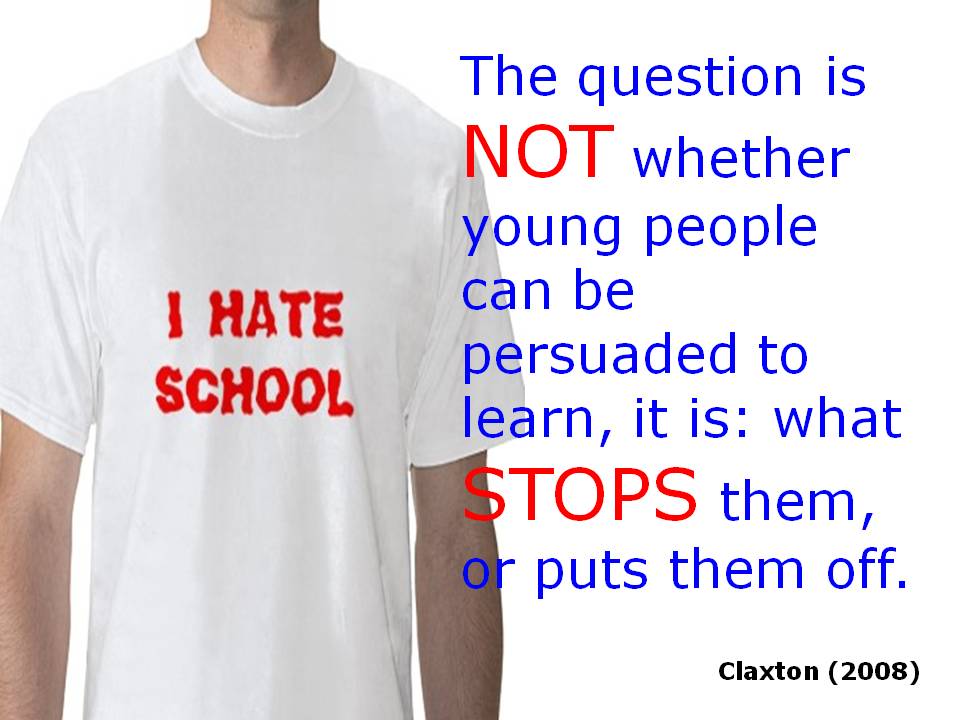
The future will require individuals that can work collaboratively to develop solutions to integrated projects. Teachers, to ensure this, need to ensure skills are taught ‘just in time’ rather than ‘just in case’. ‘Learnacy’, as educationalist Guy Claxton writes, ‘is as important as literacy and numeracy’. This is reinforced by Sir Ken Robinson who says ‘creativity is as important asliteracy and numeracy.  ‘Students need’, as Piaget said decades ago, 'to know what to do when they do not know what to do.’
Teaching how to learn, how to research, how to express ideas needs to be the central role of teaching along with challenging students ideas they may have gained. As Jerome Bruner wrote decades ago, ‘teaching is the canny art of intellectual temptation’. Students, as suggested in the NZC, need to become ‘seekers, users and creators of their own knowledge’. Schools need to be seen as communities of scientists and artists equipped to make sense of the challenges that they will face.
The choices for a future education are not as simplistic as the market forces solutions our current government would suggest, or simply defending the status quo.
The time for simple solutions is over.  The quest for an equitable and empowering education for all students needs to become a critical issue for us all –we can’t thrive as a nation if large segments of the population are being denied a real opportunity to succeed. Everyone has the right to learn .
This is not the path we are on.

Friday, August 03, 2012

Educational Reading for the weekend: Jon Banks,Marion Brady, Tony Gurr


Weekend Readings


By Allan Alach


The ‘coincidences’ continue. Hot on the heels of the UK announcement that academy (aka charter schools) can hire unqualified teachers, the New Zealand Government have followed suit with the teaching staff at the proposed ‘partnership schools’ (aka charter schools).  On the other hand the government wants all teaching qualifications to be at post graduate level. Further, they have decided to review the Teachers’ Council that manages teacher registration, to ‘improve quality.’ Am I missing something here? Why is it that school ‘deform’ around the world sees untrained teachers as a solution?


I welcome suggested articles, so if you come across a gem, email it to me at allan.alach@ihug.co.nz.

This week’s homework!

Charter Schools – Another lie from John Banks!

This article needs no introduction.


The American revolution in English schools

And Australian and New Zealand schools…..


UK Academies told they can hire unqualified teachers

Next step in the denigration of teaching as a profession - “anybody can be a teacher.”


In Support of the Whole Child

This is an excellent article - the title says it all.


Education’s biggest design flaw

Another punchy article by Marion Brady. Very relevant: “Traditional instruction is dumping poorly organized information on the young, and they can’t process it.”


Are Standardized Tests Worthless?

Apparently so, what a surprise!


What Economists Don't Understand About Educators

Everything?  However, what do you think of ‘loss aversion’ instead of performance pay? Pay a bonus upfront at the start of the year, then remove some/all depending on test results at the end of the year. Will this make you work harder? A better teacher?


Education reform’s central myths

“The education debate rests on two faulty premises: that public schools are failures, and choice is the solution.” Written about the USA situation, and equally applicable wherever ‘deform’ is on the agenda.


Can a teacher “create” LEARNing THAT LASTS?

To end with something more positive, here’s an excellent blog post by Tony Gurr.
http://tinyurl.com/cz8npk7


..

Thursday, August 02, 2012

Why art is important in education?


It is wonderful to experience children’s art. Some cat by a 5yr old - Picasso would be proud!
(Notes for a children’s art exhibition opening)

I don’t think it is necessary to tell children that art is fun but I want to tell the artists here today that art is also important – and particularly their parents.
Art is even as important as reading and maths but I am not sure many parents or children would think this – and not many teachers.
One amazing educator Sir Ken Robinson has said that creativity is as important as literacy and numeracy and that if we focus on reading and maths too much we will have the time discover the gifts and talents children have in other areas.
As important as reading and maths being creative, being keen to learn, to use ones imagination is far more important and most important of all is being confident to express one’s self without fear of being wrong – and art is great for developing this.
When I was a teacher I taught a girl whose dad (an accountant) at parent interviews questioned me about his daughters disinterested in maths, her untidy handwriting and her indifference to spelling. I tried to tell him she had gifts in other areas, she could dance, write poetry – and best of all she was the most caring student in the class. He didn’t seem impressed with me or his daughter. I had an e-mail from her a year or so ago thanking me for teaching her. She is now 40 years old, married and is an artist selling her work for $5000 a painting. It is difficult abstract work – I find it hard to understand myself. The funny thing is I never picked her as a future artist! And she said her dad is so proud of her. Two boys I taught were hopeless at reading and maths - one today is a top woodworker and kitchen designer and the other designs boats. You never know. It’s all about the gifts each child has.
Just imagine if schools were focused on developing everychild’s gifts. It wouldn’t be hard because they would be working with kids – not making them do things for adult’s reasons.
It would be easy because children are born scientists and artists. They ask questions until they learn not to – and they draw on everything. Wallpaper was my first art experience!
Art, someone said, is asking questions and drawing answers - I like that!

Art teaches important things about life:
You need to be able to experiment – look at what you’ve done – and then take the next step. There is no paint by numbers in art or life. It is all about give it a go and keep what works. Don’t worry about rubbing out – just draw or paint over the top.
The best art has an element of unknowablity about it.
As you start work the piece of art suggests ideas you might never have thought of. This is like life – you may have good intention but you have to go with the flow – know when to change your mind.
Another thing that I like about art, any kind of art, it starts off with an idea but soon gets really messy. Often at this point many people give in but if you can get through the messy confusing stage then good things happen. In this way art prepares you for many things that will happen in your life. You just got to keep going. All the best learning involves being confused and uncertain – being confused is part of life. There are no easy plans to use if you want to develop new ideas.
Art teaches about perseverance – not giving in.  Art is at first a messy business but slowly ideas begin to take shape.
Art is about doing fewer things well – not rushing through things. Good art involves real effort.

The best art is expressing something that is important to you – what you draw, paint etc. It should be your point of view not what others want. Art is not copying – good art is original.
Good artists are good observers or people andtheir environment. They are often the first people to notice things others taken for granted. Artists see and feel things – they have sharp senses – they have not lost these ways of exploring that all children were born with.

Sometimes what artists say is not appreciated by others – it is easier to do what others do or say – but not if you are a real artist.
Sometimes what is important for an artist is the idea they want to express, other times it the material or media that you work with that is the challenge.  Artists need to learn about skills and techniques, about how to use paint and other drawing material – but good art is far more than just good technique or being skillful.
It is almost impossible to decide what piece of art is best – some artists draw dead real, others boldly, others in an abstract way.  Art is about celebrating differences. Very young children are the real abstract painters – they just like making marks! Art is about leaving your mark. Graffiti is a form of art – often by people who are trying to tell others they exist! Even if it annoys people!
Art can be confusing – it makes you think. Strangely the best art takes time to like – van Gogh was never valued in his own lifetime but now his work is highly valued. So we have to be careful not to rush in to judge art because, all too often, we only select the kind of work we already like.  Difficult art grows on you.
Everything we do has an element of artistry about it – gardening, cooking, teaching, design, graphics fashion, information technology graphics, acting, dancing, maths, architecture, playing a musical, decorating, giving a speech – anything.
And going back to thinking that art is as important as any subject - artistic ability- artistic talents - lead to lots of future jobs.
Everybody needs to appreciate art but some students are lucky enough to have a real gift.

For these students whatever art form they use will be their life – they will be the lucky ones.
If you ever visit an artist’s home you will see that they enjoy all sorts of ways of thinking and they are often the best readers of all. Any many make use of lots of maths and science – especially the potters

So let’s hope there are future artist on display today and let’s hope everyone here learns to enjoy art in any form forever. And keep an eye out when you walk around for the different ones – future van Goghs.

Two very different 9 olds interpretationsof native bush
Don’t expect to understand everything on display– just enjoy the magic of what you see