Friday, October 14, 2016

Teachable moments/ for profit education/ paying attention to attention/digital biographies/ creative schools and ability grouping


Escape the audit surveillance culture

Education Readings

By Allan Alach


I welcome suggested articles, so if you come across a gem, email it to me at allanalach@inspire.net.nz

The problem of perfectionism: five tips to help your students
Pressure to be perfect
‘As well as affecting general well-being, perfectionism can lead to fear of failure. When your whole self-worth and identity are tied to your success, mistakes and setbacks are seen as a threat and you avoid taking risks.
We need to talk about these issues – but where to begin? Here are some tips for helping students manage and overcome perfectionism.’

Why For-Profit Education Fails
Good…
‘Indeed, over the past couple of decades, a veritable who’s who of investors and entrepreneurs has seen an opportunity to apply market discipline or new technology to a sector that often seems to shun both on principle. Yet as attractive and intuitive as these opportunities seemed, those who pursued them have, with surprising regularity, lost their shirts.’

Teachable Moment
What is a Teachable Moment?
Difficult to achieve in an education environment dominated by accountability/standards/raising achievement etc.
‘A teachable moment is an unplanned opportunity that arises in the classroom where a teacher has an ideal chance to offer insight to his or her students. A teachable moment is not something that you can plan for; rather, it is a fleeting opportunity that must be sensed and seized by the teacher. Often it will require a brief digression that temporarily sidetracks the original lesson plan so that the teacher can explain a concept that has inadvertently captured the students' collective interest.’

Privatizing schools for profit


Education in Africa
The Uberfication of Education by Bridge International Academies.
How a US for-profit, data-driven, education experiment is failing children from poor African families and homogenising culture.’
‘So bottom line. No reliable evidence of efficacy supported by independent academic research conducting randomised school trials.’
We live in a sick world…

Why do parents take such different approaches to their kids’ education?
Tiger mums
Thanks to Phil Cullen for this article.
‘While some children spend the school holidays studying in tutoring centres, enrolled in sports camps or other structured activities, others are left to do their own thing.
So why is it that parents take such different approaches to education and how their children spend their time?’

Getting Curious (Not Furious) With Students
‘When their students act out, I propose the novice teachers do the following: Get curious, not furious. Let's explore what that means. Rather than a teacher resorting to traditional discipline measures, it behooves the student greatly for the teacher to realize classroom outbursts, verbal defiance, or volatile anger can be symptomatic of repeated exposure to neglect, abuse, or violence. Traumatic stress can also manifest as withdrawal or self-injury.’
Bruce the teacher - best days ever

Contributed by Bruce Hammonds:

One best piece of advice to ensure students achieve quality learning and teachers time to teach: 'Slow the Pace of Work’.
Bruce's latest article:
‘Too many students spoil what they do by rushing through their tasks working on the principle that 'first finished is best'. When teachers allow this 'mindset' to be an implicit part of the school culture students are not encouraged to stop and think (or reflect) about whatever they are undertaking and, as a result, a frenetic atmosphere can result. Slowing the pace  allows no time for teachers to give students (particularly those struggling) appropriate help.’

STEM to STEAM
‘Makerspaces are environments that foster passion for projects of all stripes and sizes. If you can dream it, a makerspace will help you breathe life into it.  I christened the makerspace the

Solder station
STEAMworks. The STEAM, as I told anyone who would listen, stood for science, technology, engineering, arts and math. The “works” came from what we accomplished there. Even though I was a science and math teacher, I realized a needed to integrate the arts into the science curriculum. The arts play a crucial role in child/learner development and can benefit the STEM classroom and workplace.’

Ten Tips for Mentoring a Student Teacher
If you have a student teacher in your room here is some good advice.
‘I remember the first time I was asked if I would be willing to have a student teacher. Looking back, I was totally unprepared, both by my experience and by the university, to know what to do as a cooperating teacher. I relied on the experience I had just a few years earlier and tried to model after the cooperating teacher I had—sort of the way some teachers teach today.If you are in the same boat I was in back then, I have a few tips that I hope will be useful.’

Students Use Phones, iPads to Create Digital Biographies for Senior Citizens
A simple but powerful idea:
Interviewing seniors
‘A group of Orange County fifth-graders isn’t only reading about history, they’re documenting it.
As part of the Fullerton School District’s narrative writing and listening curriculum, 100 students taking part in the “Story Angels” program have begun interviewing seniors and using technology to create digital biographies of their lives.’

From Bruce’s ‘goldie oldies’ file:

Creative Schools – an impossible dream?
‘If children grew up according to early indications, we should have nothing but geniuses’ said Johann Wolfgang von Goethe.It is hard to believe that something that starts so well results in so
many students leaving school with little to show for their experience – and even those deemed successful still have talents and gifts unrealised.’

What’s wrong with Ability Grouping?
‘New areas of research started to focus what was happening in classrooms which showed that teachers themselves are implicated and maintaining persistent patterns of differential achievement; that ability grouping helps create the very disparities it purports to solve. It does this in subtle and unintended ways through the ways it has on teacher’s thinking and through the impact it has on self-image for children in the ‘lower’ ability groups. It is obvious that teachers do not set out to do their children harm but they also know that children live up or down to what is expected of them.’


All students can 'grow' given the right conditions

Wednesday, October 12, 2016

Quality learning through paying attention to attention


'Paying attention to attention'

Seems a simple idea but  a powerful one. 

Too many students spoil what they do by rushing through their tasks working on the principle that 'first finished is best'. When teachers allow this 'mindset' to be an implicit part of the school culture students are not encouraged to stop and think ( or
Ten year old observation
reflect) about whatever they are undertaking and , as a result, a frenetic atmosphere can result. Slowing the pace  allows no time for teachers to give students ( particularly those struggling) appropriate help.

One wise old teacher ( long retired) once told me, as a result of this many students never get to finish most tasks they undertake . He called them the 'three quarters of a page kids'. If teachers were to look closely at the work their students 'complete' they will find many students who have achieved very little.

One solution is to have different expectation for every students and to make sure every student is able to  exceed their previous 'personal best'. Any book , or research work, language work or
Quality book work
piece of art  should show qualitative improvement but, all too often, it is hard to see any improvement - particularly for children having difficulty
.


The traditional answer to this problem is to place students into ability grouping - a strategy that research shows  does more harm than good.. Students inability to do reasonable work is more the result of an 'opportunity' rather than an 'achievement gap.

What is required are teachers dedicated to ensuring all students are able to show growth and to do this requires 'personalized ' teaching .

This brings us back to my one piece of advice - the need to 'slow
Scientific observation 10 yr old
the pace' of students work and the need to develop a learning culture that values quality over speed.


Every task can be 'slowed down'  but it requires teachers to provide ways to help students to develop a sense of craftsmanship. This of course will take time but if quality learning is the end point it will be worth it.

One easy way to develop this sense of quality learning through slowing the pace is through drawing.

Many years ago I read that in the future learners will need to be helped 'to pay attention to attention'; to the act of observing. Many students (and adults) look but do not see.
.

This was the point of 'observational drawing'.

 Before you begin  a drawing activity ask the class who are the best artists - students will have internalised who are the artists and why ( usually those who can draw 'real'). As a teacher the aim is for students to believe they are all artists. Teaching is the business to changing minds - to develop positive attitudes in any area of learning.

 Try it out with a simple leaf ( or photo of an insect).. Get the students to draw with no instruction. It will take students a few seconds to complete. Put the drawing away and get students to do a new drawing but this time tell students to take their time, to go really slowly, and to draw every thing they can see. For students attuned to rushing get them to look harder and to add details the might have
Science drawing 8yr old
missed,

When the second drawing is finished get them to compare their 'before and after' drawings and to consider what they have learnt.  And , as a teacher, give credit to the variety of interpretations from the real to the 'interpretative' so as to break down stereotypes about what makes a good drawing.

Simple stuff but it is the core of scientific observation and the basis for  imaginative interpretation through art. Drawing, it has been said, is the act of asking questions and drawing answers. Evidently  surgeons, through slow drawing, learn much about organs of the body.

The slowing of the process of learning is valuable in all areas of learning.

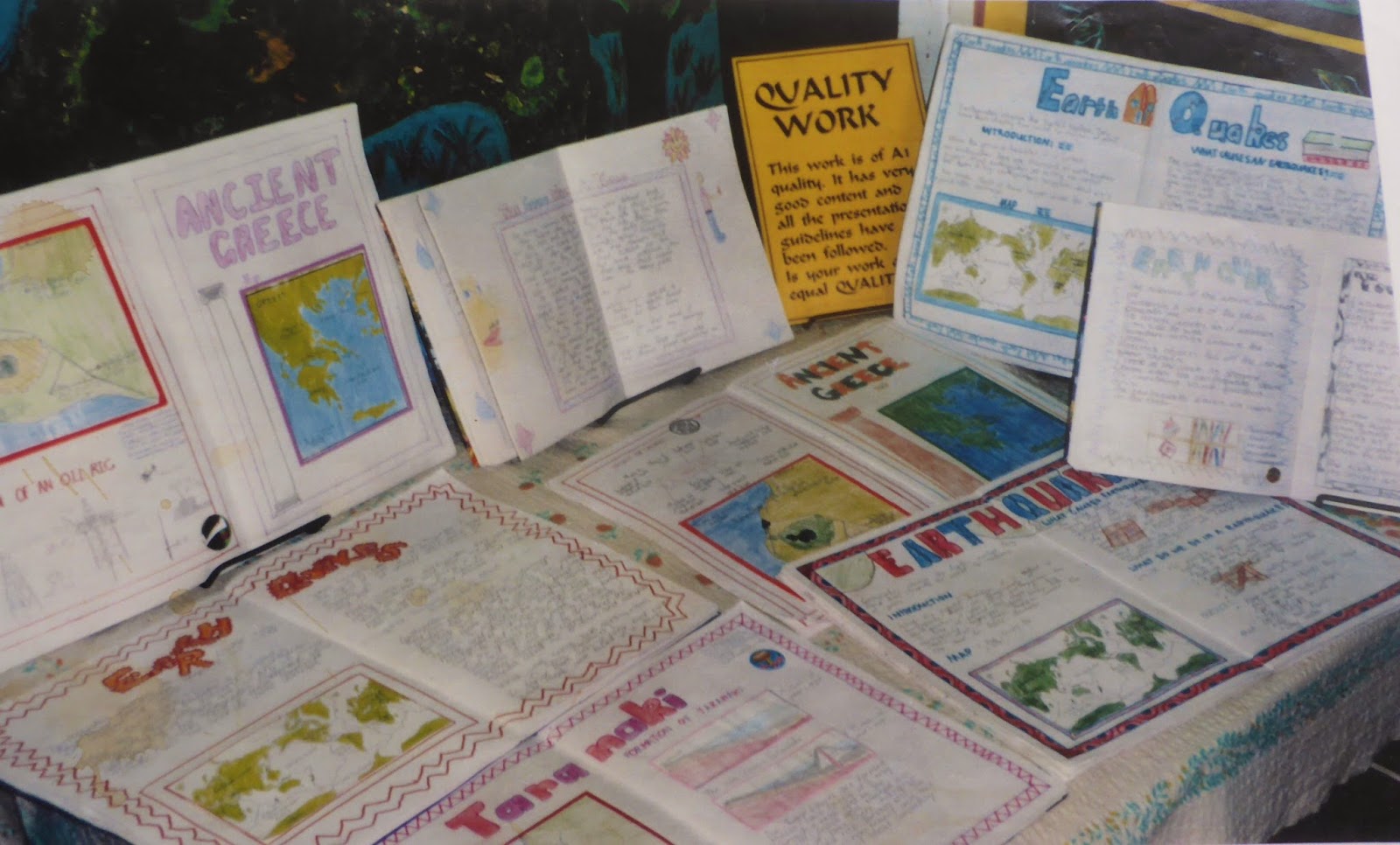
Whenever  students present their findings, including the thinking as part of process, there are ways 'slow the pace' so as to elaborate and extend their thinking. This includes aesthetic and design aspects. The best examples are students' completed exhibits for science, technology or art fairs. The same thoughtful presentation of student inquiry should be reflected on the classroom walls.

Several writers have written about this need to 'slow the pace of work' so as to achieve quality work and in the process provide the the time to come alongside the learner to provide sensitive help bur always leaving final decisions with the learner. The need to avoid this dependence has been well written about by Jerome Bruner.

Kingfisher 10yr old
Guy Claxton is another who has written about this need for reflective thinking in his book 'Hare Brain Tortoise Mind'.

Carl Honare has written a book 'In Praise of Slow' - about doing 'fewer things well'

Another writer Professor Maurice Holt has called for a slow school movement' - a  educational
movement  relating to the 'slow food movement'.

I personally like the phrase the 'haiku curriculum' - a curriculum based on the value of simplicity and depth of thinking. And I like the quote from 1930s film star  Mae West who said 'anything worth doing is worth doing slowly' but I don't think she was talking about teaching and learning.

The virtual world is 'trumping' the real world.
Drawing in the museum

I had the occasion to watch a five year old so busy on his i-pad that he couldn't be encouraged to watch some fireworks being set off!  All too often the virtual world trumps the real world. In contrast, the same five year old, was later photographed doing a drawing of a dinosaur at the Auckland museum oblivious to museum visitors walking past him. That's the power of focused attention - a lesson Leonardo da Vinci taught us centuries ago.

Kawa kawa
Computer scientist Clifford Still has written that for every hour in front of a screen a person need he equivalent time sitting by a tree or river to compensate; there is little time for 'wired' students to 'stand and stare'.

I believe that in this age of distraction ( and the associated ADHD students) that helping students 'slow the pace' by encouraging the elaboration of what they are asked to do is important and worth the effort.

.So 'slowing the pace of work'  to do 'fewer things in depth' is powerful advice

Check out these links

The power of observation More Power of Observation

Observation a basic learning skill

Observation and learning styles

Observation and imagination

Teacher's role in observation Bill Guild

Simple but Deep

The Power of Observation - Bill Clarkson

Guy Claxton's' Hare Brain Tortoise Mind' More Zen less Zest

The thoughts of Jerome Bruner

Carl Honare's  'In Praise of Slow'

Maurice Holt's 'slow education movement'

Slow food - slow teaching

Slow learning for fast times - Andy Hargreaves


Is this the future?


Friday, October 07, 2016

New Zealand education at risk/ Arts education/ Rubrics? Exemplars? Charters Schools? Modern Learning Environments and Bruner


At risk by politicians!

Education Readings

By Allan Alach


I welcome suggested articles, so if you come across a gem, email it to me at allanalach@inspire.net.nz

If I Were Secretary of Education – A Classroom Teacher’s Fantasy
If only teachers were given the chance to run education.
Steven Singer:
‘I’m only a classroom teacher. The powers that be don’t trust someone like me with that kind of responsibility. It’s okay to give me a roomful of impressionable children everyday, but there’s no confidence I can make sound policy decisions. For that we need someone with experience in management – not schools, pedagogy, children or psychology.’

Creativity and Academics: The Power of an Arts Education
‘The arts are as important as academics, and they should be treated that way in school curriculum. This is what we believe and practice at New Mexico School for the Arts (NMSA). While the positive impact of the arts on academic achievement is worthwhile in itself, it's also the tip of the iceberg when looking at the whole child. Learning art goes beyond creating more successful students. We believe that it creates more successful human beings.’

Government hell-bent on dismantling public education, says Auckland professor
Hekia Parata 
New Zealand education is also under attack, as the government follows the overseas rule book.
‘Make no mistake, Minister of Education Hekia Parata is on a mission to systematically dismantle public education. Changes already in place and those planned will radically alter the education landscape in New Zealand. Public education serves many purposes. It prepares young people for a life of work, teaching basic skills in literacy and numeracy. This is seen as its primary purpose by the minister.’

Why I Threw Away My Rubrics
‘It was only when I was on the receiving end of a rubric, while taking a graduate-level education class, that I had my first critical thought about rubrics. After looking at the rubric the professor had completed for me, I wondered, where is the human response in all of this?’

The Problem with Exemplars
‘While I believe showing examples of quality work can be useful, many students immediately shut down when they perceive too great a gap between their current ability and what is deemed exemplary. I’m certainly not against the use of high quality exemplars but caution against too few examples as well as a lack of scaffolding to see where incremental success can be found. In addition, the power comes when the student decides what they want their work to be.’

Charters and Choice: Research Shows Negative Impact
So much for the ‘school choice’ ideology:
‘The press continually gets eye-fulls of graphics indicating that accountability and charter schools can increase student performance. Rarely are these studies peer reviewed and almost none ask the questions that policy researchers should investigate. Few ask what will be the most likely results of reforms.  These papers shout out the supposed benefits of favored policies while ignoring their inherent costs.’

Contributed by Bruce Hammonds:

Modern Learning Environments (MLEs) - pedagogy from Jerome Bruner
Bruce’s latest blog posting:
‘Bruner's ideas are in opposition to the standardized direction being imposed on our schools but are surely the essence of what a modern learning environment is all about? 'Towards a Theory of Instruction'  is the book, first published 1969, I want to share today..’

Finnish education: a system based on equity, trust & responsibility
Yet another article on Finland for the reformers to ignore. Why is this? Maybe this is the answer:
‘Teaching is a respected profession In Finland, and teachers have a great deal of autonomy in the delivery of the curriculum and caring for their students’ welfare and learning.’

Getting Restless At The Head Of The Class
‘They read a book quietly under their desks, pester the teacher for extra credit, or, perhaps, they simply check out and act up. Every classroom has a few overachievers who perform above their grade level and don't feel challenged by the status quo. A new report suggests they are surprisingly common — in some cases, nearly half of all students in a given grade.’

From Bruce’s ‘goldie oldies’ file:

Why are teachers so reluctant to change?
‘Changing entrenched mindsets is a difficult task even for those in charge. Leaders are more conditioned that those lesser mortal working at the fringes. The idea of getting to the top to change things is a myth. Creative ideas are always watered down by what is possible – the art of compromise.’

An amoeba - a model for future change!
‘It seems strange to think of one of natures most simplistic animals as metaphor for an organizational model for the future but the amoeba is a good choice, as it has survived almost as
long as life has been on the planet. It is able to sense environmental threats through its semi permeable membrane and move away from threats – it is also able to equally sense the opportunity to move to a better environment or to seek out food which it simply engulfs. The intelligence of the organism is centred in its nucleus and a deeper look indicates it is not as simple as it first looks.’

The killing of creativity by the technocrats.
The killing of creativity by John Hattie
‘As I visit classrooms I have become increasingly concerned about the use of a number of strategies as defined by John Hattie and promulgated by the contracted advisers spreading the word about his 'best practices'.Somehow, just because Hattie has amalgamated every piece of 'school effectiveness' research available ( mainly it seems from the USA) his findings, it seems, ought to be
A false guru
taken for read. The opposite ought to be the case - we need to be very wary of such so called 'meta research.'. More worrying however is that the approaches he is peddling is pushing into the background the home grown innovative creative learning centred philosophy that was once an important element in many classrooms. Overseas experts always seem to know best - or those that return with their carpet bag full of snake oil.’

Wednesday, October 05, 2016

Modern Learning Environments (MLEs) - pedagogy from Jerome Bruner


Jerome Bruner 
1916-2016

Pedagogy for  21stC flexible learning environments

Jerome Bruner has a always  been a favourite of mine. I have previously written a blog about one of his bis books that  I have read several times ( because one reading is not enough to  fully comprehend - some essays are still beyond me)


Bruner's ideas are in opposition to the standardized direction being imposed on our schools but are surely the essence of what a modern learning environment is all about?

'Towards a Theory of Instruction' 

is the book, first published 1969, I want to share today..


'The will to learn is an intrinsic motive, one that finds both its source and its reward in its own exercise. The will to learn becomes
a "problem" only under specialized circumstances like those of school......what the school imposes often fails to enlist the natural energies that sustain spontaneous learning - curiosity, a desire for competence, aspiration to emulate a model, and a deep-sensed commitment to the web of social reciprocity.'
.

Bruner's concern has been with how these energies may be cultivated in support of school learning. The book's theme is dual: how children learn, and how they can be helped to learn - how than be brought to the fullest realization of their capacities.

Developing this sense of a learning community, Bruner believes, is somehow overlooked but it is surely the challenge of a modern learning environment.


Children get interested in waht they get good at
Bruner spent his early research  studying the nature of learning blocks - students whose behavior 'is designed to defend against entry into the problem'. A problem that is still with us today. We all tend to avoid activities that we feel we can't do. Bruner was also concerned how successful individuals 'reach their high water mark'. One thought he shares is that much of what is to be learnt  is 'wordlessness'- for an example  learning a sport, skiing or riding a bike. Such things are learnt by experience if a desire to achieve such things is important.

Children', he writes, ' are born into a culture and formed by it', an idea that has both negative and positive consequences. Consider why, after years of 'education' many students still leave with a dislike of mathematics and writing.. What kind of culture would need to be established to ensure all students develop a positive attitudes to two such important areas. This goes well beyond simplistic National Standards ideas that negates a rich curriculum

Creating a learning community for all is a challenge for those teaching in a modern learning environment. Such an environment might look nothing like a traditional school. Such a community would not include  current ability grouping  and obsessive testing.

Bruner writes by the age of three  'the child has become a paragon of sensory distractablliity. He is the victim of vividness...a creature of the moment'. How to help children learn to focus and extend their curiosity is a 'process that goes on throughout childhood' and the language and the arts provide the means to deepen knowledge, ' dialogue can lead people to discover things of great depth and wisdom'. and later  'notation of one sort or another surely becomes enormously important whether bu models, pictures, words or mathematical symbols' He comments 'we know too little about the use of the notebook, the sketch, the outline, i reflective work.

Modern learning environments need to provide motivational challenges ( through provocative displays?) and need to consider how students should record their questions, ideas and procedures. maybe in learning journals?

The learning environment need to help students get over distractability and to focus on the task i
Currently sidelined
n hand
.. One thought ( from my own experience) is to help students 'slow the pace of their work' as many students have a mindset that first finished is best.; developing this reflective approach allows adults to come alongside the learner to provide the necessary help leading to, what Bruner says, 'translating experiences into more powerful systems of notation and ordering' - 'the patient pursuit of the possible'. Every domain has skills to learn and acquiring these Bruner writes  'through the subtle interaction of parent and child'.

The spiral curriculum

It was Bruner who introduced the idea of the 'spiral curriculum' but in this book he makes the point that learning is not about gradual accretion but more' a staircase with sharp riders, more a mater of spurts and rests'. First sages in learning are mainly manipulative - learning how to do something, but with age and experience it becomes more reflective and explainable through language - the high point for this is between five and seven.

This process cant be rushed and students having time to perceptually experience things is important and rushing students only leads to students beginning to feel they can't cope. This would point to the need for personalized help or learning 'quickly becomes out of reach'.

Teaching is more about providing opportunities rather than measuring achievement; a modern learning environment is all about providing the opportunities to learn.

Bruner writes powerfully about 'the power of learning' which comes from mastery of a task. Such mastery leads to the power to 'go on to to something that is out of reach'. 'The principle emphasis in education should be placed on skills - skills in handling, in seeing and imagining and in This relates well to the 'seeking, using and developing ones own knowledge' of the New Zealand Curriculum.
A flexible learning environment


Visual education

Visual education, how people analyse and sort their environment, Bruner thinks is very important, 'I do not think we have begun the to scratch the surface of training in visualization - whether related to the arts, to science, or simply to the pleasures of viewing our environment more richly. Sounds so much like the work of pioneer New Zealand teacher Elwyn Richardson.

Power through mastery

Bruner sees the curriculum  as something 'that should involve the mastery of skills that in turn lead to the mastery of still more powerful ones, the establishment of self -reward sequences'. This, he believes, can be done in mathematics and science and also such things as poetry. This relates to Bruner's 'spiral curriculum' ; 'that there is an appropriate version of any skill or knowledge at whatever age one wishes to begin teaching'. This he writes is about 'deepening and enrichment of earlier understanding' and the reward of achievement and is the development development of personal style.
An earlier Bruner book

Amplifying learning power

An innovative learning environment is all about 'optimizing learning' - exploring the limits of each individual's learning; to amplify 'learning power'.. As for the teacher Bruner writes 'discovering how to make something comprehensible to the young is only a continuation of making something comprehensible to ourselves in the first place - that understanding and aiding others to understand are both of a piece'.

Powerful learning experiences

Bruner's advice ( applicable for those teaching in an innovative/flexible learning environment)  is to be explicit about the ';experiences which most effectively implant in the individual a predisposition towards learning'. And , he continues, that any structure to assist learning 'must be related to the status and gifts of the learner'. and that in any learning 'it is better to shift away from extrinsic rewards...to the intrinsic rewards in solving  a complex problem for oneself'.

The artistry of the teacher

Teachers working with students must never put at risk the learner's disposition to learn. This is rewarded by the 'degree to which a learner develops an independent skill, the degree to which he is confident of his ability to perform on his own'. Teachers must be aware of helping stunts explore A major condition he writes is the 'presence of some optimal level of uncertainty' stating that 'curiosity is a response to to uncertainty and ambiguity'. Once something is learned with the help of an instructor further experiences 'should be less risky or painful'
Bruner would agree
alternatives and exploration of alternatives 'requires something to get started, something to keep it going, and something to keep it from being random' This is the artistry of a teacher.

Successful learning requires 'a sense of the goal or task' ; that the task 'must be known in some approximate fashion' - once again relating to Brunei's 'spiral curriculum' and that such learning can be expressed in a variety of ways. through ;actions, words,. pictures and symbols.

Success based on improving on previous personal best efforts.

When it comes to learning anything Bruner writes 'there is no unique sequence for all learners' and that this 'will depend upon a variety of factors, including past learning, stage of development, nature of the material, and individual differences'.

Education must be about providing the opportunities to discover the 'special power' of whatever one chooses to teach - art , science , music, maths or poetry.

Learning a 'form of trial and error, means end testing, trial and check, hypothesis testing and so on' ( I  like the phrase 'enlightened trial and error') and learners need to be able to learn to assess his or her own progress and  be open to ask for help when required. Any instruction has  has to 'make the learner or problem self sufficient' and to avoid 'the learner becoming permanently dependent' on the tutor. If students remain dependent the will 'rely upon the perpetual presence of a teacher'.

A favourite Bruner quote is  'teaching is the canny art of intellectual temptation'.

The first task of a teacher 'is to gain and hold the child's interest and to lead  the learner to
Inquiry learning
problem solving activity.
'perhaps the greatest problem( for the teachers) is prevent oneself from becoming a perpetual source of information, interfering with the child's ability to take over the role of being his own corrector'. Teaching is a form of 'enlightened opportunism'. - a creative act.

Knowing is a process

Students need to be involved in creating their own curriculum  so that that they ''participate in the process that makes possible the establishment of knowledge.' .'We teach a subject ...to get a student to think mathematically for himself, to consider matters as an historian does, to take part in the process of knowledge getting. Knowing is a process not a product'. Ideas that sound very modern, very 21st C  - the idea that knowledge is a 'doing word' - a verb. Very much in line with the intent of the 2007 New Zealand Curriculum.

Intellectual substance - depth and passion

The substance of what is taught  provides the 'intellectual substance' and shapes the 'curiosity of of the student'. forming the 'intellectual power of those whom it serves'. 'We can make every effort at the outset to tell children where we hope to travel with them. Yet little understanding gets through. Much more useful get questions from the students themselves 'so that their own views can be brought into the open'. 'If we can activate a passion for bringing order into what has been studied, the task is well started.' The best approach is through mastering the art of getting and using information- learning what is involved in going beyond the information given',

Respect for student's thinking

Students need to be encouraged to 'pause and review in order to recognize the connections within what they have learned......for if we do nothing else , we should somehow give to children a respect for their own power of thinking, for their power to generate good questions, to come up with interesting informed guesses.'

Bruner writes 'it is more than a little troubling to me that so many of our students dislike the two major tools of thought - mathematics.... and language inn its written form, both of them devices for ordering thoughts about things and thoughts about thoughts'. Bruner hops that 'in the new era ahead we will ..make make these tools more lovable.' Something we have yet to achieve.

The will to learn.

'The single most characteristic thing about human being is that they learn' yet we still are faced with students who leave school feeling failures  with negative attitudes to wards learning. This cannot be their fault. As mentioned earlier we are conditioned by our environment.

'School demands an orderliness and neatness beyond what the child has known before; it requires restraint and immobility never asked of him before; and t often puts him in a spot where he does not know ...whether he is on the right track,' For many students this provides a challenge and for some anxiety..

The big question
In a school situation 'the will to learn' becomes important. Almost all students enter school  with 'intrinsic motives for learning ....one that does not depend upon reward that lies outside the activity it impels, Reward inheres in the the successful termination of that activity or even in the activity itself.'

'Little is known about how to help a child become master of his own attention, to sustain it over a long connected sequence'. One possibility is help the learner move 'from more surfacy forms of curiosity and attention, and then cultivating curiosity to more subtle and active expression'. By helping the students achieve beyond expectation provides 'astonishing results'.

The drive for competence

'Curiosity is only one of the intrinsic motives for learning. The drive to achieve competence is another'. Teachers can emphasize competence helping focus their energy 'when they get into a subject they like'. 'Unless there is some meaningful unity in what we are doing, and some ways of telling how well we are doing, we are not likely to strive to excel ourselves.' and Bruner adds 'everybody does not want to be competent in the same activities'.

We get interested in what we get good at'.

Once an activity has been 'approved' by the learner requires 'some meaningful structure to it if it requires skill that is a little bit beyond that now possessed by the person - that it be learned by the exercise of effort.'

This requires an 'ability to understand the the material' and the need  to understand  delving into 'a topic in some depth, of going somewhere in a subject. It is this that is the heart of competence motives, and surely our schools have not begun to tap this enormous reservoir of zest'.

'How can education  keeps alive  and nourish  a drive to competence? What sustains a sense of pleasure and achievement in mastering things for their own sake? This believes Bruner is 'an instinct for workmanship'.
Current standardization

Bruner is writing about 'creating a community of learners' a phrase echoing Elwyn Richardson who wrote that he 'wanted to create a community of scientists and artists '.

The problem, writes Bruner, is 'how to stimulate thought in school, how to personalise learning, and how to evaluate what one is doing.


'There is nothing more important in teaching ( any discipline)  than to provide the child the earliest opportunity to learn that way of thinking - the forms of connection, the attitude, hopes, joke, and frustrations that go with it.At the very first breathe, the young learner, we think, be given the chance to solve problems, to conjecture, to quarrel, as these are done at the heart of any discipline'.

'Children in school can quickly be led to such problem finding by encouragement and instruction.' 'Children, like adults, need reassurance that it is all right to entertain and express highly subjective ideas, to treat a task as a problem where you invent an answer rather than finding one out there'in a book', or today on the internet.

Valuing the student's 'voice'.

'We need to reestablish in the child's mind not only to have his own private ideas but to express them in the public setting of a classroom.'

One difficulty Bruner writes is that 'young children in school expend extraordinary time and effort figuring out what it is that the teacher wants - and usually coming to the conclusion that she or he
wants tidiness or remembering or doing things at a certain time in a certain way.'

Content and process  inseparable

Problem solving - problem finding.

One way to achieve stimulating problem solving is 'to train teachers to want it' and by providing 'them and their children with materials ...that permit legitimate problem solving'.Teachers can make or break learning by their attitudes

This requires the 'personalization of knowledge' ; knowledge that is related to the child's own experience. We need to value students feelings and preconception - their prior knowledge of the learning being undertaken.

Success for all students..

Teachers in modern learning environment is all 'about assisting the development of  (all) human beings so that they can use their potential powers to achieve a good lie and make an effective contribution to their society'.

This is something we have not achieved yet in New Zealand. but one thing is sure the answer is not narrowing the curriculum through National Standards and obsessive testing.


New Zealand was well on the way under Dr Beeby

One school I admire is New Science Tech School

Pioneer New Zealand teacher was ahead of his time!


Inspirational New Zealand schools well on the way


Taranaki teachers in the 70s and 80s implemented Bruner's ideas.


John Dewey - inspiration from the past.

Basing learning around student inquiry


What the Western World has forgotten about learning that Modern Learning EnvironmentS should implement

Pedagogy fro a MLE/ ILE /FLE


Friday, September 30, 2016

Teaching strategies/ virtual classrooms/ developing cognitive flexibility/ teaching inquiry and creativity


Education Readings

By Allan Alach


I welcome suggested articles, so if you come across a gem, email it to me at allanalach@inspire.net.nz

The education system would fall over without many hours of teacher overtime. How long until this goodwill is withdrawn?
This article is from the UK; however it sure applies to New Zealand, and, I suspect, to many
Colin Harris - former primary principal
other countries as well.
‘There is no doubt that the vast majority of teachers do far more work than they are either contracted or paid to do. Recent BBC research showed that the average primary class teacher, if there is such a thing, worked 59 hours per week. If we consider that only 20 hours of this time is actually in front of a class, then it means a phenomenal amount of time is spent on preparation or marking or taking on the many additional responsibilities a class teacher now has.’

Author Ron Ritchart
How Clear Expectations Can Inhibit Genuine Thinking in Students
Time to rethink WALTs, learning outcomes, etc?
‘Karen did have very clear expectations, communicated effectively and upheld relentlessly in an admirable fashion. But somehow these expectations, the clearest manifestation of what Karen’s classroom was like, seemed to be standing in the way of creating a culture of thinking. How could that be? Why would having such clear expectations for students’ behavior and performance inhibit their development as thinkers?’

The Bonus Effect
One Kind of Interest that Rewards Don’t Kill
Alfie Kohn:
‘Alas, too many parents, teachers, and managers persist in treating people like pets, offering the equivalent of a doggie biscuit to children, students, and employees in an effort to get them to jump through hoops. (Rewards are tools used by people with more power on those with less.) The more familiar you are with the mountain of research on this topic, the more depressed you’ll be to find, for example, that schools continue to rely on Skinnerian programs such as PBIS, Class Dojo, Accelerated Reader, and the like. It’s not just that they’re manipulative, or even that they’re ultimately unsuccessful. It’s that they’re actively harmful.’

Virtual Classrooms Can Be as Unequal as Real Ones
Online courses are praised for their potential to make education accessible to everyone—but they’re leaving students behind.
Think harder Hekia
So much for the latest brainwave from New Zealand’s Minister of Education …
“The same factors that have held back low-income or minority students in physical classrooms also plague virtual ones. Studies have found that online-learning resources had trouble attracting low-income students—or, in the case of school-age children, their parents—and that those who did participate in online classes performed more poorly than their peers.”

Educational Malpractice – The Child Manufacturing Process
An educational 'product'
‘Over the last decades, research in education and child development indicates that the factory model is based on several faulty assumptions. It assumes that learning can be measured by standardized tests, and that all children will learn at the same rate and in the same manner. This is just not true. The fact that children learn best when something is meaningful, enjoyable and interesting for them is ignored. The importance of learning in groups and from slightly older children is also not considered relevant.’

Contributed by Bruce Hammonds:

Building Students' Cognitive Flexibility
Develop cognitive flexibility
‘In today's world, the skillsets of cognitive flexibility are more critical and valuable than ever before. These skillsets include:Open-minded evaluation of different opinions, perspectives, and points of view.Willingness to risk mistakes.Consideration of multiple ways to solve problems.Engagement in learning, discovery, and problem solving with innovative creativity.’

Why Are Some People Better at Drawing than Others?
‘Since the dawn of human art-making, the divide has been clear: There are people who can effortlessly sketch an object's likeness, and people who struggle for hours just to get the angles and proportions right (by which point the picture is scarred by eraser marks, anyway). What separates the drawers from the drawer-nots?’

7 Simple Ways To Teach Creativity In The Classroom
‘In the 20th century creativity as valued in society as it is today.It wasn’t important for landing a job, nor was it crucial for building a successful business; the industrial revolution did emerge thanks to some creative out-of-the-box thinking, but it was hard graft and monotonous work that kept it alive and thriving.Skip forward to 2016 and creativity is a highly prized trait. No longer can you depend on conventional thinking to get you by in life; modern society demands ever more creative and innovation solutions — and you’re students can be the ones to provide them.’

Our children aren't ready for class, so we are 'worldschooling' them instead 
'Worldschooling'
‘Over a decade later, I can answer my own question unhesitatingly: my daughter, like thousands of others her age, is simply not ready for the pressures of formal schooling. On first teaching a Year One class, I was shocked and had a crisis of integrity: it felt wrong to expect all these five-year-olds to read and write when they were clearly programmed for play.’

From Bruce’s ‘goldie oldies’ file:

Beautiful minds - 'in a world of their own’
Russell Crowe as John Nash
‘The capacity of the brain is infinite. Lucky for most of us so called 'normal' people our brains suppress, or filter out, most of the information coming our way but for the savants their brains take in everything in their particular sphere of interest without interference. It is as if they have no ‘delete’ button; their mind, like a ‘google’ search, recalls everything! And as a result they miss out on capacities such as social and practical skills that we all take for granted.’

Finding a real curriculum
My cat - as good as Picasso?
‘By the age five, when children arrive in elementary schools, they have evolved definite selves.....they have their passionate interests, concerns, topics,humour; a style that is theirs'.In other words their own personal curriculum for teachers to tap into , amplify and challenge. Unfortunately, even from a very early age this curriculum is subsumed by topics teachers want to study with their class. Nothing wrong with this but it ought not be at the expense of children's interests and concerns. Eventually teacher imposed curriculums lead to the disengagement of many older students.’

Why are schools not implementing authentic inquiry learning? By Allan Alach
I wish I had a magic wand
‘I wish there was a magic wand to get this message of authentic inquiry learning  into all schools and into all teachers' heads around the country, and beyond them, our politicians. Sadly I fear we are losing the battle, bit by bit. The rot set in during the 1990s and seems to be spreading, in spite of the best intentions of the New Zealand Curriculum. I guess it hasn't helped having 'standards' imposed upon schools to meet yet to be announced political agendas. I used the quote marks, deliberately as labelling these vague statements as 'standards' is an oxymoron of the highest degree. Setting 'standards' aside, why are schools and teachers not taking advantage of the NZC?’

http://bitly.com/1DLwL73


Standardized teaching is destroying student  creativity