Showing posts sorted by relevance for query John Cunningham. Sort by date Show all posts

Tuesday, January 02, 2018

Creative teaching:Learning from the past - John Cunningham teacher 1970s

A study based on local and famous churches.
Students potato printed background.
Uncovering ideas worth sharing

The other day I was visiting my old friend John Cunningham. He had been recently sorting through old notes ( John is a bit of a hoarder) and had found some photos from his 1970 classroom and I suggested they might make an interesting blog..  In all areas of life we need to look backwards to move into the future; ' Those who do not learn from history are doomed to repeat it' ( Santana ).

A little bit of pre-history.

 In  the  1950s the Director of Education Dr Beeby  established an art advisory service led by Gordon Tovey. The advisers encouraged teachers to develop  integrated related arts  programmes breaking away from the then tight timetables. In the 60s many teachers ( mainly in rural schools ) developed such student centred programmes and John Cunningham was one such teacher.  An important influence the time was the work of Elwyn Richardson who worked in the far North in the 1950s - his book In The Early World became an inspiration to us all..


John's 1970 class. All now in their late 40s!
It is pertinent to remember it was the 60s and traditional power structures were being challenged in all areas  of life.Education was not immune. In the UK  the Plowden Report (67) gave official approval of progressive educational developments.

My involvement

As an adviser ( in Nature Study and then Science) I worked with teachers developing integrated programmes in our province - Taranaki. .We were all impressed with an open ended approach to science known as the Junior Nuffield Science Approach. One  UKteacher we admired was Henry Pluckrose whose school I visited.
.
As a group teachers involved shred idea, notes and books. The above are a few of the books used.
Elwyn's book top centre. The booklet 'Learning with the Children'  was published for the NZEI 
World Education Conference 76 held at the  Ellerslie Racecourse. NZ's biggest  educational conference 
John and I presented our ideas at workshops.

In 1969 I visited the UK to learn more about child centred teaching and the Nuffield Science.

In 1970 I began working with sympathetic local teachers to meld the related art and open ended science approaches. One idea that impressed me abut UK teaching was the emphasis they placed on motivational displays  to motivate curiosity room environments celebrating quality student work in all areas of learning.

In the following decade teachers involved became recognised widely throughout New Zealand as the Taranaki Environmental Approach.
.
The 'environment' referred to the intellectual, aesthetic, social and emotional aspects of the classrooms involved - today maybe 'culture' is a more preferable word.

John Cunningham teacher 1970

So this brings me back to John Cunningham. Contrary to other teachers involved John taught in a large urban school in what we now would call decile one. His 1970 year was an exciting and somewhat challenging one but  finally a very successful one.

An emphasis on displaying quality students work. Extra display boards were provided.
John recorded his progress and wrote detailed plans and evaluations of his progress. Moving from a tightly timetabled to open programme was to be no easy task. A rotary four group time table for the integrated study areas was established  with the fifth day used for students to finish off their work. The study units ranged from three weeks to most of the term and, where possible the language and maths programmes were integrated providing skills and content for the pm programme

Developing observational skills vital - the above relate to Land Wars study.
Work framed and mounted and displayed on coloured hessian.
Rotational group work

In Johns words the first attempts to develop four active social  rotational groups 'were an absolute disaster'. The students did not have the skills to take advantage of all the opportunities offered and John wrote 'I had neglected to take into account the need for a gradual change' and he continues 'there was an important need to slow down the pace of work and to encourage the idea of craftsmanship and finish'. 
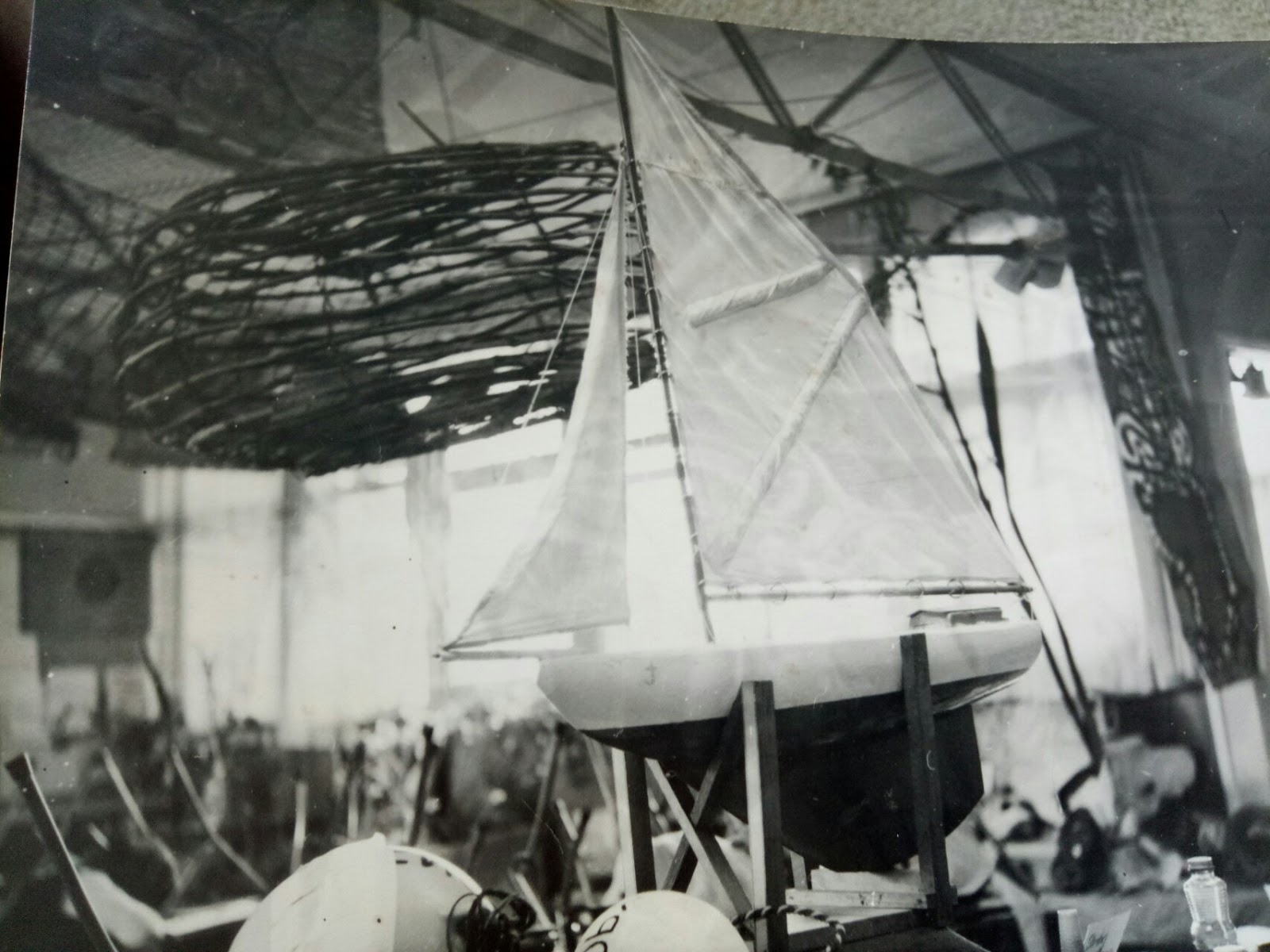

Class studies linked all aspects of the curriculum. The display above was centred around
Hemmingway's book The Old Man and the Sea which the class really enjoyed.
.The rotational group work became more directed until students gained the skills required ( an important part of the language arts morning programme) and not all involved activity. One group were researching their questions and writing reports, another completing observational drawing tasks ( having been taught the necessary skills),  an art group and one working with the teacher.

Trips into the environmental feature - this photo is a part of an extensive bridge study.
Importance of personal best.

Slowly the students learnt the need for slow careful work giving John the opportunity to help students, or small groups as required. Lessons were taken to develop observational drawing ('OD') and presentation skills and students began to understand their concept of achieving their 'personal best ( ' PB'). Student bookwork began to show a real growth in quality - study books and personal writing books in particular.  Four page concertina books (made from a half sheet of cartridge) were developed to present finished work and aspects were part of the rotary group work.

 As John wrote 'independence, initiative and genuine interest were being fostered'.


Blackboards defined group rotational tasks as well as reading and maths.
Class, group and individual studies

Whole class themes rotated with group studies and individual research projects. Field trips into the local environment were a feature of the programme as were the variety of art media introduced. As success developed parents became involved both working in the classroom with designated groups an on field trips.

Spider unit. John made use of the Learning in Science inquiry approach

As the year (and teacher and students skills developed) whole day integrated programmes were introduced but reading and maths programmes  were mostly keep to the morning programme but, as mentioned, integrated as much as possible.

Display based on class trip to Mount Taranaki,
An evolving programme.

John's programme was constantly evolving as skills developed. Later John was to develop the ideas in an open plan situation working with four other teachers but that's another story.  John's experience in an open plan environment provides insight for those developing today's Innovative Learning Environments.
Display of work based om monarch study
John wrote 'It was the students themselves who effected the changing nature of the classrooms and I had to accept the children as who they are than what i wanted them to be'. Those who visited John's classroom could not but be impressed with the quality of students work on display and of the way they were able to work independently.

Quality art work based on local house study.

Students regularly visited from the Palmerston North Teachers College and one of their lectures , David Aitken, complied a photo book on John's classroom, The book was shown to Dr Beeby who commented the this was the kind of teaching he envisaged in the 1940/50s. Unfortunately this valuable record has been lost.


Art work from a snail study
John appreciated creative diversity in his classroom


There is always something to learn from the past it seems.


An illustration from 'our' booklet
Learning from the Children
John went on to be principal of Fitzroy and Spotswood schools where he developed a whole school approach based around the ideas he had developed. As mentioned he was one of the few to develop a highly successful Open Plan Unit in the 70s. Over the years John presented his ideas throughout at National Refresher courses..


Friday, February 16, 2018

Readings for creative teachers: John Hattie ??/ maths ( Jo Boaler)/ John Holt / John Cunnningham / and lots more...


With a new government in NZ time to think out of the box!

Education Readings

By Allan Alach

If you are a creative teacher who has not yet read Bruce’s article below “Creative teaching:Learning from the past - John Cunningham teacher 1970s” I really suggest that you prioritise it.

I welcome suggested articles, so if you come across a gem, email it to me at allanalach@inspire.net.nz

‘The Cult of Hattie’: ‘wilful blindness’?

Yet another ‘debunking’ of Hattie - got the message yet?

Debunking John Hattie
‘Unfortunately, in reading Visible Learning and subsequent work by Hattie and his team, anybody who is knowledgeable in statistical analysis is quickly disillusioned. Why? Because data cannot be collected in any which way nor analysed or interpreted in any which way either. Yet, this summarises the New Zealander’s actual methodology. To believe Hattie is to have a blind spot in one’s critical thinking when assessing scientific rigour. To promote his work is to unfortunately fall into the promotion of pseudoscience.’


Five Ways To Shift Teaching Practice So Students Feel Less Math Anxious

‘Rather than focusing on the algorithms and procedures that make mathematics feel like a lock-step
Jo Boaler
process — with one right way of solving problems — Boaler encourages teachers to embrace the visual aspects of math. She encourages teachers to ask students to grapple with open-ended problems, to share ideas and to see math as a creative endeavor. She works with students every summer and says that when students are in a math environment that doesn’t focus on performance, speed, procedures, and right and wrong answers they thrive. They even begin to change their perceptions of whether they can or can’t do math.’


Why forcing kids to do things ‘sooner and
faster’ doesn’t get them further in school

‘Why do some children who learn to read earlier than their peers do so poorly in ways that matter later on? Why do children for whom every aspect of their education, from kindergarten onward, is tailored toward graduating from college often struggle to graduate from college?’


The Joy and Sorrow of Rereading Holt’s "How Children Learn


‘This clearly is a corollary of the point that children learn because they are motivated to do the things they see others do.  They are, of course, motivated to do whole things, not pieces abstracted out of the whole.  They are motivated to speak meaningful sentences, not phonemes. Nobody speaks phonemes.  They are motivated to read interesting stories, not memorize grapheme-phoneme relationships or be drilled on sight words.’


Contributed by Bruce Hammonds:

Creative teaching:Learning from the past - John Cunningham teacher 1970s

‘
Diversity and creativity 1970
John wrote “It was the students themselves who effected the changing nature of the classrooms and I had to accept the children as who they are than what I wanted them to be”. Those who visited John's classroom could not but be impressed with the quality of students work on display and of the way they were able to work independently.’


Teaching: Just Like Performing Magic

‘Education, at its most engaging, is performance art. From the moment a teacher steps into the classroom, students look to him or her to set the tone and course of study for everyone, from the most enthusiastic to the most apathetic students. Even teachers
Teller - all about magic
who have moved away from the traditional lecture format, toward more learner autonomy-supportive approaches such as project-based and peer-to-peer learning, still need to engage students in the process, and serve as a vital conduit between learner and subject matter.’


Personalized Learning Vs Personalization of Learning

‘Before she started speaking, I was skeptical because I have seen the idea of “personalized” learning happening in many schools where a student jumped on a computer and based on the information they share, the technology creates a pathway for that student.  Although the technology is impressive, it doesn’t mean that it is good.  Seeing a student completely zone out in front of a screen and letting the computer lead the learning is not where I hope education is moving.’


Technology can hurt students’ learning, research shows

Giving school students access to iPads, laptops or e-books in the classroom appears to hurt their learning, new research has found.However, putting this technology in the hands of a teacher is associated with more positive results.’


Non-Math Essentials for Learning Math

Focusing on these five qualities of thriving classrooms can help foster confident young mathematicians.
'
As a math consultant, I’m in many classrooms, and I get to witness lots of math instruction. I find that there are similar qualities among the classrooms that are really thriving—and those qualities quite often don’t really have much to do with math. There are five non-math qualities I see in the best-run classrooms.’


The New Preschool Is Crushing Kids

(USA): Today’s young children are working more, but they’re learning less.

Until recently, school-readiness skills weren’t high on anyone’s agenda, nor was the idea that the youngest learners might be disqualified from moving on to a subsequent stage. But now that kindergarten serves as a gatekeeper, not a welcome mat, to elementary school, concerns about school preparedness kick in earlier and earlier. A child who’s supposed to read by the end of kindergarten had better be getting ready in preschool.’


From Bruce’s ‘goldie oldies’ file:

Control your own destiny - do something!

‘The answer is for principals and schools to work to share their expertise and insights and to
develop a group consciousness able to stand up to outside pressures. There will need to be courageous individual principals prepared to start the collaborative ball rolling. I can see problems with so called ‘successful schools’, or the competitive, ‘look at me' schools, wanting to share, and as well schools who are struggling ‘owning up ‘and agreeing to being helped. But, if someone starts the ball rolling then, as Dean Fink writes, schools can, ‘shake off the shackles of conformity and compliance and imagine and create.... do something. ‘So the answer to stress is to work with others to ‘do something’ and to develop, what Fullan calls, ‘local creative adaptability.’


A new metaphor : Assessment tasks as performance.

“It is somewhat surprising that some educationalists have only just picked up on this way of assessing learning, one used naturally in the real world. The problem is that schools have been diverted from such an understanding by believing in tests, written exams divorced from reality, and an obsession with assessing atomised bits of learning. Such educationalists have not been able to see the wood for the trees. It is exiting to read, in a recent Ministry pamphlet 'Assessing Key Competencies' (written by Dr Rosemary Hipkins), that one way to think of assessment is to consider the demonstration of competency as a complex performance’.”

Marina Bay students Auckland

Friday, January 26, 2018

First educational readings for the new year - a year of great possibilities in NZ


Goodbye National Standards. A opportunity for creativity in schools

Education Readings

By Allan Alach

Time for new thinking
The New Zealand school year is about to begin, so Bruce Hammonds and I are back again with our education readings. Hopefully New Zealand schools are well prepared to make the most of the opportunities provided by the dumping of national standards, although we have our concerns that too many principals and teachers will struggle to break their mindsets free from the raising achievement focused dictates of the the previous nine years.

I welcome suggested articles, so if you come across a gem, email it to me at allanalach@inspire.net.nz

Assessment too often fails to prioritise learning – let's change that

‘By relying less on data and more on teachers’ judgment, schools can give student assessment greater meaning while also cutting workload.

Often the focus is on what tracked data tells us about student progress, but I know of no large-scale study that demonstrates the positive impact of data-tracking systems on learning. My hunch is that you could delete all this data and the students would never notice the difference in terms of the education they receive. The majority of teachers have excellent knowledge of their students, with or without the data.'


IXL: Caveat Emptor & Personalized Misery
NZ may have been saved from this by the change of government, but …

As the computerized version of personalized [sic] learning continues to gather steam, we can anticipate increasingly aggressive marketing. Remember – you don't win in a free market by having the best product, but by having the most effective marketing. Marketing for these algorithm-driven software packages of mass-produced custom education belongs to a special class of marketing – marketing that is designed to sell a product to people other than the actual end users… Education has always suffered from this problem-- teachers get stuck using products that are purchased by district administrators who will never have to actually work with them.’


This is the one skill your child needs for the jobs of the future

‘Every child begins their journey through life with an incredible potential: a creative mindset that approaches the world with curiosity, with questions, and with a desire to learn about the world and themselves through play.

However, this mindset is often eroded or even erased by conventional educational practices when young children enter school.’


Contributed by Bruce Hammonds:

'A World of Difference': the philosophy of a Taranaki pioneer creative teacher - Bill Guild

‘
Bill's room  environment
In 2003 Bill Guild attended the Frankley Road 150th Jubilee, a school he had been principal of for 28 years from 1959 to 1986. An accomplished photographer,
Bill complied a book ‘A World of Difference’ of the experiences and creativity of the students he taught to share with past students attending. Later an edited booklet was shared widely with teachers throughout New Zealand who knew of the quality of teaching he was well known for. Maybe it’s time to share his ideas again?’


Creative teaching:Learning from the past - John Cunningham teacher 1970s

Creativity not conformity
Uncovering ideas worth sharing

‘The other day I was visiting my old friend John Cunningham. He had been recently sorting through old notes ( John is a bit of a hoarder) and had found some photos from his 1970 classroom and I suggested they might make an interesting blog.  In all areas of life we need to look backwards to move into the future; ' Those who do not learn from history are doomed to repeat it' (Santana).’


Starting the year right – building learning-focused relationships

'If we want students who are confident, connected, actively involved, lifelong learners, how do we
maximise the beginning of the school year to ensure this happens? We often use words such as ‘learning’ and ‘learner’ with our students, yet how often do we stop and check that they understand what these words actually mean? It seems to me that with a new year before us we have an opportune time to unpack these concepts with our students. Learning-focused relationships with and between students will not happen by accident; they need to be nurtured through careful planning and design.’


Why Are Kids Impatient, Bored, Friendless, And Entitled?

I am an occupational therapist with years of experience working with children, parents, and teachers. I completely agree with this teacher’s message that our children are getting worse and worse in many aspects. I hear the same consistent message from every teacher I meet. Clearly, throughout my time as an Occupational Therapist, I have seen and continue to see a decline in children’s social, emotional, and academic functioning, as well as a sharp increase in learning disabilities and other diagnoses.’


Teachers celebrate the end of National Standards

‘Primary teachers sound excited after the sudden announcement of the dropping of National Standards, and their New Year’s resolutions for teaching in 2018 are about re-discovering the New Zealand Curriculum, and locally relevant learning. They’re talking about passion-based projects, vision, and innovation; about drones and gardens, marine reserves and whakapapa. The romance has been re-ignited.’


Ken Robinson – How Schools Kill Creativity

Now that national standards have been dumped in the rubbish bin of history, it’s timely to bring back Sir Ken Robinson.

‘And the third part of this is that we’ve all agreed, nonetheless, on the really extraordinary capacities that children have — their capacities for innovation… And my contention is, all kids have tremendous talents. And we squander them, pretty ruthlessly. So I want to talk about education and I want to talk about creativity. My contention is that creativity now is as important in education as literacy, and we should treat it with the same status… ‘


Who should learn most about White Privilege—Māori children or Pākehā children?

Ann Milne:

‘Although, internationally, there is a significant body of research on Whiteness and White privilege (for example, see here, here, and here), in Aotearoa New Zealand we have been largely silent about White spaces in our “Whitestream” schools. The racist backdrop that is pervasive in our education system creates and perpetuates the White spaces that marginalise and alienate our Māori learners, yet it is a backdrop that we rarely name as being a problem.’


Secret Teacher: why can't my school just trust us to do our job?

Time to trust
‘When I started my career in teaching, I was encouraged to be creative and experiment. I loved that freedom and I think it helped to make me a good teacher. I got used to reading around my subject and trying out different ideas. I made some mistakes, but I was always thinking, always learning, always trying to do better with my students. I got good results. I enjoyed my work. Contrast that with the situation I and many of my colleagues face today. My job and so much of what happens in my classroom is being controlled and my teaching hindered by excessive micromanagement.’


From Bruce’s ‘goldie oldies’ file:

What messages does your school pass on to students?

‘It is important if students are to become active learners for them to tell their own stories, to pose their own questions and to make their own interpretations of what they experience. If their ‘voices’ are not recognised there will be many who will continue to disengage from their learning.’

Wednesday, March 07, 2018

Teaching in a Modern Learning Environment - with a twist !


Teaching in a Modern Learning Environment (MLE) or an ILA – innovative learning environment or a FLE – flexible learning environment.

Theme based on Hemmingway's Old Man and the Sea
Teaching in a Modern Learning Environment (MLE) offers an opportunity to extend the educational opportunities that can be offered to students.
To achieve anything that is more than an extension than which can be achieved in ordinary classrooms is the problem.
Architecturally ‘opening’ out the classrooms will naturally make quite a difference to the learning situations for both learners and teachers.
 Students will be able to feel part of larger more complex and initially exciting unit and this will apply to the teachers as well but for the teachers in particular will be the feeling of being in a team. This will allow teachers to share their problems and successes – and most importantly will enable a variety of organisational arrangements to be made imposable in self-contained classroom.
Theme based on local and famous churches
These gains in themselves for both teachers and students are considerable but if the teaching methods are only an extension of ‘traditional ‘ subject centred teaching then the advantages are minimal.
 New classroom design asks for a more imaginative approach.
Modern Learning Environments must be more than an architectural innovation. Modern Learning Environments provide the means to devise learning situations which open up the potential for extending the learning of the students. It means attempting to develop within the individual learner all the skills and attitudes of a competent independent learner.
It means giving the students the chance to learn for their own reasons rather than completing teacher arranged tasks which in many traditional classrooms are completely divorced from the learners own reality. These newer opportunities requires a new philosophy towards education.
It will mean different things to different people but essentially it is a learner centred approach which has as its key the need for all students to become successful learners. Failure as a concept must be minimized and seem as a learning opportunity and not a dominant feature as it is in our present traditional approach.  The needs and attitudes of the students are of greater importance than the needs of any traditional subject. 
It can be seen that to operate a Modern Learning Environment can be simply an extension of traditional teaching. 
In the present educational climate Modern Learning Environments provide the glamour but innovative teaching can often be seen in ‘ordinary’ classrooms.
Much of the current Modern Learning Environment teaching is more correctly ‘team teaching’, a devise to teach subjects using traditional methods in a new situation (streaming, ability grouping and a focus on subjects). Merely individualising learning is an extension of current practice and not an innovation.
To best take advantage of a Modern Learning Environment best requires teachers who have achieved success developing creative programmes in a contained classroom. 
It will be a challenge to extend such a philosophy in a diversified space. Necessarily there will a considerable transitional period to introduce new ideas; a time for all to adapt to the new conditions.  No doubt for a considerable length of time methods may have to be utilised that may be contrary to the spirit of a Modern Learning Environment until new methods and new confidence are gained by both teachers and students.

  I wrote the above  in the 1970s. 

‘Those who don’t know history are doomed to repeat it’ Edmund Burke

In those times such flexible buildings were called open plan schools. I have simply written in Modern Learning Environment to replace the original phrase of open plan schools. In the 1970s there was a movement (centering in the USA) known as ‘open’ education.
I worked with one of the few very successful open units in the 70s one led by John Cunningham at Waitara Central in Taranaki 1974-5. 
Most of the open plan schools eventually replied or closed off their walls and their success, or lack of it, provides valuable learning for teachers involved in today’s Modern Learning Environments.
The ideas that John and his team implemented were (based on his notes):
1.       To develop a diversified day utilising group organisations to allow students to work as individual with, where possible, a choice of activities; to develop a ‘workshop’ type atmosphere with a number of subject areas progressing at any one time.
2.      To develop a curriculum based largely on the immediate environment (historical and natural), student’s interests, all with a focus on providing students with first hand experiences. An emphasis to be placed on careful observational work.
3.      The importance of the development of skills  to assist the students to become independent and self-motivated learners, in particular the  need for students to work carefully by slowing down the pace of their work and also to develop a range of presentation skills.
4.      Appreciating the importance of the total learning environment. This require students’ work to be carefully displayed and new topics introduced by well-arranged teacher displays. All visual space should be thoughtfully utilised. Every attempt should be make the classrooms as stimulating and challenging as possible.
5.      Every learner should experience success and appreciate the need for self-discipline. Learning should be personalised as well as individualised.

The Waitara open unit was based on a ‘nook and cranny ‘model rather than the ‘open prairies’ of the architecturally designed units - an approach more suited for team teaching.
Theme based on Mount Taranaki Study
Open plan units (or Modern Learning Environments) require an evolutionary programme.
The 100 students and 4 teachers structured around four home groups deliberately keeping the security of conventional classrooms but care was taken to avoid home rooms returning to conventional teaching. The daily programme was evolutionary and as teachers and students gained skills more choice was offered to students. Programmes ranged from formal to flexible. As the year progressed programmes became more student orientated.
There was a need to ensure a balance of content areas to be covered and teachers focussed on ensuring students’ were not occupied by busy ‘shallow’ work particularly when given choices. Basic skill teaching to ensure independent was covered by withdrawal groups as required.
Cooperative planning is a strength of open plan teaching and the main themes of the activity programme were planned together. 
Within this planning there needs to be the necessary element of choice for teachers and students – teachers strengths can be shared with all.  From the ‘master plan’ teachers choose areas to develop and share. Check lists are used to ensure all students cover planned areas. At all times the unit has a number of activities being undertaken. The current theme is introduced by teacher arranged motivational displays that are added to by student work as the study progresses.
Science maths technology study based on  local bridges
Themes are chosen which offer a diversity of subject areas and creative activities and are introduced to the whole group by a selected teacher. Integrated learning.
After starting in the home group students are involved in mixed ability groups with the maths programme which features activity problem solving challenges and related to the current theme study if appropriate. This is followed by language time – once again integrated as required with the theme study. Students with special needs are helped in small withdrawal group and then returned to the main groups.  Language time includes research reading, spelling (words from the current
Snail art, maths and language 
study) and handwriting also linked with the current theme.
Literature usually starts the afternoon programme in home groups. The remainder of the day involves students undertaking a range of tasks based around the theme working with teachers with strengths in the area. Times are programmed for Maori culture, music and PE with groups rotating. Whole unit singing on Friday and sharing of work finish the week
For all this there is no one system of organisation and the open unit offers opportunity for flexibility and change. 
 Sometimes an activity and withdrawal programme; sometimes whole day student choice (true open education); sometimes students take up choice from a range offered by the teachers.
Students are given considerable choice and are free to move about and talk about their work.
 Success depends on student ownership of tasks (group or individual) and having the opportunity to have the skills in place to achieve quality work – this includes presentation skills.
Special attention is given to finished work that reflects the students own questions and research. 
Student completed work – their research, language, art and maths is displayed with the care it deserves.
One quote that underpins the unit comes from Charles Silberman author of Crisis in the Classroom, ‘Happiness has got to derive from achievement and success not by just having a good time’.
Themes introduced through teacher displays with student work later added
Relevance to today’s Modern Learning Environments.
Obviously the ideas above were pre modern information technology but the basic issue remains that to make such flexible, or innovative learning, spaces work depend on: pedagogical leadership and alignment of staff; relationships between all involved; and the quality of the learning undertaken by the students.
In all areas of life we need to look backwards to move into the future.


' Those who do not learn from history are doomed to repeat it'  Santana

‘We build our building and then they shape us’ Winston Churchill.
Local historical  swing bridge basis on an integrated study