Sunday, August 13, 2006

Here's to the crazy ones.

  Posted by Picasa Here is to the crazy ones
The misfits
The rebels
The trouble makers
The round people in the square holes.

The ones who see things differently
They’re not fond of rules
And they have no respect for the status quo.

You can praise them, disagree with them, quote them
disbelieve them, glorify or vilify them.

About the only thing you can’t do is ignore them.
Because they change things.

They invent. They imagine. They heal.

They explore. They create. They inspire.

They push the human race forward.

Maybe they have to be crazy?

How else can you stare at an empty canvas and see a work of art?

Or sit in silence and hear a song that’s never been written?

Or gaze at a red planet and see a laboratory on wheels?

We make tools for these kinds of people.

While some see them as the crazy ones,
we see genius.

Because the people who are crazy enough to think
they can change the world,
are the ones who do.


Poem from Apple Computer.

Seems to be putting computers in their rightful place to help people, in all creative fields, explore things that make them curious – inspired by their talents, passion and dreams. The crazy teachers know this, developing personalized curriculum for every one of their students, rather than fitting them into preplanned curriculum boxes.

Let’s have more crazy teachers!

Saturday, August 12, 2006

A sign that says it all!


'Sometimes you don't ever have to see a school to know with absolute certainty that something profound is going on there'.

A quote about the sign from an American website! Well done Puketaha! Posted by Picasa

Friday, August 11, 2006

Robert Fried on Seymour Sarason

  Seymour Sarason: Sculptor of IdeasPosted by Picasa Seymour Sarason is a name I often see quoted and so it was great to be sent a copy of an introduction to one of his books by my friend Robert Fried ( see picture) himself a writer of such wonderful books as the ‘Passionate Teacher’ and the ‘Game of School’.

One of Sarason’s forty odd books has a name that reflects his lifetime theme ‘The Predictable Failure of School Reform’. He retired in 1989 as professor of clinical psychology at Yale University.

Fried calls Sarason as a ‘cautious radical’ and a pragmatic idealist who staunchly defends classroom teachers in one breathe and scolds them ( and policy makers) in another for their failure to make schools interesting places for teachers and children.

Fried believes we should take him seriously. For sixty years Sarasan has agonized about why our institutions and social systems so rarely succeeded in achieving the visions of those who created them despite the hard work and sincere efforts of all involved. Sarason has relentlessly challenged conventional thinking about why schools seem so resistant to change.

Fried introduces Sarason as a ‘sculptor of ideas’ who has shaped the ideas of many scholars and educators over the years.

Some of the ideas he has shared are:

1. Every school has a culture that defines how people within it operate. Culture affects people in ways they acknowledge as well as in ways that are hidden from their consciousness. Taken for granted culture is rarely questioned by teachers, students, or the wider community. Until the assumptions behind the culture are questioned as to how well it is performing things carry on as they are.

2. The ‘regularities’ of that culture – the rules and procedures that are mostly assumed tend to undermine the basic purposes of educating our youth. ‘But we have always done it that way’ ensures culture remains unexamined and unchallenged.

3. The overriding purpose of the school ought to be that children should want to keep learning more about themselves, other, and the world, yet that purpose is mostly ignored. Why should kids go to school? To learn basics or to gain cultural heritage, or do we want them to become better learners, more confident, more capable, and more curious? Is there any goal, Sarason believes, that even comes close in importance to having students increase their desire to learn more about themselves, others, and the world. If not why this goal is so rarely articulated?

4. The educational ‘system’ has an oppressive impact stifling progress. The search for culprits – teachers, students, bad parents and schools is a popular activity. But the real culprit is the system itself, a system nobody designed, nobody champions, and almost nobody challenges. The system seems pervasive and everybody at every level seems to distrust and resent those who wield power over them and disrespect those who have less power e.g. students.

5. The system, as it currently functions, is intractable, not easily reformed, and reform efforts that ignore systemic obstacles will predictably fail. The most significant feature of the system is to perpetrate itself, to roll along in the face of research illuminating its inefficiencies and failures. Reform efforts that do not address undesirable features of the system itself are doomed to failure as change gets stymied by the very dysfunctional aspects one is attempting to alter. For example it is common to changes to be handed down from on high yet this way of initiating change almost always leads to resentment, subversion, and failure.

6. More specifically, reforms that do not change the power relationships between and among people in schools are fated to suffer paralyzing inertia. Power is unjustly and inequitably distributed in schools and school systems. We have to ask ourselves why we behave as we do towards those above and below us in the hierarchy of power and how we can change those relationships so that they reflect our democratic values and promote shared decision making.

7. Sustained and productive contexts of learning can exist for students if they do not simultaneously exist for teachers. Everyone in a school needs to work together to create an environment in which learners feel motivated and supported as they build on what they know and seek to learn more. Unless teachers feel that they are part of a high quality respectful learning environment we cannot expect more than a few such teachers to create that environment for their students.

8. Applying labels to people, especially a student is futile and unjust. Too many children have had their careers misshapen by being tested and put into categories that often have little to do with their real potential as learners.

9. The democratic principle, while often celebrated, is undermined or ignored in our schools and school systems. Those who will be affected by decisions have a right to be included in helping shape that decision.

10. Parents are vital partners, and teachers qualified leaders, and both are potential governors of schools. It is easy to proclaim the values of parent participation, or involvement, but such advocacy is meaningless when parents are sidelined or their roles trivialized. Parents, along with teachers, deserve a much greater role to run their schools.

11. Politicians need to understand the systemic features ( failures) of the education system and not just to foist new pressures, programmes, goals haphazardly on schools.

One place to begin, Fried believes, is with Sarason’s notion of the culture of the school. The school culture is so evident, so persuasive, yet so invisible. If we fail to see the school as more than a collection of classrooms we will be continually disappointed by the inability of people in schools to make those changes that are called up by research, intellectual honesty and democratic principles. We need, Sarason believes, to identify, examine and challenge aspects of school culture that stifle progress. If not we will fail to see the forest for the trees.

Until systemic problems are faced up to changes designed to improve will be sidelined, 'sweet talked' to death, ignored, or sabotaged. It is this stagnation that has inspired Sarason to challenge the ‘status quo’ as much as had John Dewey a good half century earlier.

Sarason is now in his mid eighties. He paradoxically remains idealistic while often taking a dim view of the possibilities of significant improvement in the schools he has devoted more than half a century to. He continues to write about the nature of the obstacles and dilemmas that confront real school reform and continues to challenge himself and other with the questions he poses. He has, as Fried writes, refused to soft pedal the truth about systems and their cultures.

All countries need their Seymour Sarasons to ‘sculpt ideas’ to keep 'us' focused on the real issues that confront those who believe passionately in developing the talents and dreams of all students in a democratic environment.


Thank you Robert for sharing this will us.

Wednesday, August 09, 2006

The 'new' or 'revised' NZ Curriculum?

  Posted by Picasa I was at a meeting recently when a Ministry ‘contracted’ employee pulled me up for giving credit to the ‘new’ NZ curriculum. She objected to my use of the word ‘new’ - ‘revised’, she informed me, is the correct title!

Who cares!

The ‘new’ or ‘revised’ curriculum has moved along way from the appalling 1992 NZ Curriculum Framework ( NZCF). The further away the better. A ‘senior’ Ministry Curriculum ‘Manager’ said recently on National radio that the original curriculum was 'good' but the ‘revised’ one is better. A real understatement – there is a world of difference. We are now back to where we should have been before politicians introduced the 92 model with little or no consultation with educationalists.

For over a decade schools have struggled to implement a document that had little to do with education and more to do with an imposed ideology of efficiency, accountability and competition. Supposedly to clarify what schools ought to ‘deliver’ it soon became obvious that it was so incoherent and complicated that it became itself a barrier to the very problems it was supposed to solve. But not before a number of creative teachers and schools had paid the price – either by trying to implement the impossible or by trying to hold on to their educational principles. In most cases professional integrity was compromised as most schools tried to do their best to ‘colonize’ the continually changing compliance expectations.

Not that original NZCF was ever ‘original’. An exchange UK lecturer at Massey College of Education (when I was their ‘Teaching Fellow’) showed us a copy of the earlier published UK National Curriculum. It was dark blue with a shell on the cover (a spiny murex) while ours was a lighter blue with a nautilus shell on the cover! On closer inspection the saving grace for the NZ version was that ‘we; had avoided national testing at ‘key stages’ and the associated league tables based on them. While working with the Bali International School I realize that the curriculum documents from the various countries or states all followed the same technocratic formula – learning areas, strands, levels and countless learning objectives, all to be taught and assessed. The insertion of a few Maori words could not disguise the lack of originality of ‘our’ curriculum statements. Since then the Ministry’s policy advisers have led us down several other UK ideas – numeracy and literacy initiatives, targets, and strategy planning. We even followed their ‘slim-lining’ of their ‘obese’ curriculums with our ‘stocktaking’ version.

So there is nothing original about the Ministry – a classic case of ‘group thinking’ leading to a false sense of consensus while all the time ignoring the ‘wisdom’ of the teaching profession.

As it became obvious to all that the ‘Emperor had no clothes’ a revision of the National Educational Guidelines (the NAGs), and then the NZCF was inevitable.

And along with this a softening of the hard line ‘name and shame’ of our Education Review Office (another UK idea) into an ‘assess and assist’ model.

The metamorphosis of the original ideology, with the publication of the ‘revised’ NZ Curriculum, is now almost complete.

Of course no one will admit that they were wrong in the first place but at least common sense seems to have prevailed even if those whose memories stretch back before the 90s will have feelings of ‘deju vu’.

Back to the ‘revised’ NZ Curriculum.

I don’t think it will evoke any great excitement, more a sense of collective relief. It legitimizes an approach that many innovative schools have already taken and for such schools it is a welcome ‘catch up’ document.

It reverses the order of the original curriculum. It begins with vision, principles, values, key competences (a ‘new’ version of essential skills), highly reduced learning areas (sending to the ‘shredder’ the eight separate curriculum statements), and finishes with effective pedagogy (a word ‘revived’ from an earlier era), designing school curriculums and planning and assessment. An ‘appendix’ is a remnant of the previous earlier incoherent learning objectives.

A few points.

No argument about the vision, values and principles. The freedom of the ‘revised’ document for schools and their communities to set their own programmes, within national guidelines, is a welcome return to democratic ideals. ‘Key competencies’ are the new ‘buzz words’ but are little more than a reframing of the ‘learning how to learn and relate to people’ of earlier progressive educationalists such as John Dewey. The ‘key competencies' phrase comes from an OECD report and seems to relate more to the technocratic past than a creative future.

The current Learning Area Frameworks have been reduced to a pull out appendix for each area. And we now thankfully ‘design’ rather than ‘deliver’ a curriculum to the students. This is an important change in terminology and ideology.

There must have been some considerable discussion about ‘effective pedagogy’ as this page has changed the most from an earlier March 06 draft. I seem to feel a strong emphasis on ‘constructivist’ teaching has been lost in the process and if so this would be a shame.

What appalls me most of all is that ‘they’ have removed a phrase from the March draft – ‘encouraging a love of learning’. This phrase, to me, symbolized most dramatically the change of ideology from the previous technocratic NZCF.

If there are ‘fishhooks’ hidden in the ‘revised’ it is in the planning and assessing of learning outcomes. ‘Effective based teaching’ is the new Ministry mantra! How this is to be interpreted is open to question. The learning objectives ‘appendixes’ could have been even more reduced by defining the ‘foundation skills’ even further and leaving the learning area objectives open to greater teacher creativity. Appendixes are all too often unnecessary organs.

A requirement to assess students’ progress on ‘key competencies’ would seem problematic; such learning dispositions ( including the missing ‘love of learning’) are not easily measured and are best seen through student actions.

All in all, ‘new’ or revised’, the draft curriculum is a ‘giant step forward’ for the teaching profession. Schools will now have to ‘shred’ all those compliance documents that have kept them away from focusing on teaching and learning!

At last it is about teaching and about time!

What is missing is a real focus on developing the talents, passions and dreams of all students. Key competencies by themselves do not make a learner. Love of learning come from exploring things of interest – we all get better at what we get good at.

Developing students’ talents means more to me than helping all ‘young people reach their potential and developing the competencies they will need’. It seems to place the cart before the horse.

And where is the mention of personalizing learning that our Minister believes is the most radical change in education since the introduction of mass education of the 30s?

Let’s hope it makes the final document.

Monday, August 07, 2006

A process to develop shared teaching beliefs.

  Posted by Picasa Poutama -stairways to knowledge pattern.


If a school is to have any impact on teaching and learning there has to be a collegial understanding of what the ‘school’ means as quality teaching and learning. This can only be achieved by a series of professional dialogues or conversation about ‘what counts as important’ to ensure the school vision and values are realized.

All too often when one asks teachers what the teaching beliefs that underpin their work are they find this question difficult to answer? This needed be the case. Teachers often have the ideas in their heads but have no simple framework to focus their thoughts.

By using a process of professional dialogue or conversations a simple teaching framework can be developed that taps into teachers ‘collective wisdom’ – a framework that they all will have sense of ownership in developing.

By developing a set beliefs to act as a ‘scaffold’, to unify and focus their thoughts, is the key. It is preferable, for ease of memory, to have no more than five core beliefs. When such a ‘common language’ is in place transitions between class levels becomes less of a problem and, as well, teachers have a means to self reference all their decisions. Such focused teaching making life simpler for all

A process to use could be to first decide on the five framework headings.

Then taking each heading at a time get the teachers in groups (depending on how big the staff is) to suggest beliefs or actions that fit under the chosen heading. Record these with no discussion. Teachers can simply say ‘pass’ if they wish.

When all ideas are contributed some can be combined but only if agreed by those who suggested them. People may ask a contributor for any clarification. No cross discussion should be allowed.

Once the list is finalized each member is given 10 votes that they can assign to any idea using four votes at a time. This process is called ‘brainstorming’ and ‘10 /4 voting’. If there is more than one group a team could aggregate group ideas to later present to staff for approval.

A 'lead team' could tidy up the list for final acceptance. When agreed the framework becomes the basis of the teacher performance system. It will take time for all teachers to gain confidence in all suggestion to close this 'gap'will become the basis for school or idividual professional development. Whatever is developed ought to be modified at the end of each year as part of the normal school review system.

The heading blow are arbitrary but most school could modify them. The ideas beneath each are just suggestions. A completed model is available on ‘our’ website.

1. All students to leave with ‘foundation skills’ in place.

Literacy and numeracy are basic to all learning (hence the ‘foundation’ metaphor) and most school would have no trouble defining a set of ‘we wills’ to ensure they are in place. Target or benchmarks could be agreed to as well as school wide programmes and teaching and assessment practices.

Detail of any ‘we wills’ need to be kept in a separate ‘best practices’ folder.

2. Our students to be ‘powerful’ learners.

The ‘shadow’ of all content experiences ought to result in students learning ‘how to learn’ so as to develop their ‘learning power’. Students ought to be aware of their particular talents. They ought to be able to articulate why, what, and how they learn able to set goals, make choices, take responsibility, and self assess their own progress against agreed criteria. Appreciating the importance of effort is important. Ensuring the ‘key competencies’ are being developed and agreed higher order thinking skills.

3. We see our role as teachers of being ‘learning advisers’.

The ‘we wills’ to be included under such a heading need to ‘mirror’ the powerful learning strategies we want the students to achieve. The teacher is a ‘learning coach’ providing diagnostic help (‘feedback’) to ensure all students are able to ‘construct’ their own learning. Idea that might be included could cover teaching an agreed inquiry model, ensuring students are goal orientated able to self assess their own work and teaching agreed design ‘scaffolds’ to ensue all students can produce work of personal excellence.

4. Students to be challenged by ‘meaningful’ learning experiences.

To engage and inspire students rich, real, relevant and rigorous learning experiences need to be provided. Ideas that might be included under the ‘we wills’ could be: planning collaboratively, developing a framework of rich topic themes to be covered each year, making use of students interests and their environment, integrating learning areas and ICT, and teaching using a ‘constructive’ inquiry model. Agreed planning formats might be considered.

5. Room environments that both ‘celebrate and inform’

Collectively the class environments provide the most obvious ‘message system’ to all visitors. Students need benign routines to allow them to take the necessary ‘learning risks’. Ideas to be considered could be: clear daily programmes and group tasks on whiteboards / blackboards, displays of students’ inquiries with appropriate headings, key questions, and process information. Agreed planning formats could be considered.


A test of any set of beliefs is whether or not every member of the school team (including Board of Trustees) an articulate them. Only when they can do you have the beginning of a learning community. When they can be seen in action in all rooms then you have real learning community.

A model for a 21stC School Vision.

  Posted by Picasa Developing a school vision is not such a difficult job.

Putting it into practice and maintaining it is the real work.

What is required is an image, or metaphor, that everyone can remember and that is in turn clarified and made more specific by the mission, the values chosen, and finally the core teaching beliefs.

Traditional schools, with reputations earned in a past era, have it easy – their school motto is clear to all and their values and beliefs are implicit and rarely questioned. They know what they stand for.

If a school wants to develop a new vision for their school it is important to involve everyone in the process because people work hard for what they have had a part in creating.

Often a local geographical feature of the landscape provides inspiration for a simple vision phrase. In other cases a Maori saying is appropriate. Sometimes the school’s name provides the inspiration. Often there is already a suitable phrase ‘hidden’ in the current school mission.

Writing a statement expanding what the vision phrase means and the challenges involved is important. What do you want to achieve for your students so they can thrive in what will be an uncertain but potentially exciting future? What strategic issues need to be considered to achieve the vision?

The mission just focuses the staff on achieving the vision but the values are important to demonstrate how you are all going to relate to each other, work together and make decisions.

Finally the teaching beliefs provide the real focus for the teaching team to achieve the intent of the vision.

It all can be as simple as:

Vision :

To develop the talents, dreams and passions of all students.

Values:

Students to respect: themselves, others, other cultures, and their environment.
To treat people as they would wish to be treated.
To learn to make the ‘best choices’ they can and always to consider ‘next time’.
To involve students and parents as learning partners.

Teaching Beliefs (each to followed by a set of agreed ‘We will’s:)

1. All students to acquire appropriate ‘foundation skills’

2. Students to be ‘powerful learners’

3. Teachers to act as ‘learning advisers’.

4. ‘Rich, real and relevant curriculum’ challenges.

5. To provide ‘celebratory and informative learning environments’.

If each of the above were combined into a Performance Agreement then the teachers could use their initiative and creativity, using the above as a means to self reference their decision and to plan appropriate professional development. If all agree with the beliefs then accountability and monitoring ought to seen as an important means to ensure the vision is not lost track of.

To achieve such focused simplicity would require a number of ‘learning conversations’ with all involved in the school to develop the clarity of intentions required to be able to trust team and individuals to get on with their job of teaching and learning. The teaching beliefs ought to be clear and 'owned' by all teachers and ensuring this is an important role of team leaders and the principal - the 'lead learner'.

If all this is achieved then you have a ‘vision lead school’; a ‘learning community’ able to trust ‘self managing teams’ able to continually reflect on how well things are going and able to make continual qualitative improvements.

Such schools are few and far between but the ones I have seen are the fun ones to work in.

Well over a score of schools in New Zealand have adopted the above model to suit their particular sitution.

There is an example our site Leading and Learning for the 21stC

Thursday, August 03, 2006

Developing a powerful school vision

  Posted by Picasa When I visit a school I often like to ask teachers what is the vision of their school – or ‘what counts as important around here?’ I also like to ask students as well and any parents that are around. I also like to ask, ‘how did the school develop its vision?’

All schools these days have Visions, Missions and Strategy Plans but all too often few people can articulate them let alone say what they really mean in action. No matter how well they are drawn up if no ones know what they mean they are not worth the paper they are written on.

I say this with the knowledge that I have helped scores of school develop such statements – I am all too often disappointed when I ask the above questions at such schools.

For all this I still believe that a vision, properly developed with all involved, is a powerful idea. There is no more important work than the development of an inspiring vision that provides a clear sense of mission for the staff based on agreed beliefs about the need for excellence of teaching and learning.

Visions do not work if individual members own belief are not congruent, or if there is no ‘buy in’, or if the vision is not powerful enough for teachers to consider changing their practices. And to be really powerful it also must include members of the school community who need to be aligned behind their school.

To achieve this require real leadership. Leaders who are courageous enough to act as ‘champions’ of the vision and who are prepared to provide the necessary support, and sometimes pressure, to ensure action are aligned behind what has been agreed to. This is the moral dimension of leadership – holding people accountable to achieve what has been agreed to no matter how painful.

The only meaningful way to develop a vision owned by all is to develop a process that involves everyone in developing their ideal school – a school of their combined dreams. Such a process should develop their school not as it is but what it could become. It must reflect the ‘best’ thinking, beliefs, and ideals of the entire community. Every body must feel empowered. This is not to say it will all be happiness and light – tension between the vision and the reality are the source for creativity and professional development but if the vision is powerful enough it will provide the rational for all decision making.

A vision is an image of a desired future – a picture of the future you seek to create. It shows where you want to go and what it will be like when you get there. It is worth describing your ideal school as if it already exists – whatever, the pull of the future must be strong enough to overcome the inertia of the ‘status quo’. It must be worth the risk of letting go of past practices and thinking.

Values are vital to ensure it is clear how we are going to relate to, or behave with, each other .When such value expectations become central to the schools vision effort they become like a moral compass helping people make the best decision they can as they move towards their vision. It helps people speak to each other openly and honestly and to share information and ideas. Team work, open communication and shared decision making will be vital. Shared values provide an environment of openness and trust and continual feedback. Some schools I have worked with have developed simple charters of suggested behaviors for teacher, students and parents to clarify such expectations.

The mission represents the fundamental purpose of the school staff to implement the agreed vision and values. It defines that we are here to achieve the agreed vision

Finally school needs to develop a set of shared teaching and learning beliefs that all teaching will be aligned behind to achieve the vision. All teachers have their own set of teaching learning ideas but this need to be articulated, shared and focused into five or six key beliefs. A number of processes are available to tap into this ‘collective wisdom’ but once settled on the teachers need to be held accountable to implement them. Naturally this will be difficult at first but with time and professional development they will become an integral part of achieving the school vision becoming a common language that all teachers can use to self reference their actions and decisions against. This is not to say all teachers will be 'clones' - what is required is enough consistency to achieve the vision combined with individual teacher creativity to explore new ideas to improve our efforts.

When all is in place a school develops a ‘future pull’ and becomes a 'community of inquiry' continually reflecting on progress and reviewing all aspects. When such a community is realized choices are made by the vision and not by the book, or any individuals personal preference. The vision, when realized, becomes the schools DNA or internal guidance system; providing everyone involved with the confidence to explore any idea that may contribute to the well being of the school.

Being a part of such a vision community is an exciting, inspiring and creative experience. Such a learning organization is well placed to thrive in what will be an ever changing and uncertain world. Such schools are capable of new learning and adapting to change able to build for themselves a unique future.

So what is your schools vision?
What are the values you all share?
What are your core teaching beliefs?
How do you know things are getting better?

For ideas about the vision process and examples of School Visions and Stratgey Plans etc visit our site 'Leading and Learning for the 21stC.

Wednesday, August 02, 2006

Future thinking - and education

  Posted by Picasa You would think that the questions that all citizens need to be asked regularly are where do we want to go as a country? What we want to create as a result of our joint efforts? What kind of society do we want to be known for?

If we are never asked such questions by our so called ‘leaders’ we will revert at election time to narrow self interest. Such short term self interested thinking will not help us think about the bigger questions that ought to determine our future.

It is becoming obvious that fast moving change is going to become a feature of our future. It is also pretty obvious that the received wisdom of the past is no longer viable. Old myths need to be debunked and new myths discovered. The uncertain future provides a great opportunity for the counties, organizations and individuals that can tap into new thinking - that is if they can escape the reactive pull of the 'status quo'.

A recent TV programme discussed the challenge of the future. The biggest issue was one of sustainability – how to manage our natural environment so that valuable natural resources are not wasted. And, as well, the need for New Zealand to develop a positive cultural identity. The question asked was what kind of identity and values do we want to encourage?

For too long we have waited for ‘leaders’ and their ‘experts’ to solve such problems for us but if we believe in democracy, as messy as it is, then the ‘voices’ of the people ought to count more than voting every three years.

Some way to tap the ‘wisdom’ of the people needs to replace the current reliance on so called ‘experts’.

What we need is a process to allow a range of national conversations to be undertaken so as to gain the diverse insights of ‘ordinary’ ‘people. Alternative scenarios could be presented of ‘preferred futures’ to debate, or groups could simply provide the answers to open questions.

Those in positions of authority need to think of such processes – either face to face meetings or by using modern information technology and then devise ways to aggregate ideas. This process could be used nationally, by communities, or in any organization.

Such ‘conversations’ could be precursors to elections (local or national) or when any organization is considering its future.

What is needed is to create a community of discussion, debate and healthy argument to replace the current cynicism that many currently hold about those in authority.

Such a community of debate must be preferable to rule by distant ‘leaders’ or their technocrats both of which seem to have little insight about the lives of ‘ordinary’ people. A healthy democracy requires a constant flow of idea from its citizens and a way to tap into their ‘collective wisdom’. Experts have no monopoly on the future as history shows.

One way to do this is to develop some agreement is about where we want to go as a country – how we want to be seen – and the behaviors we want to encourage.

If we can develop a future that encapsulates the shared dreams of us all we can shape our own destiny and create a better and more sustainable world.

This will take real visionary leadership.

Tuesday, August 01, 2006

'The Wisdom of Crowds'

  Posted by Picasa The book by James Surowiekki ‘Wisdom Of Crowds’ is an intriguing read and it’s findings seem counterintuitive – that under the right conditions groups of people are smarter than an elite few, no matter how brilliant.

Most traditional organizations, including schools, are run on the assumption that someone higher up always knows better. Learning to trust the collective judgment of a group, the author says, might be difficult but it is also smart. We need to learn to rely less on individual leaders, and so called ‘experts’, and ourselves more.

To be able to tap the ‘wisdom of crowds’ three conditions are necessary.

1. There must be a diversity of group members and opinions.

2. Individuals must act independently providing contestable ideas to avoid an ‘assumed consensus’.

3. Organizations need to be decentralized to draw on local expertise.

But to capture the ‘wisdom’ some sort of process to aggregate ideas needs to be in place.

Without the conditions outlined above in place you can easily get ‘group think’, ‘going along with the crowd’, be swayed by the most talkative members, or be just be unable to make a decision.

Individualism and diversity is hard to get when all members share the same views or where member are exposed to the same cultural expectations. In such situations potentially valued contrary opinions are not listened to.

Decentralized organizations that tap into local expertise, diversity of members and independence of thought, are of little use if there is no way to aggregate ‘wisdom’.

Flocking birds, schools of fish and bees seem to be able to tap this collective intelligence but they all follow a few basic rules – the same ‘intelligence’ that allow hundreds of walkers to cross a busy pedestrian cross section without bumping into each other.

With a few rules groups can aggregate their shared wisdom. Paradoxically some sort of leadership process is required to do so. One way is for all group members to contribute their ideas without discussion and when all suggestions are gathered some form of voting can take place to decide on actions.

Teamwork is an ideal way, providing multiple perspectives, to utilize the wisdom of groups as long as all the conditions are in place and there is way to aggregate ideas. When groups work well they develop an identity of their own and develop what Surowiecki calls ‘intellectual swing’.


Leaders need to take an active role in making sure everyone gets a chance to speak and can act as a ‘devils advocate’ to interrogate ideas. Leaders can also ‘champion’ the ideas decided on by the group. Most important of all leadership is required to ‘give the group a means of aggregating the opinions of its members’ and then to ensure group members take the responsibility to get on with agreed tasks. This means members must be ‘honest about their performance’ and value feedback about progress. When an agreement is made everybody must play the same game.

Making collective judgments in ‘top down’ organizations is not easy. All too often hidden assumption or ‘mindsets’ get in the way but if it can be done it is a way for any organization to learn to be smarter. By accesiing the 'wisdom of crowds' 'learning organisations' can be created able to tap into and value the creativity of all members.

Fun places to work in!

Thursday, July 27, 2006

Listening to the students!

  Posted by Picasa Whose ‘voices’ ought to be heard when it comes to what is going on in schools?

Who tells the schools story?

Who knows best what happens in classrooms?

School Reviews often listen to teachers’ views but rarely listen to parents or students. Parent views are all too often limited to school surveys and questionnaires but some schools are beginning the process of interviewing random groups of parents about important issues. In primary schools parents are a common sight visiting or helping in classrooms. Not so in secondary schools. There the parents are kept at a healthy distance. Often not even teachers visit each other. Privatization of practice is the norm.

The answer to who knows best about what goes on in the classrooms are the those closest to the action – the students themselves. They are the ultimate insiders and have the most intimate insight into the quality of the learning they receive. Teachers might supply a ‘bird’s eye’ view of the whole class and note patterns but it is the students who have the ‘worm’s eye’ view!

Students have the richest insight into the hidden life that goes on in individual classrooms.

Pupils are the school largest untapped source of information. Any organization that overlooks the experience of its ‘clients’ would be in trouble.

Information about suspension and behavior problem can indicate valuable information or indicators about student experience that all is not well, but only where the teachers do not hold ‘deficit theory ideas’ about students. Such teachers tend to blame everyone but themselves for student problems. If schools are alienating their students the question to ask is what would make all students want to attend school?

Schools ought to develop processes to add student ‘voices’ to school management and reviews far beyond having a student on the Board of Trustees or having a student council. Students have a pretty good idea about what makes a good teacher and sharing their perceptions would help any teacher improve their skill. Most students are fair and honest in their views but they can also be critics, challenging some of the assumptions current schools are based on.

Student group discussions based around a set of question would provide ideas for school and teachers to improve their performance. What would make an ideal school for students? What teacher behavior do they appreciate? What ‘turns students on’ to learning – or what ‘turns then off’?

Teachers could also share modern insights with each other about how students learn and how their teaching can leave students responsible for their own learning. How can students' questions and views be integrated into their teaching?

Many schools have made great advances, the past decade or so, in assisting students select study topics making use of their own question and valuing their own prior ideas as well as encouraging goal setting and self evaluation using criteria negotiated with the students.

In such schools, where students and teachers work in partnership, teachers would have nothing to fear from listening to their students ‘voices’.

Such schools would be well on the way to developing a personalized learning where students are leaders of their own learning and teachers see their role as assisting students gain the skills and knowledge the students need to achieve personal excellence

Such developments would require both trust in teachers and students but if realized would develop schools as true learning environments.

Wednesday, July 19, 2006

Creativity is more than process.

  Posted by Picasa As I visit schools I see the effects of heavy interventionist 'training' programmes – usually in the literacy and numeracy fields, that are being ‘delivered’ to school through contracts.

They all seem heavily biased towards ‘best evidenced’ and ‘well researched’ processes, procedures and techniques and, as a result, can hardly be called creative.

There seems an obsession with winning the ‘achievement ‘stakes – internationally, or year by year in every school. Teachers pore over variances in achievement with the intensity of voodoo priests staring at chicken bones.

There is no doubt that the heavily interventionalist ‘training’ programmes in literacy and numeracy are making a difference but at the cost of teacher creativity - the ‘life blood’ of real progress in any area of learning. The pressure/support schools receive ensure that ‘target setting’ (another imported technocratic ‘voodoo’ idea) is narrowly restricted to literacy and numeracy.
As a result, as one UK commentator says, ‘The evil twins of literacy and numeracy have all but gobbled up the entire curriculum.’ This has resulted in a lessoning of emphasis on creative learning in a range of areas.

As well, research is showing that although there have been impressive achievement gains these cannot be sustained and they eventually plateau out and trend down. This is being interpreted as the result of a real lack of 'ownership' of the process by teachers and the effects of growing feelings of dependency on outside providers. Teachers, by applying this well researched ‘one size fits all model, are becoming intelligent technicians.

I guess if there are good things about the imposed ‘efficiency’ and highly monitored programmes it has been that teachers are now talking more about teaching and sharing ideas so all is not lost! It is within this collegial sharing that future developments ought to lie.

A look around many classrooms with a ‘creative eye’ illustrates this heavy handed approach of imposed processes, pre set criteria, intentions, and exemplars. The students work on display, including of all things art, has the look of a high level of mediocrity.

Inadvertently what is being demeaned is the creative power of each teacher, particularly of the few really creative teachers who still exist in the bland managerial environment created in the past decades.

Let’s hope that an understanding develops that it is the wisdom lying untapped with the teachers themselves that is where real educational change resides.

Creative teachers have one obsession that protects them from 'managerialism'. They are passionate about developing the talents, passions, interests and dreams of the students rather than implementing, or ‘delivering’, curriculum guidelines. Because they understand the creative process ( which is often messy and always unpredictable) they gain their satisfaction, not in achieving set targets, but in the idiosyncratic thinking, language and creative expression of their students. Creative teachers are not distracted by their students having to achieve preset achievement goals but are energised by being continually surprised by the creativity of their students.

Creative differences are what we should be aiming for (along with agreed ‘foundation skills’) in our classrooms and schools

The skill of teachers (and school leaders) ought to lie in creating the conditions to develop the creativity and talents of all students. They need to be skilled in assisting students to generate ideas, to provide help in realizing such ideas (but with a ‘light’ hand) and by challenging each individual student to continually reach for personal excellence.

Excellence, it is said, is a journey not a destination. Creative exellence is hard to measure but easy to see or experience – it is the opposite to the dull conformity (called 'high achievement standards') so loved by technocrats.

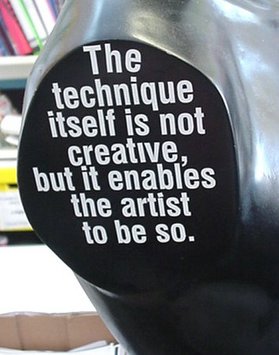
Creativity must always be more than technique.

And if we want to be a creative country it is the most important educational quality of all to be nurtured in our students, teachers and schools.

Tuesday, July 18, 2006

We need a new view point!

  Posted by Picasa For centuries it seems those with expertise have determined what the rest of us want. Many of our current organization are based on this hierarchal authority – somebody always knows best!

This might have worked in earlier times but in an age of open information, information is available to anyone, anywhere, anytime. Wisdom is no longer restricted to those at the top and innovative businesses are developing ‘learning cultures’ based on agreed values, beliefs and behaviors to take advantage of the new environment. The wisdom and experience of those who interact with, or those who buy or use the services, needs to be tapped and shared with others. Expertise and leadership is to be found in all corners of any organization. The success of any future orientated organization needs to be built on accessing the insights of individual at the front line.

As well people are now demanding the right to develop their own perspectives on life and not to be judged or assisted by those distant from the reality of their own lives. As people search for their own identities they are not looking for organizations to tell them how to act and think. The 'one size fits all' mentality is long gone!

To tap into the energy and ideas of all people is the challenge of 21stC organizations including schools – in fact schools ought to re-position themselves to develop the talents of all students and not to see students as ‘consumers’ ( often unwilling) of their programmes. To do this they have to work in co-operation with all their students to develop individual education programmes. It is the subjective quality of the experience, not the graphed achievement level, that any student values. New metrics need to be developed to assess students’ experience – or any one who receives a service from any organization.

Innovative schools know that the best way to develop life long learners is to ‘engage’ students (a problem endemic in traditional schools). So measuring the success of engagement is vital .How do students’ rate their learning experiences? Teachers (and other serve providers) need immediate feedback on the impact of their actions. They need to access the wisdom and insights of those they are assisting.

In this sense all who provide ‘services’ (including teachers) need to serve people in a way that builds up each individuals capacity for coping. This will require changes and new ‘mindsets’ in all aspects of any organization.

All this is revolutionary. It is those in control who need to assess their ability to make such transformational changes.

We may need ‘new minds for a new millennium’!

Sunday, July 16, 2006

Developing a learning identity

  Posted by Picasa Identity is an important idea for individuals and organizations.

Students who develop an open positive learning identity are indeed lucky. Ensuring all students develop such an identity ought to be the number one priority of all teachers well ahead of any content requirements. Unfortunately this is not always the case. Other agendas get in the way namely numeracy and literacy. Important as they are a positive learning identity (some call it ‘learnacy’) is more important.

The identify concept applies to organizations such as schools communities and countries as well.

Identity is hard to tie down but it is an essential element of such things as vision and culture - things you experience or feel. When individuals, or organizations, act within their beliefs they have coherence and integrity and are able to make confident informed choices. Without a strong sense of identity they fall apart or are indecisive. A strong sense of organizational identity or energy is based on congruent agreed behaviors.

A positive learning identity, at the individual or organizational level, provides a filter to help ‘us’ interpret and make sense of the world and gives us the confidence to be open to new possibilities. We all construct our world by what we choose to notice but the culture we live in provides the groundwork; culture can expand or diminish our identities.

A strong cultural identity reaches to every corner of a powerful learning environment – the ideas must be lived by all. Once such a strong learning identify or vision has been developed it will sustain and self renew itself continually adapting to whatever situation arises, providing all involved with the security of a unified sense of direction.

Organizations beginning such a journey must engage everyone to explore its purpose or vision so as to develop its identity; ‘what’s important around here’! What are the current concerns? What does the school want to achieve? What is possible now? How will things be different because of our actions? What beliefs and behaviors will we need to agree to? And, most important of all, everyone must say 'yes' to belonging.

If this is not done ‘we’ will end up with a jumble of contradictory behaviors with people going in all sorts of directions with an associated loss of energy.

A strong sense of identity provides the means of self reference for organizations, or individuals, allowing them to guide their choices. When we agree to work with others within such agreements we may sacrifice some of our freedom but we open ourselves to more creativity. Our individual and group identity co-evolves.

Vision, values, shared behaviours and beliefs provide ‘self reference’ giving coherence and allowing autonomous choices. Such cultural ‘relationships’ are preferable to imposed plans and procedures.

Appropriate behaviours and choices are guided by one rule – they must be consistent with guiding principles. If the culture and identity is strong then what is appropriate is not a problem.

A learning identity is all about making meaning- all positive individuals or organization are drawn, by their creativity and energy, to continually extend their knowledge. Identity is a strong ‘force’ – a seamless web of relationships, responsibity, participation, harmony, and recognition.

Organizations with a strong learning identity based on clear beliefs and trust are 'attractive' and 'inviting' to others, and those who live and work in them develop a strong passion for what they are trying to achieve. Those with rigid controlling identities cut themselves off from creative possibilities - as do individuals.

With a strong learning identity individuals and organizations are open to continual exploration, happy with the appreciation that there are no right answers and that life is a continual creative process of improvisation.

Only people or organizations with strong learning identities will have the capacity to thrive in the future.

Tuesday, July 11, 2006

Another 'buzz' phrase - 'building capacity'!

  Posted by Picasa What is this thing called ‘capacity’?

In the Minister of Educations recent speech, ‘Personalized Learning: putting the heart back into education', given to the 2006 Primary Principals Conference, he mentions that the role of government is to help school build ‘capacity’ to meet students needs.

To develop the transformation required by personalized learning, particularly to return the ‘heart’ or ‘spirit’ to education , will require more than the current system’s ‘capacity’.

Phillip Schlechty, in his paper ‘Creating the Capacity to Support Innovation’, provides some pertinent thoughts.

Schlechty says everyone wants to build capacity’ but it is not always clear what people mean. In the most generic sense the word ‘capacity’ has to do with potentials and limitations. A bucket can only hold the ‘capacity’ it was designed for – no more.

School reformers or leaders seldom take capacity issues into account when they are installing innovation and, because of this, many innovations end up as failures. Most current innovations are about improving the current system to make it perform up to capacity – filling the bucket. As such they are, according to Schlechty, ‘sustaining’ and as such have little impact on the structure or culture of the organization.

In contrast, he says, there are ideas, innovations or technologies that are ‘disruptive’ and are beyond the ‘capacity’ of the current system and require dramatic alterations of both the culture and the structures. They alter roles, rules and relationships and change dramatically the culture of the organization.

Personalization falls into this category – particularly for secondary schools.

Up until now most innovation have been ‘sustaining' rather than ‘disruptive’.

Schlechty believes there are three general capacities that schools and school systems must have in place if they are to transform school along the lines our Minister is suggesting.

1. The capacity to establish a focus on the future

2. The capacity to maintain direction once a clear focus has been established

3. The capacity to act strategically and to create new future rather than being dominated by problems with their origins in the past.

The key to transformation, Schlechty writes, lies in understanding that the present system was designed to produce attendance and compliance. He believes that if public education is to survive and thrive in the 21stC it will be necessary to focus on nurturing student engagement. ‘Schools must be positioned to be in the student engagement business rather than the compliance business.’ ‘They must attend to creating work that commands students' attention as well as commitment.’

If Schlechty’s view is accepted it is clear that school of the future must be organized in different ways and that teachers will need to do new things. Teachers will have to learn to rely less on tradition based authority and rely more on expert understanding that derives from a deep understanding of student motives and how to appeal to them.

To achieve such a transformational change goes beyond the current ‘capacity’ of the present system. The current 'bucket' is already leaking!

To develop 'disruptive' change requires ‘capacity building'. Leaders need to develop the ‘capacity’ to communicate new transformative beliefs, to commit to them, and to encourage a similar leadership ‘capacity’ throughout the school. Leaders need to be able to assess the ‘capacity’ of the school to support ‘disruptive' innovations and, most of all, they will need the moral courage to persevere when innovations go through the 'messy' middle stages of change when everything feels like a failure!

There are lots of barriers to such transformation other than loss of nerve as the current system has a tendency to maintain the ‘status quo'. ‘Disruptive’ innovations require people to do things they have never done and to thrive the school requires the ‘capacity’ to drive out fear and encourage responsible risk taking. Schools need to develop strong collegial bonds of trust so as to able to live at the ‘cutting edge of ignorance’ to be able to absorb uncertainty and failure and to 'stick' with the innovation long enough.

It may be, as Schlechty thinks, that the era of traditional school is past. We need to expect more from our schools. Schools need to contribute to the building of communities as well as engaging all students in meaningful activities. Schools need to transform themselves from organizations, with their genesis in an industrial society that focused on producing compliance, to ones that nurture and develop engagement of all students.

Our Minister of Education’s vision of transforming our system into one that personalizes learning is a true 'disruptive' innovation, one that will require new 'mindsets' from all involved if his words are to be transformed from rhetoric to reality.

If we want our schools to achieve personalization they will need to have the ‘capacity’, perseverance, persistence and real courage to reinvent themselves so all students can learn at the highest level.

It seems we need a new ‘post modern’ ever expanding bucket with an infinite capacity if we are to develop schools as 21stC personalized learning organizations!

Fundamental shift in Education

It is amazing how a new consensus can be realized by those who administer education that strikes creative teachers as common sense.

Suddenly those at the top, it seems, understand what really matters –that the most important factor in a child’s learning is the quality of the individual teacher, that high expectations are important as is involving the student’s family.

I guess it isn’t so strange when you consider that those at the top have been too busy imposing technocratic curriculums for the past 15 or so years, that relate to now a discredited market forces ideology, to see the wood for the trees.

What has been ‘rediscovered’ is ‘personalized learning’.

These are now becoming the ‘buzz words’ for our new Minister of Education Steve Maharey. Not that I disagree with him, far from it, I am enthusiastic, but lets not think it is anything new.

The Minister expanded ‘his’ ideas about the idea about personalized learning at the NZ Primary Principals Conference earlier this month saying that he believes, ‘it captures everything we’re trying to do in education at the present time’.

As the Minister said, however, it relates back to the ideas of John Dewey who saw education integrated into students lives and not, as Maharey continued, a ‘one size fits all’ ‘chalk and talk' approach. The ideas of people like John Dewey never made it up into the secondary system which was more concerned with what the Minister called ‘social sifting’. Our secondary system owes more to the mass production factory mentality of Henry Ford!

The best writing on the topic is coming from the UK and Maharey quoting their former secretary of education said personalized learning , ‘means shaping the teaching around the way different youngsters learn; it means taking care to nurture the unique talents of every student.’ It is about fitting the curriculum to the needs of the learner rather than fitting the students to the curriculum.

The Minister indicated this shift will be supported by the yet to be released revised simplified NZ Curriculum which will focus on: effective teaching, strengthening school leadership, and allow greater local ownership of the curriculum.

To me it is one ‘giant step to the left’ – or to the past; ‘Deju vu’, but it will allow schools the opportunity to become future rather than compliance orientated.

If there is a concern it is in the area of assessment which, although the Minister prefaced by a need to ensure all students understand their strength and weaknesses, could easily be 'bogged down' in the collection and interpretation of endless 'evidence' resulting in not being able 'to see the wood for the trees'. The Minister mentions requiring information about student’s progress in the essential learning areas, and gathering and analyzing data about student achievement, and the need to disaggregate student data; and all this on top of a current obsession with literacy and numeracy data above the more important concept I prefer ‘learnacy’!

While I am all in favour of ensuring students learn I would’ve thought information about their attitudes and strategies ( ‘key competencies’) would be more relevant along with information about the talents the students are developing – and this is best seen by what students can do, communicate, present, sing, perform and demonstrate

This spiritless obsession with endless data and analysis is not the approach of creative teachers (or scientists or artists) who work along amore enlightened trial and error approach, continually revising and extending their ideas.

Let’s assess what is important and be selective about it. Teachers have only so much time and energy and it would be a shame to waste it on endless analysis.

However you look at it, as the Minister says, the move towards personalized education is a fundamental shift in education. In a previous speech the Minister did relate it to the unrealized vision of Dr Beeby and Peter Fraser of the late 1930s. Those who taught in the late 60 and the 70s will also recognize the underlying philosophy.

The Minister is talking about creating a ‘high trust low compliance’ environment that will allow communities and schools to take a leadership role in developing learning chalenges to ensure all students gain success.

The Minister claims he has, ‘been challenging the education system – teachers, principals and others- to bring about changes’.

You have to ask who has been responsible for taking us in the wrong direction, creating the low trust high compliance environment? Certainly not the teachers, schools and BOTs who have been exhausted trying to keep up with all the compliance requirements of the past decades!

The Minister aslo needs to challenge the politicians and the bureaucrats – it has been their ‘mindsets’ that have impinged on the creativity of schools and in turn produced school and student failure.

And he should nave listened to the 'voices' of the many ‘critics’, and the creative teachers that have been ignored the past years.

But at least we are back heading in the right direction – hopefully.

The Minister might only have three years!

I for one am prepared to do what I can to assist! It is great being able to support the Minister, and the Ministry, for a change!

Wednesday, July 05, 2006

Whose learning is it?

  Posted by Picasa Recently I added a blog about 'what we steal from children' based on thoughts by Australian educator John Edwards. In his article he wrote that research says that for year 10 students in Australia that 75% of all tasks across the curriculum allowed students no choice in any aspects of the task.

He went on to say that UK research (Tizard and Hughes 86)showed that at home students discussed a range of interesting topics and had fruitful discussions about these things with their mothers. They puzzled over all sorts of things in their innate desire to make sense of their world. In contrast at school researchers were disappointed. Although students were happy the richness, depth, variety and intellectual struggle which characterized the home conversations were sadly missing. The questioning puzzling child was gone and their role was now largely answering questions not asking them.

Gordon Wells in his book, ‘The Meaning Makers’ (86), makes similar points reporting that at school utterances by a child to an adult were 63% less than at home and conversation initiated by students dropped 64% and questions by 70%.

The ownership of learning is vital if children are to develop learning identities.

Without meaning to many teachers not only diminish their student’s authentic sense of self but miss out in inspiration to develop engaging personalized programmes. As DH Lawrence wrote, ‘you have to know yourself to be yourself’. At school students learn to fit into a world designed by teachers and not all students will thrive in such an artificial environment.

This theme is expanded in a book by Elley and Smith (2000) on students writing. The authors say students from an early age expect others to make sense of their 'marks' but again, at school, these early attempts are often ignored in a desire to ensure reading is in place. At home students write about all sorts of things but at school it was found that they express fewer ideas and use less complex language. And they also found that genuine questions are replaced by ‘guess what I am thinking’ questions asked by teachers. As Heenan (86) says, ‘Children are soon conditioned to play it safe, sacrificing spontaneity, freshness and independence for correctness, teacher approval and dependency.’

All learning is about power – learning power, writing power- all in the need to make sense of life.

Classrooms ought to reflect the ‘voice’, the questions, the ideas, the theories, and the artistic expression of the students themselves not just teachers ‘curriculum’. This was, and still is, central to the philosophy of creative teachers.


Teachers ought to place at the centre of all they do that the students need to be in control of their own ‘meaning making’. Meaning making, in any learning task, is the students number one priority.

Sunday, July 02, 2006

Saturday, July 01, 2006

Are you my Mummy?

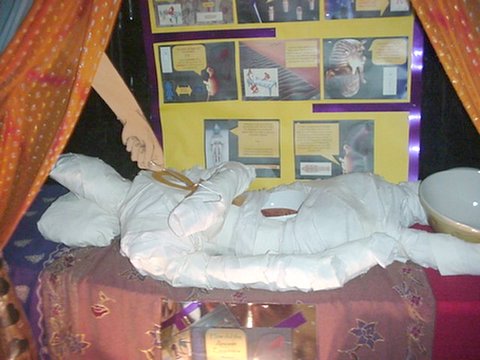
  Posted by Picasa Last day of term I drove to see the culmination of an eight week integrated study based around the theme of Egypt – called ‘Are You My Mummy’?

It was well worth the trip and I spent a couple of enjoyable hours reading, viewing and absorbing the wealth of content the various classes had studied. Just as impressive was observing the obvious pride shown by the young children taking their parents and grandparents around the display to show them the work that they had done. And what I also liked was that all the work was of real artistic quality – the whole exhibition was simply impressive.

Each term the teachers at this school collaboratively plan a theme arising from suggestions gathered from the students themselves about what thay wanted to study. Earlier studies had focused around space and Harry Potter.

These are no superficial studies. The themes involve the whole school and for the first few weeks student work in family groups completing tasks devised by various teachers. This requires the teaching of co-operative learning skills so the older students can assist the younger students. As the study evolves, and as the students get greater depth of understanding, further questions develop and students then work at tasks in their own classes. Inquiry learning skills are learnt as students undertake their ‘action research’ and a full range of information technology is integrated as required. As well some students take on extra homework tasks that they complete with the help of their family members.

The theme was introduced by a mock presentation by teachers of getting a body ready for mummification – complete with body parts provided by the local butcher!

All the work culminates with a two open days and a night for parents and friends. Two spare rooms are converted with student murals based on the theme, lighting, and displays featuring the various topics the classes has researched. This includes a large sphinx, a pyramid with a model mummy inside, a life sized mummification process etc.

A data projector PowerPoint runs continually illustrating research on making pyramids, mummification etc, and computers screen various animations and plays.

A closer look at the displays illustrates the: science of building, model making, jewelry making, Egyptian style art, cooking, making paper, hieroglyphics, model mummified cats, pottery, Egyptian maths, and water clocks. Every area of the curriculum, and every intelligence, seems to be included. The study also asked the students to compare life in their town and ancient Egyptian life. I particularly liked the similarities between the Egyptian ad Maori myths of creation.

Being present is a powerful experience, from the overall effect, to the most intimate detail of each individual students work. Quality in depth learning!

The students have learnt a lot from their study other than content. They have learnt to work together and share ideas. They have learnt 'how to learn' and how to go about presenting their ideas with sense of aesthetic design. They have learnt to value their various strengths. Most of all they have gained in 'learning power' and pride.

And all this in school that a couple of years ago was struggling.

The greatest benefit of might well be in the new understandings about learning, and the power of working together collegiality, that the teachers have gained in the process.

Their pride was as obvious as their students - they are a true learning community

It was well worth the visit and I can't wait to see their next exhibition.

What did you steal from your students today?

  Painting by NZ artist Jan Nigro. Posted by Picasa Many of you will have worked with John Edwards an Australian educator who works both in schools and in the business area. I came across an article he wrote about education for the gifted and talented impressed me and so I thought I would share a few of has ideas.

The thoughts below were inspired by John’s wife asking him, ‘what did you steal from your students today?’ He and his wife then sat down and wrote the following. I have only selected a few of their thoughts but you will get the meassge.

‘If where we go is always the decision of the curriculum or my curiosity and not theirs.
If I always decide on the topic to be studied, the problem to be worked on.
How will they ever know how to begin?

If I am the one who is always monitoring progress.
If bells and I are always in control of the pace and the flow
How will they learn to continue their own work?

If all the marking and editing is done by me
If the selection of work to be published or evaluated is made by me
If they do not have language of self assessment.
How will they find ownership, direction and delight in what they do?

If I speak of individuals but present learning as if they are all the same
If we do not take opportunity to think about our thinking.
If I never openly respect their thoughts.
If I never let them persevere with something really difficult.
If there is no time to explore.
How will they get to know themselves as thinkers?


If the never help anyone else.
If we do not teach them the skills of working cooperativelity.
How will they learn to work with others?

For if they
Have never experiences being challenged in a safe environment.
Have had all their creative thoughts explained away
Are unaware of what catches their interest and how then to have confidence in that interest
Have never followed something they are passionate about to a satisfying conclusion.
Have not clarified how they sabotage their own learning.
Are afraid to ask help and do not know who to ask.
Have not experienced at overcoming their own inertia.
Are paralyzed by the need to know everything before writing or acting.
Have never got bogged down.
Have never failed.
Have always played it safe.
How will the ever know who they are?


So what are you stealing from your students?

I guess the real question is, what do we want our students to leave with so they can continue their learning journey? We need to discuss this with out colleagues.

I think the answers lie in the above thoughts.

The implication for teachers ( not just for those who teach the gifted and talented) is that. ‘Schools and curricula need to be redesigned so that teachers and their students can genuinely rediscover the joy of learning.

Perhaps this is what the new ‘buzz word’ personalization really means?

Wednesday, June 28, 2006

Personalised learning - the reality

  Posted by Picasa If you want to learn about personalized teaching visit a classroom of a creative teacher.

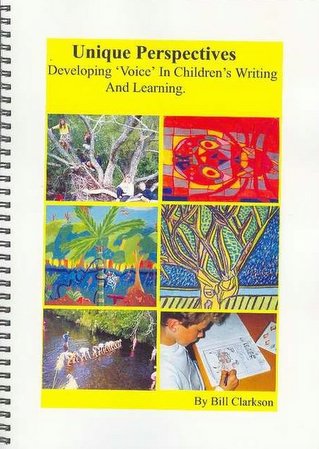
In the book written by my friend Bill he begins by writing:

‘Any classroom programme to be truly successful must value and respect the ideas viewpoints and interests of its students. Similarly the best of learning and its true reward for the learner is always found simply in the context of doing something of interest and doing it well.’

He continues, ‘When children are genuinely engaged in their learning and pursuing things that are of interest or of importance to them the way they will respond will be unique’.

Bill values the idea of developing students ‘voice’. He writes, ‘that if learning is sufficiently personalized not only will unique styles of writing be evident but also unique perceptions and perspectives will be conveyed and unique learning direction will be explored and developed.’

‘What is at stake is crucial to the extent that it may determine whether or not the learner will be able to develop as an independent and creative thinking individual in control of their own identity and their chosen path in life.’

‘It is crucial that a supportive environment is developed: that is, an environment that respects, values and encourages individual thought and expression. However it is important that this environment challenges and enriches, and taps into children’s natural curiosity about their world’

Bill is very much a co-constructivist teacher learning along side the children he teachers to ensure they develop personally meaningful ideas. He quotes NZ’s inspirational pioneer teacher Elwyn Richardson who wrote, ‘They are my teachers as much as I was theirs and the basis of our relationship was sincerity without which I am convinced there can be no creative education.’

If we want to explore the concept of personalized teaching we need to search out such teachers as Bill in our schools and share their insights with others. This is the best way to spread ideas, far preferable to having them imposed by contacted advisers.

Far too much creative work in school is distorted by trying to implement imposed curriculums, an over use of preplanned teacher intentions and pre-set criteria, resulting in work that while it may look impressive lacks the idiosyncratic ‘voice’ and style of students.

It would be a shame if the uniqueness of each individual was lost – if personalized teaching recognize this it would be a positives move.

There is nothing new about personalized learning! It has always underpinned curative teachers approach to learning.

Passionate teaching

  Posted by Picasa Personalized learning values the relationships between the teacher and the students.

It recognizes that teaching is emotional work and is infused with pleasure, passion, creativity, challenge and joy (Hargreaves 95).

It is, as Robert Fried writes, a passionate vocation.

Such an appreciation has been neglected the past 15 or so years as teachers have struggled in implement and assess impossibly incoherent curriculums.

Primary teachers, when asked about their jobs, see it in terms of care and affection, even love. ‘Creative teachers’ (Woods and Jeffery 96) try to generate relationships that create ‘interests, enthusiasm, inquiry, excitement, discovery, risk taking and fun.’ Their assistance given to learners (‘scaffolding’ to use an ‘in’ word) is ‘held together by bonds of emotion.’

This is the essence of personalized learning and we have seen little of it being encouraged the last decades – quite the opposite - it has all been objective measurements of criteria and targets.

The reforms that have been imposed have been all about efficiency rather than effectiveness; cognition above care. As a result important things get marginalized as too hard to measure and learning becomes depersonalized.

For all this technocratic pressure most teachers don’t plan in a linear way but start with their knowledge and feeling about their students and what will interest them – using their intuition to gauge what will engage the learners. Only after this is done do they refer to the official curriculum outcomes to ensure they have an ‘audit trail’ for others to check off. They know it is the teachers enthusiasm and passion that ‘flows’ over to students.

Teaching is a creative act – a personal act held together by respectful relationships. True teaching cannot be preplanned and whatever is introduced only ‘sticks’ if it connects with the students purposes or needs.

As Jerome Bruner wrote, 'Teaching is the canny art of intellectual temptation.'

Personalized teaching is passionate teaching – it about creating positive emotional relationships. It is far more than students gaining achievement or specific knowledge. Such teaching is an art form informed by professional understanding gained from experience, other teachers and readings.

As one wise old principal used to say, ‘Teaching is about 30 plus kids, a good relationship, and doing neat things well.’

If personalized learning get back to such wisdom then it will be great!

I guess the ‘experts’ will tell us what it is – after all they read all the books!

Monday, June 26, 2006

What is this thing called 'Personalised Learning'

  Posted by Picasa The Minister of Education is going to introduce the idea of ‘personalization of learning’ to the annual gathering of Primary School Principal at Napier next week.

What exactly does it mean?

The dream that has underpinned Western society for the last century was 'mass' education for all students up until the age of 15. This has been achieved but for far too many students it has become a 'mass nightmare' with up to 20% of our students still leaving with little to show for their compulsory attendance.

The trouble relates to mindsets.

Early education, for all ages, was built on a simple concept of transmission of ideas from the old to the young – and for many years it only involved the three ‘Rs’ – reading , 'riting and 'rithmetic ( a fourth could’ve been regurgitation). Only the wealthy gained a more ‘well rounded’ education. For most it was simply ‘training’ to fit into jobs required by an industrial society; and for those who failed school manual labor was readily available. Schools, particularly secondary schools, were modeled on industrial factories and run efficiently with bells, timetables, separate subjects and punishment. As a result many tudents today, according to an industrial aged metaphor, are ‘disengaged’.

The introduction of NCEA has softened the failure concept but so far has not changed the industrial structures or 'mindsets'. In many cases it has simply futher fragmented learning but there is potential to be realized.

Progressive thinking, representing a more personalized approach, slowly entered the early years of learning but so far has made little impression on the secondary system. Even in the more 'child centred' primary schools the idea of developing, for each learner, their own curriculums based on their interests and concerns is rarely found. Teachers, and ‘their’ curriculums, still shape the learning of the children in primary schpols and the ‘three Rs’ still reign supreme.

Our Minister, talking about personalization, says the system must become learner centred and that we need to put the learner at the heart of all that is done. This, he believes, is a 'radical' proposal, one that will assist in transforming our (industrial aged) society. He continues, to develop a 21stC culture of continuous inquiry, innovation, risk taking and entrepreneurship, schools need to lead the change.

Personalization, no matter how you dress it up,basically means adapting the school to the unique needs of the students, rather that current practice of making students conform to school requirements - like a modern day 'Procrustean bed' - 'one size must fit all'.

There was a time in the 70 s when this dream shone brightly but it was extinguished by the power of the ‘status quo’ and a lack of appropriate conditions.

Perhaps now, as we enter the Information Age where the new ‘capital’ is the human talent, the time is right. And, as our fragmented Industrial Aged institutions are patently not coping (including secondary schools), personalization is urgent. Added to this is the failure of a 'market forces' approach which has eroded valuable human capital in the name of competition and efficiency. To add to the problem the technocratic top down curriculums, imposed in the 90s, are now seen as failing.

Personalization offers us a chance to throw off the shackles of conformity, control and compliance and to imagine, create, innovate and to do something exciting; a chance to develop the unique talents of all students.

This will require new ‘mindsets’. ‘Mindsets’ that focus on creating condition to assist all students realize their own special mix of talents, passions, and dreams

The concept of personalization will be rather scary for those brought up in an environment of ‘top down’ authority and control. It will require a belief in people, given the right conditions, to do appropriate things and to continually improve. Life in this new environment is always ‘next time’.

It is pretty obvious that some people (both teachers and parents) will find this hard to accept or to cope with.

I guess there will need to be a transition period. At first teachers could listen to their students ‘voices’ and begin to value their questions and current understandings. Such teachers will 'evolve' into learning advisers, or ‘coaches’ and come along side their students to help each learner ‘co-construct’ their own meanings.

It will become obvious that both teachers and students will need to work in teams sharing their creative intelligences and that school structures will need to change to allow this collaborative approach to happen. When modern information technology is added to this mix learning will be 'amplified'.

True personalization will only occur when each student is assisted to develop their own curriculum – their own 'individualized learning plan'. This does not mean students will work alone but that they will balance individual inquiry with group or team projects. It does mean that students need to study topics of interest in depth and express, or communicate, their ideas in range of creative ways to a wider audience.

Curriculum and tasks will ‘emerge’ from student’s questions, concerns and queries. Teachers and students, utilizing community resources and expertise, will become the norm as school turn themselves into democratic ‘learning communities’.

There are schools, at all levels, that are already doing this. It is tapping into, and sharing their expertise ,that will be the key to transformation, not ideas imposed from the top.

This would be ‘radical’ transformation. Let’s hope 'personalization' captures our imagination. It is a chance to help each learner be the best they can be. It would make both teaching and learning ‘stretching’ and fun.

It would require leadership and courage at all levels – none the least the Ministers.

You heard it first on Bruce's Blog!

The Minister to give a major speech on Personalised Learning at the Primary Principals Conference this weekend!

All I can say it is about time for a new 'direction' - or is it a 'blast from the past' - a case for creative teachers of 'deju vu'. If it is 'back to the future' this time we need to do it properly. And this time it needs to reach the secondary schools! It was at best a 'half finished revolution' in the 60s and 70s!

After years of neglect the Minister is going to dig up the 1939 vision of Peter Fraser and Dr Beeby and give it a fresh take. Yippee!

Time to dump all those silly current curriculums with all their idiotic levels and learning objectives. Down with the technocrats! At last the Ministry ( or their researchers) have caught up with what real learning was always all about!