Monday, January 14, 2013

Elwyn S Richardson 1925 -2012 Creative teacher.


On December the 24th Elwyn Richardson, New Zealand pioneer creative teacher died. Richardson was born July 8, 1925.
Elwyn was an inspiration to teachers who were interested in a creative approach to learning. I first learnt about Elwyn in the early 60s, first by reputation, and then through his book ‘In the Early World’ published by the NZCER in 1964.
In the sixties there were a number of NZ teachers experimenting along the same lines as Elwyn. In the UK, there were also teachers interested in freeing up the traditional curriculum. In 1969, in the UK, the Plowden Report was published which gave ‘child centred’ education official approval. In the late 60s I worked with local teachers whowere integrating their programmes placing first hand experiences and thecreative arts central. At this time I made my first contact with Elwyn - the beginning of a long association.
A little background about Elwyn. He applied for the remote country position at Oruaiti School in 1949 largely because of its distinct fauna of sea life, but also because the sole-charge posting offered him the opportunity to work out his own ideas about teaching and learning alone. .
Elwyn’s educational philosophy was based on the belief that all real learning must be anchored in personal experience. It was this conviction that provided the foundation for his developmental approach to education. Central to this was his theory of integration, a personalised process whereby children moved from one expressive medium to another, between all subject areas. Richardson’s theory of integration was informed by his conception of artistic ability as a universal human attribute, his well-developed ideas about the nature of artistic development in children and a firm belief in the learning potential of every child.
 At Oruaiti School Elwyn discarded the official syllabus and turned to the children’s lives and immediate environment for the basis of his curriculum. Using the children’s natural curiosity and interest, he taught them how to observe closely the world around them and to record their new discoveries and their own responses to these. From here, he developed a school programme that was anchored in the children’s surroundings and real lives. Through environmental studies the children learned the basis of scientific method, and brought these skills to bear on studies that spanned all subjects. His method was a revolt away from science as a separate subject to an integrated programme of arts and science.
Elwyn’s book ‘In the Early World’ was published by The New Zealand Council for Educational Research NZCER in 1964. The book tells the story of how his students became increasingly aware of their own capacity for personal expression, while collectively establishing a shared understanding of aesthetic values.

The book was well received by the New Zealand educational establishment and widely taken up as a text by teacher training colleges in New Zealand in the 1960s and 1970s. Joseph Featherstone former professor of education emeritus at Michigan State University, reviewed the book and stated, 'it may be the best book about teaching ever written.' Following Featherstone’s review Pantheon Books published a Canadian and an American edition simultaneously in 1969. The book was praised by international reviewers. British writer and musician R. W. B. Lewis wrote, 'Not only does this book point to a new direction in education, its very existence is a landmark in the recognition of human potential and dignity.' Over the next decade Richardson and his school became an international symbol of progressive education in New Zealand with a particular focus on arts and crafts.
 A third edition witha new foreword and a twenty page appendix of children's art work has beenpublished by NZCER  June 2012.


The new edition of Elwyn's book.
I was invited to attend the opening in Auckland – it was to be my last contact with Elwyn.  

In the forward to the first edition of Elwyn’s book John Melser wrote that the book, ‘gives a vivid picture of a school full of vitality in the pursuit of values deeply rooted in the children’s lives and capable of serving them lifelong’. ‘Oruaiti School’, Melser continues, ‘functioned as a community of artists and scientists who turned a frank and searching gaze on all that came within their gambit. Curiosity and emotional force led them to explore the natural world and the world of their feelings…..Studies and activities grew out of what preceded them. New techniques were discovered and skills practiced as each achievement set new standards.’
Elwyn’s role in achieving personal and artistic excellence was a delicate and encouraging one, always humbly ready to learn from the children. Elwyn has written elsewhere that ‘the children were his teachers as much as he was theirs’. The results were certainly not the standardization of product that one sees today. Believing in high standards  Elwyn  believed  each new creative product mattered as much as the process.
Elwyn, along with all the other creative teachers I have had the privilege of working with, responded to all children’s efforts and achievements with sincere interest and pride. His book is a testament to his love of children’s ideas and imagery and, the respect he gave their work, respect that was returned in kind to Elwyn. Elwyn gave his students Melser writes, ‘an opportunity to reach their full heights as artists, as craftsmen, as scientists, and as students’ in a ‘community of mutual respect’.
Unfortunately since 1986 the winds of change worldwide have sent school off in another direction towards standardised education -an approach that undermines the very creativity and diversity that New Zealand educators had gained world-wide respect for.  Unfortunately, in recent decades, 'experts' from outside the classroom have become the sources of ‘official’ knowledge and this has led to a reduction in the importance of those creative teachers. This is a shame.
It is time for schools to return to believing in the importance of creative teachers as the source of lasting change.  Teachers will need to work together (they now have the technology to do so) to articulate a set of beliefs for the new century - one thing that they could do is get behind the almost side tracked 2007 New Zealand National Curriculum.
The new edition has a hard hitting forward written by educationalist.  Gwenneth Phillips.
Gwenneth writes  that the book comes at an opportune time as the current government is finally showing its true 'market forces' neo liberal competitive ideology with its intention to introduce 'League Tables' based on National Standards data to encourage competitionn through students and school comparison.
 Schools she believes now have a moral dilemma - to comply to such impositions that will narrow the curriculum and encourage teachers to teach to the tests and the side lining of the creative arts, or  to be creative. Ironically countries that have imposed such approaches are well behind New Zealand in international testing!
'Times have changed,’ Gwenneth writes,’ educational decision making has shifted from such innovative educators to non-teaching politicians and policy makers; and in the classroom from practicing teachers to academics.'
‘This new guard of decision makers' Gwenneth writes, ‘juggle political, fiscal and/or research agendas’. ‘Teachers’, she writes, 'have long struggled with the conflicting demands.....in particular the demands for accountability- based on the precise articulation of outcomes as well as their measurement. As a result, the basic tenants of our unique child-centred approach...have been compromised.....the child's creative power has been strangled and the child marginalised'.
One might add so has the creative power of teachers and creative schools.

'An old challenge has re-emerged. How can we put the lives of children and our trust in their creative power back into classroom practice?' And how can we develop trust in teachers to be creative in our present risk averse surveillance culture!
Gwenneth believes this new edition of Elwyn's book is both timely and important, for this challenge is at the heart of present debate. It presents a backdrop to current issues in education and to teachers' concerns - the narrowing of the curriculum, the setting of externally prescribed adult motivated progressions and outputs that neglect the developmental nature of learning'.
Elwyn's student's success was sustained by the knowledge and professional artistry of a caring teacher who esteemed the voice and thinking of the children. As Elwyn himself wrote, ' they were my teachers as I was theirs, and the basis was sincerity, without which, I am convinced, there can be no creative education.'
The ways of working captured in Elwyn’s book are 'in stark contrast to that have emerged in the last decades. Current ways are based clearly articulated and predetermined pathways. The children are forced to state goals and are evaluated through criteria and standards that conform not to their own understandings of themselves in the world, but by expectations dissected from the forms and structures of adult thinking.' These approaches, Gwenneth writes, 'are the antithesis of child centred approaches. They marginalise children and show little respect for their creative power to develop their own life-learning pathways'
The choice for schools is clear: Standardisation of learning or personalization that celebrates every student’s unique gift and talents.
Unfortunately many schools are well down this imposed formulaic 'best practices' approaches. Gwenneth writes, 'for many teachers, especially primary teachers, the knowledge and professional artistry of their child-centred practice has been usurped; the courage and tenacity of the pioneering spirit stifled; and the recognition and trust of the child's creative power has been undermined.'
'In The Early World, together with the stories of other early pioneers, tempered with new insights...has the power to inspire a '"new" guard of educational pioneers'. It is a book that 'celebrates the pioneering spirit of New Zealand teachers'
Creative teaching is not new it has just been side-tracked.
Elwyn remains as an inspiration of what can be achieved if we want to develop the talents and gifts of all students.
I recommend that all schools acquire a copy of the latest edition if only to show what could have been.

Sunday, January 13, 2013

The End of Education


I came across this article and it resonated so much with my thoughts I have posted it as a blog


(Cite This Article as: Teachers College Record, Date Published: February 06, 2012)

Our current test orientated system

by Russell Hvolbek — February 06, 2012

I argue that as we absorb the socio-economic values of our age, an age ruled by business, we have drifted away from what we in the educational community should be doing: teaching students to think, to see, to read, and to write.
Education as a dwelling in the human experience of reality is ending. As with the Roman Empire, it is ending with a whimper, not a bang.
The root of the problem is that we have absorbed the socio-economic and intellectual values of our age, an age ruled by business and science. The pragmatic values of business and science have become the values of our educational practices.
 Within these two orientations there is little understanding of and no place for the life enhancing studies of philosophy, history, literature, and the arts. Today we train students. A practical utility determines our thinking.
Pragmatic and useful things, of course, are easy to evaluate and quantify, but when the useful is quantified it precipitates a judgment: 5,500 square foot houses are superior to 1,500 square foot houses. An “A” is superior to a “B” and an “A” student is superior to a “B” student. Measurements. Judgments. The accountant’s truths are what are now deemed important.
That the accountant’s truths seem clear and distinct to us is a statement about the seriousness of the problem. For such ideas have become our common sense. The objectifications we now deem as truths are merely the dominating judgments our age. We have forgotten that they are all based upon ingrained and unanalyzed prejudices, and that every judgment is a statement about the values of the person making the judgment. Today we have fallen in love with objectively quantifying reality and see it as a solution to our problems. Today students are judged and judge themselves based upon such pitiful scales, the scales of measurement.
Moreover, the goals of business humans are to make money and do it as efficiently and quickly as possible. They desire exact facts and data to help them make money. Business humans live for a goal.
We have created educational institutions that do the same. We have reduced education into a goal, a goal that is antithetical to education itself. Our educational practices are ruled by haste, guided by the belief that acquiring information is important, but simultaneously and contradictorily that the information serves a higher end, viz., getting a good grade; which in turn serves a higher end: getting into college; which in turn serves a higher end: getting a good job; which in turn serves a higher end: getting a house on Mullholand.


The trouble with targets you don't notice the ones you miss.


This prevents students from entering into the process of learning itself. They are taught to learn information for a reason ulterior to learning itself: a grade. This alienates them from the simple joy of learning, an activity that is a process and cannot be quantified. Examinations are reduced to the recollection of data and facts as though disparate data can fascinate anyone, much less be retained.
Learning for an objectively determined social goal has serious consequences: It justifies cheating and lying and deceptions of all kinds. Why not cheat if the only concern is the grade?
There are personal consequences to this orientation. Since we all become what we do, when we cheat, lie, and deceive for our goal, we become cheaters, liars, and deceivers in quest of our goals. Barry Bonds ended up playing baseball for the record books, not for the love of the sport. Cheating the system was justified and rewarded with fame and the money that our social and business values dictate as our ultimate success.
The reduction of things to the quantifiable and to an end makes shallow a world that is deep; it makes dull a species that should be complex; it makes unthinking, uninvolved humans; it reduces human life to quantities: more money, more fame; more things, higher test scores. We aren’t interested in education; we are interested in getting things out of what passes for education.
Strangely, even in educational institutions the word education is not analyzed. It is a word that everyone believes they clearly understand. Like the words love, spirit, evil, justice, the word education fits easily into each and every culture’s biases, into each and every human’s prejudices. Thus it flits between being used by anyone and everyone for their own benefit.
The German philosopher Friedrich Nietzsche, responding to what he saw as the dismal state of education in Germany after Bismarck unified the Reich, writes that an education is learning to see, to think, to read, and to write.
These are fundamental and powerful words, and they can be applied to any subject in the educational curriculum. In every subject students need to learn how to see, to think, to read, and to write.
Let us think about these words. They are all verbs. They are not like our goal-oriented cultural assumptions about education that posit goals as the point of education. Verbs are not closed, exact words. They are not facts, and they are not mere information. Verbs designate activities. This means that education is an activity, a process, and an ongoing involvement done for the sake of the involvement itself. When one applies oneself to this task, this thinking and seeing what thinking and seeing might be, one is in the process of being a student. One begins to get an education when one initiates the process of seeing and thinking.

( Seeing learning as a verb, a 'doing word', is in line with an important phrase from the currently almost sidelined  2007 New Zealand Curriculum  - students should 'seek, use and create their own knowledge'.) 
Nietzsche elaborates by writing: “to see” means “accustoming the eye to calmness, to patience, to letting things come up to it postponing judgment, learning to go around and grasp each individual case from all sides … not to react at once to a stimulus, but to gain control of all the inhabiting, excluding instincts. Learning to see, as I understand it, is . . . called a strong will: the essential feature is precisely not to ‘will’—to be able to suspend decision.” In education, haste is not the path.
Thus education in all matters demands openness to the other and not imposing a knee-jerk opinion upon the subject matter. The subject must be allowed to teach the student.
When one learns to see one will have become altogether “slow, mistrustful, recalcitrant. One will let strange, new things of every kind come up to oneself.” Seeing is to lie “servilely on one’s stomach before every little fact, always prepared for the leap of putting oneself into the place of, or of plunging into others and other things.”
Seeing allows oneself to be struck by the seen, the other, the flowers, the poem.
In this sense, seeing requires that we forget the name of the thing being seen.
All objectivity is bad taste, merely a symptom of one or another prejudice. The businessman may want objectivity. The student wants nuance.
Thinking, writing and reading are separate but similar skills that must be learned. “Thinking wants to be learned like dancing, as a kind of dancing.” “One must be able to dance with one’s feet, with concepts, with words.” Writing is learning to dance with a pen, a brush, a basketball, on a wrestling mat or on a soccer field. Reading is learning to dance with a text, a mathematical formula, a technique, a physics equation, an atom.
What a strange point! Dancing? Reading, writing, and sports are a type of dance? Yes. Dancing is relating, it is being moved by the other and moving with the other. Dancing is a relationship of movement, a relationship of evolving steps and meanings. Education is an evolving dance with intellectual ideas.
Learning like dance unfolds with experience
In conclusion, the fact that students are not getting educated is not their fault. They were weaned into these socio-cultural values. Students are not participating in their education. Students are being trained to live for goals and new electronic devices. Goals have become a narcotic that society accepts as education, which they are not.
Education is not chasing a grade. It is not chasing a college or a job. If you do that you may get what you want, an “A” or a “B,” but you will never be educated. An education is a process. It has a beginning but no end. It continues throughout life. It is learning to see and think.
Ultimately an education is a deep unfolding involvement with life here on earth. The deeper the involvement in seeing and thinking, the more complex is the dance in which you participate.

(http://www.tcrecord.org ID Number: 16686, Date Accessed: 12/28/2012 3:42:07 PM)

Thursday, January 10, 2013

New bush track - all but finished!

Adding finishing touches.

Plant life will grow back to walkway
Looking out over parataniwha swamp.

Wednesday, January 09, 2013

New Bush Track - half completed!

Bridge across stream

Two or three years ago I arranged for my cousin Hillary's husband Rodney ( a hard working farmer) to continue  a bush track that finished in a dead end. To use this track you had to be wearing gumboots to get through patches of swamp! Due to difficulty few people made the effort to enjoy the experience.

Bridge over  swampy area
When I first bought my bush valley home the previous owner ( a landscape gardener) told me it was a 'wilderness' garden. Years later I realized that I took him far to literally and over the years have had to remove a number of trees to let the light in.

Wood ready to make walkway
Hostas in early Spring
Now that I have past my 'use by date' as an educator I have become focused on developing my garden as well as taking up painting - but that's another story.

When visiting friends in the UK last year we visited Charles Darwin's house in Kent where I was impressed with a walk he established for contemplation - he placed 20  flint stones and kicked then off one a time until all finished then he went inside to write,

In my garden close to the house I have established hosta planting - plants that really enjoy the shady situation and there are a wide range of introduced trees and shrubs but it was the bush that originally attracted my attention.

The first track we completed runs along the side of a steep hill and features large puriri, tawa  , mangeo and pukatea. Rodney ( with the help of Hillary) cut a new track down to the stream and Rodney built two bridges to cross the stream and two  duckwalks through  swampy areas.  Now the track is a reasonably easy walk.

Duckwalk through swamp
The track,  now under construction, makes a loop walk through the best bush  and swamp on the property. The original owner had planted a wonderful range of native trees to complement the original pukatea, kohekohe, rewarewa  and mature mamaku tree ferns. The planted natives  include rimu, kauri,totara, tanekaha, kowhai and maire. Para ( or king or horseshoe fern) and silver tree ferns are also a feature.

When completed the two tracks will join together to make a figure eight walk.


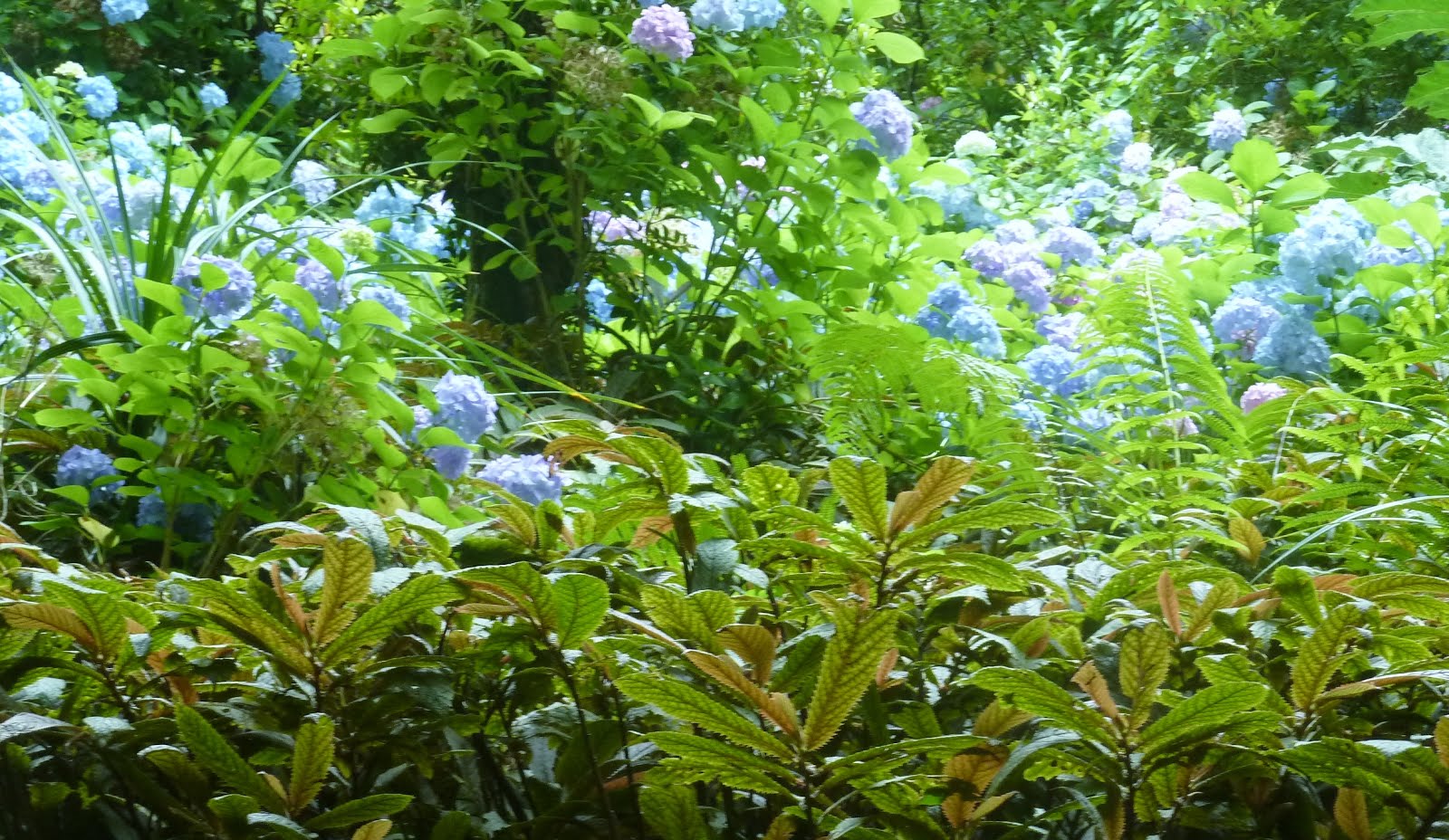
View across parataniwha and hydrangea in swamp
If all goes well  I will celebrate my next birthday with a bush track opening.

Thursday, December 27, 2012

Christmas Time - a season of excess? The engine of consumption.

Christmas has come and gone for another season.

More than we can eat - or afford?
I had a very enjoyable and stress free Xmas. Lovely breakfast with the family arranged by my daughters in one of my daughters new house. I followed this up with ham and buns at a musical friends place  so it was pleasant to listen to the guitars.  Then out to the beach for the evening meal and swim. Couldn't have been better. Even got some great presents - new frying pans and gumboots!

Simple pleasures
But it all makes you wonder. This year lots of people needed help with their budgeting and Christmas meal. And lots of people will have to face up to debts incurred which will be stressful. Ironically this is the season of increased family violence as well.

Humble beginnings
As an aside the Christmas (Christ's Mass) celebrations have an interesting and somewhat confusing history. It is a shame that schools are closed for the summer break because there are a lot of questions for children to research. How did Christmas evolve? How did Father Christmas get involved?  Why is he also called Santa Claus? Who was Saint Nicholas? Why do we have a big feast, give presents and decorate a tree? Where did the idea of a conifer tree come from? When did cards begin to be sent? Why holly, mistletoe and ivy? And what is the origin of  Boxing Day

It would be interesting  for students to learn about the mix of  pagan pre-christian and religious origins involved in Christmas. What questions and views do children have about Christmas?


Chandran Nair
To be honest the issue of Christmas as a season of excess consumption has been brought to my mind through listening to a radio replay of a talk about 'Consumptionomics - Asia's role in Reshaping Capitalism and Saving the Planet'  given by Chandran Nair  at the 2012Auckland Readers and Writers gathering .

Christmas is the peak season for retailers. In the USA a quarter of all spending occurs during the season and Boxing Day has evolved into a shopping day with the greatest turnover of any day.

Chandran Nair's point is that if the Asian countries consumed goods at the rate of the West the results will be catastrophic across the globe as nations scramble for diminishing resources.

He feels that this issue is important as failing Western 'market forces' countries are encouraging Asian countries to consume more to help save the global economy. It will be like Easter Island on a large scale where competing tribes felled all the trees in a competition to roll their huge monument into place.

He believes Asian governments find them selves at a crossroads. They may take up the challenge to consume to the level of Western nations or take the responsibility of leading the world to a more sustainable path. It is message for New Zealand as well who, he thinks, could be a model of a sustainable community.

Do they need the American dream?
For Asians to aim for the 'American Dream'  is neither desirable or even possible. Imagine, he asks,  all the resources that Asia would need to bring their citizens up to the consumption level of the West? Imagine the results if all Asians became middle class consumers  . If the Chinese and Indians used as much energy per capita as Americans use their total power consumption would be 14 times as great as the United States! Take cars. If Asian countries reached Western levels their could be 3 billion cars in the world. Where would the fuel come for all theses vehicles? Similar calculations can be made for everything we take for granted in the West - even Christmas turkeys!

So, he believes, Asian governments need to reject the views of those who urge Asians to consume relentlessly - free markets, faith in technology and hope for the best is not a plan.

He is not arguing that Asians must remain poor , nor is he against economic development, or capitalism , or democracy. He is for 'contstrained consumerism', funnelled in a way that does not deplete the demand for resources that in turn depletes the environment.

 Asian governments must prioritise and provide incentives to use fewer materials. Management of resources needs to be at the centre of all policy making if consumption habits are to be changed. Efficient public transport needs to be in place to replace cars and motorways - a lesson for New Zealand. This move away from today's extreme capitalism could mark the start of a new industrial revolution.


How many cars are too many?

To achieve this will require strong and bold government interventions especially to combat vested interests. Such measures must be supplemented by 'draconian rules' constraining consumption of a range of goods , particularly fossil fuels, fisheries and forest products. It will require massive investments in public infrastructure to give people the transport, water and sanitation, health and education services badly need in Asia. Food, security and safety must be a priority.

Chandran Nair knows this will not be easy particularly for countries influenced by Western economics  who believe prosperity can be achieved through conventional forms of consumption driven economic growth.

Collective welfare and a 'hands on' state is preferable to the destructive current ideology of  less government and a 'free for all' unbridled market economy resulting in few greedy winners and lots of losers.

He concludes , 'if the governments of the region can rise to this challenge, it will be the decision makers in Beijing, Delhi and Jakarta that will determine whether our world has a future - not , as it has been for the last two centuries, the capitals of the West'.

Cutting back on Christmas excess might be a start for us?

Maybe looking after the needs of all people, particularly those living in poverty, would be a return to the true spirit of Christmas?


Sunday, December 09, 2012

End of year class survey

 
My fifth most popular blog is one about the end of the school year so here it is again -slightly amended.  There might be an idea that you might find useful?
Norman Rockwell painting of a classroom in the 50s
At the end of the school year it is a good idea to gather information from the students you are passing on. Not only is this a chance for you to get some insight about your teaching but it is also a great way to value the ‘voice’ of your students. 

It  is also a good time for the students (and the teacher) to reflect on what has been achieved. This is preferable to letting the end of the year become 'fill in' time. As a principal I always encouraged teachers to work right up to the last minute. I had learnt, from experience as a teacher, that working hard is easier than improvising programmes the last week or so

One idea would be to develop a  mini-unit of work with the students for them to reflect on  their own achievements. Not only will this bring a sense of closure to the year but it will help the students develop a sense of accomplishment and an affirmation of their years efforts. One theme could be, 'This is what I could do at the beginning of the year and this is what I can do now', or, 'Things I am most proud of this year'.

The class could 'brainstorm' all the activities they have studied throughout the year. It would feature all the exciting content studies that have provided the 'energy' for the years student research and creativity. This in itself will remind the students of what an interesting year they have had.

A display, featuring artifacts from the various studies (and maths and language themes), could be developed with information on the 'big ideas' of each study.

Students could develop their own wall display, or chart, of things ( say, the top six) they have learnt during the year. This could include, not only ideas, but also poems and pieces of art. Digital cameras would be useful to capture visual information. An idea would be to develop a 'My Reflections and Memories of the Year' booklet, or 'Things I have learnt during the year', or 'Things I am most proud of,'or 'Talents I have developed during the year'.

Students might also like to include their thoughts and hopes for the year to come - this might involve questioning older students in the next class to gather 'data'.

One valuable idea ( really an evaluation of the culture the teacher has established) is to ask the students to write, for next years students, 'How to survive in this class', or 'Tips for New Students'. This might include ideas,to  you, as the teacher, about how to improve the programme for the next year, and even things that students felt were not useful to them!

We really loved the bush walks

Ideas for students at the end of the year to consider

1. What have been the best things you have done this year? Why? 
2. What would you liked to have done more of this year? 
3. What didn’t we do that I wish we had? 
4. In what way have I changed this year? What areas have I improved in, or grown to like more? 
5. What were the things I didn’t like most this year? 
6. What would you change about how I teach or the class? 
7. If you were giving advice for next years students of how to survive in style in my room, what would you say to them? 


Below are some interesting sentences for students to finish that will give you some idea of how they see schools, teachers and themselves.  What metaphors would they choose?

A school is a place where…………….. 
A teacher is a person who………………… 
A student is a person who……………… 

It is interesting to see what metaphors students come up with  if they see themselves as learners or someone who is taught things.  For the first :do students see school as a place they have to go or a place they go to learn? For the second is the teacher a person who tells you what to do or is teacher a person who helps you learn? For the last is students some who is taught by teachers or a person who learns with teachers' help?

Try it. You might be surprised. You might even learn something.


A class newsletter to all parents , based on the reflections of the students, would be a great way to finish the year on a positive note.

Saturday, December 08, 2012

Educational Readings : Marion Brady, Cathy Wylie.


By Allan Alach

Another week, with the end of year approaching fast. New Zealand and Australian primary teachers are in the ‘gritting teeth and hanging on to the end” stages of their school year, with a well earned break looming. Because of this coming break, this is the last education readings posting for 2012. Things will kick off again towards the end of January. Wouldn’t it be lovely for 2013 to see the end of GERM so that we can focus on what really matters - the children!
 

I welcome suggested articles, so if you come across a gem, email it to me at allan.alach@ihug.co.nz.


This week’s homework!


How Bad Can It Get?

The ultimate in ‘paint by numbers’ education.

“Perhaps the greatest evil of high stakes standardized testing is that it takes our eyes away from the children and focuses them instead on the tests themselves. Children become sources of data. Learning becomes something that is cut, sliced, packaged and weighed.

Until we rid ourselves of this impediment to education and find valid, humane, child centred forms of assessment, testing will continue to STOP our children from learning.”


The Common Core Kool-Aid

Ultimate aim of common core standards (aka national standards) is to prove how poorly schools are doing and therefore justify reform. Sounds plausible to me.


Nine questions about ’21st Century curriculum’

Another gem from Marion Brady.


Schools Ditch The Classroom To Put Play Back In Education

There is still hope - this is from USA. More evidence for politicians to ignore.

“At the PlayMaker school, don’t be surprised to find kids in a workshop or playing a game, just not in front of a chalkboard. It’s part of a new movement that is attempting to make education more fun--and work better.”


Teachers' pay rises pegged to performance

England today, down under tomorrow?


In a similar vein..

Seven Myths of Performance Management


A+ Schools Infuse Arts and Other 'Essentials'

Self explanatory!


Cathy Wylie outlines new wave of change for New Zealand Schools!

Here’s Bruce Hammonds’ review of Cathy Wylie’s book that analyses the so-called “Tomorrow’s Schools’ neo-liberal schooling system that was instituted in 1990. While there were ‘plusses’ from this, Cathy suggests that there were more ‘minuses’ and that revisions are needed. While NZ focussed, there’s plenty here for overseas readers.

Wednesday, December 05, 2012

Cathy Wylie outlines new wave of change for New Zealand Schools!

Time for a new wave of change!

In the 1980s a new political ideology swept through Anglo American countries. It was a time of dramatic change as the democratic welfare state was replaced by  what has come to be known as a ‘Market Forces business oriented’ approach based on small government, valuing self-interest, privatisation, competition, choice and accountability. This neo liberal approach was believed to be the only way to cope with dramatic worsening worldwide economic circumstances. A common phrase at the time was TINA (there is no alternative).
New Zealand was not immune. The recently elected Labour Government led by David Lange was influenced by finance minister Roger Douglas and the Treasury. ‘Thatcherism’ in the UK, ‘Reaganism’ in the US and ‘Rogernomics’ in New Zealand – continued by National’s Ruth Richardson and alive but not so well today!
The new ideology was applied across the public service and education was not immune.
In 1986 an ‘earthquake ‘hit education in the form of ‘Tomorrows Schools’; following the publication of the Picot Report self-managing schools were born.
Now, almost three decades later, A  NZCER  chief researcher Cathy Wylie has written a definitive and compelling story of school self-management called ’VitalConnections: Why We Need More Than Self-managing Schools’. For two background papers: link one - link two
Cathy Wylie
Cathy answers the questions: What was the real effect of ‘Tomorrows Schools’? Has the New Zealand Schools system improved as a result? And what changes are needed now to meet our expectations of schools?
People who were principals during the transition (as I was) will find the book enlightening and younger principals will learn that a lot of shared wisdom was lost in the process.
It is interesting to find that New Zealand was the only country to take self-managing schools to such extremes of local control and now Cathy believes that we have ‘made self-management into a barrier’ if we want all students to be treated equitably. Keep in mind our growing ‘achievement gap’.
The impression given at the time was that the then system was too bureaucratic, too centralised, to allow school flexibility and initiative.
An early chapter Principals  focuses on the situation before ‘Tomorrows Schools’. Contrary to the myth  being spread by those propagating change schools enjoyed considerable latitude in comparison to other education systems. They had on-going connections with the inspectorate, the local advisers and curriculum experts in the Department of Education and teachers often belonged to networks of teachers developing and trialling new ideas.
Inspectors and advisers could ‘connect individual teachers with expertise ….. They knew where good practice was occurring…they could identify and encourage talent’. All schools had liaison inspectors and inspectors arranged for teachers to visit other schools and to develop and share ideas. As a result there was a healthy cross fertilisation of ideas. As Cathy writes ‘they could connect the dots’ and ‘foster collective strengths of teachers working together’.
An OECD report in the early 80s was full of praise for existing educational provisions and did not find people wanting dramatic changes and was impressed with the engaging and active learning that keeps children motivated to learn. New Zealand students do well and still do, in international testing
But there were shortcomings. There was no national systematic way to support schools. The locally elected Education Boards looked after property and finance while inspectors focused on educational issues. Both were involved in principal and teacher appointment. There was growing concern with the failure rate of Maori students, communities were not fully involved with their schools and a growing number of students were not being catered for in secondary schools as students we were encouraged( by lack of jobs) to stay at school longer.
Education Boards and inspectors disappeared in the change and advisers placed with College Of Educations (later Universities) and employed on contract. In the process connections and collective wisdom was lost.
So where was the bureaucracy and over centralisation that was blocking the initiative and creativity of the system? It was in the regulations to do with staffing, with property and with resources for teaching. ’Tomorrows Schools certainly had its attraction when it came to these issues. Responsibility for such areas really appealed to principals.
‘Tomorrows Schools’ would tackle bureaucracy but this came at a price. Key interconnections were lost. Schools and Boards were on their own and this would create winners and losers.
An overseas observer described the New Zealand approach as the ‘earthquake method of educational reform’. Teacher unions were excluded. Changes were less to do with educational reasons but with political determination to restructure the economy and the role of the state. David Lange, as Minister of Education, at least did not allow education vouchers or privatisation to be part of the mix.
It seems there was not much thought given to the infrastructure needed to support the self-management of schools and the sharing of useful ideas. The general tenor was that schools were to be left to make their own decisions.
What eventuated was at best ‘fragmented freedom’. Schools in ‘better’ environments had the local expertise to do well but self-management was ‘sown on uneven ground’. Principals and BOTs learnt ‘by the seat of their pants’ and became occupied with compliance and the ‘demanding twins’ of property and finance issues and less a focus on teaching and learning. Competition between schools – the result of an emphasis on parent choice had unfortunate effects. Some schools ‘had the upper hand’. As a result self-management put one’s own school first.
The years that followed were demanding as the Ministry chopped and changed to keep schools viable. It was an era of ‘CRAP’   as the Ministry and ERO ‘continually revised all procedures’ Charters came and went. Strategy and annual plans were introduced. Growing problems with failing schools resulted in a number of safety net interventions. The introduction of the New Zealand Curriculum was rolled (and NZCEA in secondary schools) added to the confusion. Schools were clustered but schools took only what they needed. ERO were ‘the watchdog and scold’. The new curriculum with its endless objectives, and arbitrary levels, was a ‘mile wide and an inch deep’ but conscientious teachers did their best to tick off objectives taught. ERO ensured they complied.
And for all this, the very students, who were to be saved by self-management, still continued to fail. Literacy tasks forces were established and Numeracy projects, and other ad hoc projects, to try to help failing students.
Benign bureaucracy had been replaced by fragmentation – out of the frying pan into the fire! ERO and the Ministry worked in isolation. The Ministry has become risk averse. It needs a more effective engagement with schools but there is no longer the trust necessary.
The ‘too hasty and undercooked’ National Standards, a throwback to earlier days, are being imposed – the worse sort of centralisation and schools were bullied into supplying their data to the Ministry. Ironically schools that resisted were showing initiative and developing the creative programmes (based on the revised Labour introduced 2007 New Zealand Curriculum) that underpinned the ethos of self-managing schools. On the horizon lie league tables and national testing – issues that will narrow the curriculum and encourage teachers to teach to the tests and down play the creative arts.  What is to be measured will become the measure – will become the default curriculum.
The time has come for fresh thinking. We ought not to have asked schools to stand alone without being part of a supportive school district. Other countries have shown the success of supportive infrastructures to both support and share ideas. Schools can no longer work in isolation reinventing the wheel – too many schools ‘do not know what they do not know’.
The current focus on school failure, the ‘achievement gap’, has increased markedly as a result of market forces ideology which has widened the ‘winner loser’ gap. Schools can always do better but can only be truly successful if a more communal narrative (ideology) replaces the current emphasis on self-interest.
Cathy concludes her book with some hard hitting recommendations.
Schools need to ensure all students succeed to realise their unique set of gift and talents, equipped with the learning competencies to thrive in the uncertain times ahead. ‘The current New Zealand schooling system,’ Wylie writes, ‘cannot meet these expectations’. We have not been able to make the best about self-managing schools…..Tomorrows Schools has certainly enhanced school initiative…..(but) on their own they are not sufficient to improve educational opportunities and outcomes across the board…..it has been too uneven. It has yet to reach all students. Our system lacks the national and local infrastructure of connections to share and keep building effective teaching practices so that schools can do what we ask of them…The Ministry has largely played a hands off role’ providing one size fits all solutions relying on ensuring schools comply to regulations.. Between 16 to 20% of schools struggle each year’.
Schools need the’ opportunity to learn from their peers in other schools…There is an unmet need for cross fertilisation that the inspectors and advisers once played, such as arranging inter-school visits so that teachers and principals can see more effective practices and have the opportunity to discuss how these practices work, how to bring about change’.
‘We need a fresh approach. We need to construct a network of education authorities that support and challenge schools….in ways that make more of the schools than schools can make of themselves – ways that nurture the capacity of schools to self-manage. ‘We haven’t the time or the money to reinvent the wheel.’
The current fragmentation of government agencies are counterproductive. ‘The past 33 years have shown limitations of positioning each school as a separate island. It will be connections that increase the effectiveness of our schools.’ What is needed is ‘integrate the key strengths of what was lost with Tomorrows Schools….This means more than tweaking our current structures and ways of doing things. It means changes in the government agencies and some changes for schools and boards… I suggest more challenging support at the local level, more connections to share and build knowledge and more coherence between the different layers of the schooling system.’
Such connected infrastructures will make real difference.’ We have the experience and knowledge now to create the more dynamic schooling system that our children need. It is time to give all our self-managing schools the vital connections, support and challenge they need to succeed.’

(To appreciate the full message best to read the book particularly the recommendations)