Wednesday, February 09, 2011

Mavericks - our only hope!


Since Tomorrows Schools of the 80s we have relied on distant experts and, worse still, politicians to determine what goes on in our classrooms.We seem to have lost more than we have gained. And most of all we have lost the insight of creative teachers past and present. And no one trusts Ministry experts.

As I was gathering material to write an article ( on the importance of the arts) it brought to my attention the importance of creative individual in any areas of human endeavour.

And as well, by gathering up resource material, it also made me reflect on the creative process - a very messy one indeed. Not a process liked by the technocrats who like to define and measure predetermined progress.

The creative process begins with some kind of vision of the finished product but whatever eventuates might, or might not, resemble the original vision. This is the essence of creativity -being open to opportunities as they arise but aways keeping the end( more or less) in mind.

And it is this creativity that we need if we are to thrive In the future.

Currently we are heading in the wrong direction with the imposition of standardisation, the current surveillance culture, and an obsessive testing of what can be tested. Most schools are in an educational no mans land unsure in what direction they should take. In such confusing and ambiguous times it is time for mavericks to be valued. Or rather for mavericks to do what they do best!

Does your school benefit from the talents and energy of the 'maverick' or does it seek to restrain them?. The following is based on material written by Pat Heenan of the Centre for Leadership Excellence , Education Queensland 2000 that I found in my search for my article on the importance of the arts .

New Zealand was settled by courageous creative Polynesian and European adventurers prepared to risk all for success in an unknown world. Not for then complying to bureaucrats sitting at their desks or self interested populist politicians.

It was anthropologist Margaret Mead who said that every new idea was started by a small group of committed people. Or as Ralph Waldo Emerson wrote, 'Every reform was once a private opinion.'

Look around your school. Who are the teachers doing great stuff that seems different from what is expected?

They may be doing great things but they may not get on so well with their more conformist colleagues and team leaders. Such people may be genuine mavericks able to make a greater contribution if treated differently.

It was pioneer creative teacher Sylvia Ashton Warner who was believed to have said , 'you can tell the creative teacher he , or she, is the one lying dead in the corridor with an arrow in their back fired by one of their fellow teachers'.

Maybe the problem is with the team culture that has become so dominant in schools these days?

It does seem that the intent of such a team culture is for every staff member to be fashioned into 'good' team player leaving little room for individuality. As some schools say 'there is no I in team'. Under such conditions mavericks are forced to conform and the benefits of their thinking ignored. And to make things worse such mavericks can become subversive.

Patriarchal, or matriarchal, leadership combined with oppressive teamwork ( backed up endless testing) are powerful combinations. All very well if all involved have helped construct, or have bought into, the vision and values of the schools - values that ought to value individuality and creativity.

In such top down environments it is all but impossible for teachers to be really creative. Everything is based on improving the status quo.

As we enter what some are calling a 'Second Renaissance' , or 'Age of Ideas' such a conformist environment is counter-productive. The past will no longer prepare us for an unpredictable future. It seems schools really dislike change - or learning - forgetting that real learning, or change, is aways at first disruptive.

It seems we are frightened to take big steps even while we know things simply not working and current remedies simply compound the problem - National Standards come to mind.

We need schools to take a creative stance and to value new ideas, ideas that come from any source.As ideas emerge trying things out and then keeping what works. Tapping into creative individuals are the key.

The challenge is for school leadership, and for team structures, to work with the way mavericks think. A kind of liberation leadership; a concept that applies to team leaders and teachers alike.

Liberation leaders need to identify the people who can challenge the status quo and who are able to devise original and creative solutions. Such leadership can liberate such people to do their best work and for such people to still be accountable within the agreed beliefs of the school. Mavericks will work with leaders they respect and within values they believe in.

Unfortunately most organisations find it hard to absorb the ideas of mavericks.

Here are a few ideas to help:

Stop excessive team building ( which can morph into group think) and put the 'I' back into team. Teams work best with different points of view.

Start tapping into the exciting the idea of mavericks and stop forcing them to conform. Let them know they are a way ahead of their time!

Stop creating conditions that stifle maverick's creativity and start developing an environment that nurtures mavericks and stimulates creativity.

Don't give the maverick too much freedom - encourage them to work within agreed boundaries however how liberal. Integrate their successful ideas into the school.

Protect your mavericks - let then know they are special. Reward them with more freedom. Start appointing/promoting people who demonstrate the characteristics of the maverick.

This is not an argument against teams - creative teamwork is vital. Nor is it an argument for rampant individualism. There is a need to fuse creative , often difficult, individuals with team requirements. It will always be a creative balancing act. Now and then individual will know better than teams! So don't overdo teams.

Stuffing mavericks into boxes will never work. It will stunt their creativity, develop them as potential wreckers, and schools will suffer for lack of their innovative ideas.

It is all a bit of a paradox.Capturing the talent, imagination,spirit and vitality of mavericks while at the same time still maximising the benefits of team building.
Leadership is the ultimate form of creativity at any level.

Tuesday, February 08, 2011

Sir Ken Robinson - amazing clip


On the 26/27 of January I gave a keynote address to the 2011 Inspired Impact Conference organised by Ross Kennedy Principal of College Street Normal school Palmerston North. Over1400 educators attended.

The major draw-card was to be creativity expert Sir Ken Robinson but, at the last moment, Ross was informed Sir Ken could not attend due to Sir Ken having had a heart attack. After the shock Ross arranged for Sir Ken to appear as if live through satellite link up. It was, perhaps, better than real life as sir Ken was screened onto two large screens and was able to take questions from the floor.

Click on the video link to get an idea of Sir Ken's message. Admire the cartoon graphics that run as Sir Ken is talking. And, if you have time, take a look at others in the series particularly the one by Dan Pink.

Sir Ken's theme of developing a new creative education system was followed up by the other keynote speakers including myself -I am a huge Sir Ken fan.

Quotable quotes:

"The present time is the most stimulating period in the history of the earth and our children are distracted by boring stuff. " [Sir Ken Robinson]

"We are alienating millions of our youth who see no purpose in going to school." [Sir Ken]

"We have to go in opposition to standardisation which is systematically destroying the capacity for cognitive development." [Sir Ken]


Why our current conservative government prefers to go back to the standardisation of a failing Industrial Age is beyond me.

Principals ought to share this link with all parents but, in particular, BOT members.

Thursday, February 03, 2011

A lesson around Waitangi Day.


A wise teacher should take advantage of important events in New Zealand history such as the signing of the Treaty of Waitangi.

As the celebration comes early in the year it is a good opportunity to introduce the students to how they will be expected to learn in the class; how to work together to develop critical thinking; how to value their own ideas; how to deepen their understandings and how to apply lessons learnt to their own class.

The message teachers need to give is that in all learning students need to follow up their own questions, to learn how to make use of whatever resources are available and, as a result of their efforts, to gain a deeper understanding.

Such a study could begin before the day and conclude the days following.

The first thing is to ask the students what important New Zealand event is happening over the weekend? Some students will be aware of the Treaty.

When the Treaty is in their minds the next thing is to ask them what they know about the Treaty.

This can be done individually, in small groups ( that could report their combined ideas back to the class) or done as a whole class discussion (with the teacher writing up their thoughts).

From such activities the teacher can then help the class write up all their 'prior' knowledge , misunderstandings included. Older students could write out their own 'prior' ideas - when such ideas are read by the teacher the range of understandings will be apparent.

At this stage teachers need to introduce some resource material for the students to study - most schools have facsimile copies of the Treaty to display and there is a range of pictorial and written resources that can be studied as part of the literacy programme as guided reading. A map of Northland would valuable to introduce focusing on the Bay of Islands. A chronological time line of events might be drawn up to clarify the happening before and during the signing. This is the time for some old fashioned teaching about the facts about the Treaty.

During the afternoon inquiry time the information gained from resources available can be used for students to answer key questions. Early in the year it is possibly best for teachers to help students define a small range of 'thinking' questions. Question should encourage comparisons and ask for students' opinions and feelings and not just be copied out as is often the case. It is a good idea to encourage students to list the resources they have made use of.

A range of outcomes could be negotiated with and developed by the students.

The teacher might take the opportunity for the class to develop a set of class rules and this could be written out on a suitable piece of paper to look like the original Treaty.

Students could study some of the main characters in and observers to the signing of the Treaty and write accounts from different peoples' perspectives - how such people might be feeling about the Treaty. Students would need to call on the knowledge gained during literacy time.

Junior teachers could write a 'big book' by scribing students thoughts about the Treaty.

Older students could complete a study chart, or booklet, following guidelines from the teacher.

The whole scene of signing the Treaty could be acted out with students dressed in suitable clothing ( which will involve considerable research). Students could compose some thought poems about the happenings of the day. Perhaps they could compose diary entry for the day -as no doubt people would have done ( those who could write that is).

Each student could choose an element of the signing that appeals to draw and later enlarge to paint or crayon. Once again this requires visual research and assistance from teachers to ensure the painting has some dramatic focus. In such times artists would have recorded the events by drawing - students could consider how such event would be recorded today.

To conclude the study parents might be invited to look at the work at the end of a school day or students ideas gained written out and sent home.

At the very least students could copy into their study books their prior thoughts and what they now know with suitable illustrations.

An event such as the signing of the Treaty provides an opportunity to bring history alive for the students as well as introducing ideas about how they will be expected to learn in the class

Wednesday, February 02, 2011

Learning: from 'novice' to 'expert' from John Edwards


This is one of the key slides from John Edward's keynote presentation to the 1400 educators who attended the recent Inspired Impact Conference held in Palmerston North.

For principals, teachers, and their students who are beginning a new year, this particular slide has an important message -a message for anyone helping another person to learn anything.

The white horizontal line at the bottom shows the growth of a learner from 'novice', to 'beginner', to 'competent', 'proficient' and finally 'expert'.

The vertical line at left shows the appropriate basis for the level of help ( rule governed behaviour).

When anyone undertakes new learning ( including first appointment as a principal or teacher)one starts in the 'novice' position. At this point individuals need to know clearly what is expected of them and how to go about it.

As learning progresses the need for rule governed behaviour decreases as shown by the rising orange line. When the 'expert' position is realised then people are able to use their experience ( having internalised rule governed behavior). Such 'experts' are able to 'read' the context and make decisions intuitively. If I remember they have reached a personal professional knowledge (PPK).

The vital transition is from 'competent' to 'proficient' leading to becoming an 'expert'.

At this point the helper needs to pull back from providing explicit 'rule governed behaviour' otherwise people get stuck at the competence level.

This idea of 'puling back' is in line with the concept of 'scaffolding' where, as learners become effective, the 'scaffolding' is removed. If this is not done the learner becomes forever controlled by the rule governed behaviour. As learners, including teachers, develop 'competence' they need to be thrown on their own resources and encouraged to use their creativity, imagination, and intuition. For example insisting that expert teachers need to provide detailed lesson plans actually decreases such teachers effectiveness. In classes over use of teacher assistance leads to all students work looking the same.

As one old principal once told me it is possible to help people to death - others call it 'learned helplessness'. This,I believe, occurs all too frequently in our current surveillance culture and over planned classrooms. We need to give all learners space to be creative.

The time required to progress from 'novice' to 'expert' will depend on the situation and what is to be learnt.

The progression from a novice to an expert performer in such a complex situation as teaching some say is a 'journey of a thousand days'. Others have written it requires 10000 hours. We need to think, depending on the entry ability of the individual, of a three year progression to become an 'expert' teacher.

In a class the 'journey' will take from term one to four for most students and, in my experience, well over six terms for some. This is one reason why I favour 'family' or mixed aged classes.

For a classroom teacher it means not to be frightened to provide students with all the help they need at the beginning of the year ( or any learning experience) but to keep in mind that the vision ought to be to develop 'confident independent life long learners' equipped with skills and attitudes ( 'key competencies') to become 'seekers, users and creators of their own knowledge'.

The artistry of the teacher is to judge when to assist and when to trust the learner to strike out on their own.

This liberation of the learner is the real challenge of a creative teacher. Unfortunately too many teachers( and learners) never progress beyond the competence level.

Thanks John for sharing the model. Good advice.

Saturday, January 29, 2011

What do we steal from our students?


I have just returned from 'The Inspired Impact ;Developing the whole Child' conference convened by Ross Kennedy of College Street Normal school in Palmerston North attended by 1400 educators.

It was ironic that many local schools were noticeable by their absence - their loss entirely.

I had the opportunity to have a keynote to share my views along with creativity expert Sir Ken Robinson, inquiry learning expert Kate Murdock and Helen Baxter, an example of where we all, well our students, might be going.

I was in good company .All speakers were helping teachers re imagine schools for a 'creative age'; or 'a second Renaissance'. Schools for 'Generation why'? Actually Sir Ken had had a heart attack and couldn't' make it at the last minute giving one in turn to Ross as well! However, due to the marvels of modern technology, Sir Ken was able to give his address from Los Angeles from two huge screens.A sign of the times.

I have not had time to get my head around the full implications of the speakers and workshop presenters messages except to say it is urgent we all start to re-imagine, rethink, or transform our schools to prepare our students for their future.We need new schools to develop the new minds for the new millennium.

Dr John Edwards based his presentation, the final one for the conference, on a question his wife had asked him when he returned after teaching his graduate students.

She asked him, 'What have you stolen from your students today'
?

The poem is worth a read because it clearly makes the distinction between an antiquated transmission style of teaching (which is still all too common) and what is now required if we are to develop all students as 'confident life long learners', the 'seekers, users,and creators of their own knowledge', that our revised curriculum asks of us.

‘What did you steal from your students today?’

(The poem is abbreviated but you will get the picture!)

‘If where we go is always the decision of the curriculum or my curiosity and not theirs.

If I always decide on the topic to be studied, the problem to be worked on.
How will they ever know how to begin?

If I am the one who is always monitoring progress.
If bells and I are always in control of the pace and the flow
How will they learn to continue their own work?

If all the marking and editing is done by me
If the selection of work to be published or evaluated is made by me
If they do not have language of self assessment.
How will they find ownership, direction and delight in what they do?

If I speak of individuals but present learning as if they are all the same
If we do not take opportunity to think about our thinking.
If I never openly respect their thoughts.
If I never let them persevere with something really difficult.
If there is no time to explore.
How will they get to know themselves as thinkers?

If the never help anyone else.
If we do not teach them the skills of working cooperativelity.
How will they learn to work with others?

For if they
Have never experiences being challenged in a safe environment.
Have had all their creative thoughts explained away
Are unaware of what catches their interest and how then to have confidence in that interest
Have never followed something they are passionate about to a satisfying conclusion.
Have not clarified how they sabotage their own learning.
Are afraid to ask help and do not know who to ask.
Have not experienced at overcoming their own inertia.
Are paralyzed by the need to know everything before writing or acting.
Have never got bogged down.
Have never failed.
Have always played it safe.
How will the ever know who they are?’

So what are you stealing from your students?
I guess the real question is, what do we want our students to leave with so they can continue their learning journey? We need to discuss this with out colleagues.

I think the answers lie in the above thoughts.

The implication for teachers is that Schools and curricula need to be redesigned so that teachers and their students can genuinely rediscover the joy of learning.

Perhaps this is what the new ‘buzz word’ personalization really means?

Sunday, January 16, 2011

Beginning the school year - 'keeping the end in mind'.


If you want a book to inspire you to become aware of the possibilities of your environment this is the book for you.Ideal for any adult wanting to expand their awareness but for teachers a most valuable classroom resource. Full of practical ideas to use with your class to help them retain ( or regain) their natural curiosity. Very creatively and visually presented. A fun book. Not written by a curriculum consultant which makes it even more valuable.

Check link for more info.


Business philosopher Stephen Covey, in his book 'The Seven Habits of Highly Effective People', writes that it is important to ' keep the end in mind'. It is too easy to get bogged down in the present just trying to get through and in the process lose sight of the 'end in mind'.If this happens you can easily end up losing your way. As the saying goes, 'it is hard to remember you came to drain the swamp when you're up to your backside in crocodiles!'

So what is the end in mind for a teacher beginning the school year?

This ought to be defined by the agreed vision,values ( agreed behaviours) and teaching beliefs of the school. And if this is important, and not just rhetoric, then success ought to measured by achieving this vision. Of course this is rarely the case - schools are all too often concerned with the 'crocodiles' of day to day hassles. Tradition, or past unquestioned habits, seem to rule the minds of most schools. Just look how they apportion their time - it would seem few have escaped from the Victorian emphasis on the 'three Rs'.

So what would be the end in mind to keep in mind?

A good place to start would be the vision pages of the revised New Zealand Curriculum 2007.

Nothing should get in the way of NZC Vision of ensuring all students become 'confident life long learners' - or life long questioners and inquirers.

This means really focusing all teaching interactions on developing the 'key competencies' of the curriculum; learning to think, work with others, persevere and use every means to communicate effectively. Some call these 'habits of mind' (Art Costa) and others 'learning power ' ( Guy Claxton). Once it was just called 'learning to learn'!

To achieve 'confidence' and 'learning power' requires teachers make certain that what is studied is seen as real and relevant by learners.

Good advice is for teachers to to do fewer things well and to continually diagnose what each individual can do and, where there are gaps in skills or understanding, teaching the missing information.Positive attitudes for, or 'feelings for', the particular learning experience are the key to successful learning.

One key phrase in the NZC ( on the vision page and in the thinking competency) is for each student to be a 'seeker, user and creator of their own knowledge'. The teachers role is to ensure all students have the skills and attitudes to achieve such personal knowledge creation. The challenge for the teacher is to ensure all students develop 'feeling for' whatever they are learning. Successful teachers really care about what their students think and feel particularly those who have lost confidence in the ability to complete any task. Valuing each learner's 'voice', questions, and ideas is vital.

Such a vision is student or learning centred one in contrast to students simply asked to do what teachers expect of them. This doesn't mean letting students do what they like ; the teacher role is a very creative one.

Teachers need to negotiate with students to ensure empowerment or a sense of ownership and to hold students to completing what they have agreed to do.

This requires firmness and teacher artistry to assess what it is each learner is capable of and then ensuring students gain the skills to continually improve their personal best. As educationalist Jerome Bruner says, 'teaching is the canny art of intellectual temptation'.

Thankfully students are easily trapped by their innate curiosity if what is put in front of them appeals. The challenge for teachers is to think up ways to tap into this sense of curiosity in all learning areas.

With such a vision in mind teachers can slowly , as students develop skill, pass greater responsibility to their students..

When it seems difficult to negotiate learning then it is honest to say 'we just have to do this so lets do it'. With maths it is possible to develop relevant studies but when practice is required then just call it that, practice. Remind students that to do anything well you need to have the skills in place and that sometimes skill practice is important , but only to be able to get back to the real learning. Literacy blocks ( and maths where possible) ought to focus on providing the research skills necessary to undertake in depth inquiry studies.

The vision of the revised curriculum's is a personalised approach to learning - helping each learner at their point of need. Students will see the point of practicing learning missing skill if it helps then achieve the 'end they have in mind'.The whole purpose of education is to develop in every learner a powerful learning identity, a strong sense of self, of being a valued and worthwhile person. This involves the teacher really listening to their students and validating them.

A good idea is to start the year with a discussion with your class of what makes a powerful learner. Work through the introductory pages of the NZC with them and develop an image of a great class - a true learning community of inquirers 'hunting' for meaning in their tasks. Such a community requires rights and obligations (agreed behaviours) for both the teacher and the class members to hold themselves to.

'Their' powerful learning attributes ( 'merged' with the NZC 'key competencies') can then be referred to, as required, to ensure students keep the 'end in mind' and do not get lost in pointless ( to them) activities.

Keeping the 'end in mind' is valuable advice for both teacher and learners.

Tuesday, January 11, 2011

Beginning the school year - some activities


My previous blog had ideas about beginning teaching and some links to articles with ideas to to think about. This blog just adds a few more.

Teaching is one profession where there is no shallow end. From day one you are presented with up to thirty plus young individuals for you to shape into a learning community; and every class community will be different. Even experienced teachers have second thoughts about starting a new class as at the end of the year they will have left students who have learnt to work with each other and their teacher.

Developing this learning community is the real challenge for any teacher. Good schools will provide structures, organisations and curriculum guidance to assist but it always worth having ideas up your sleeve.

First impressions count and the students' parents will be waiting to hear from their children what their teacher is like so it is important not to leave it to chance.

A good idea is to begin by introducing yourself to your students with a small potted history of yourself based around a number of questions. The students can then use this model ( or scaffold) to write up something similar to share with you or even, in small groups, with each other.It is a good idea for then to write a draft, or make a mind map, before they start - and this also you can model.

Keep this reasonably short and ask them for their best writing - this will give you an idea of their personal best they bring with them.

You might like to have 'mini lesson' on the school vision, mission and values and what they mean if they are available. This could be developed later into a class treaty of expectations and positive behaviours and linked to a 'mini study' on the Treaty of Waitangi. If so it is a good idea to get them to draft out , or mind map, their 'prior views'. After this done students can complete research to clarify their knowledge.

The idea of valuing students 'prior' ideas, or skills, should be part of all learning activities.

During the first day you might share with them one of the best things ( most memorable or exciting) you did during the holidays. Then get them to do something similar. Emphasize the importance of writing as if they were back in the situation, what they felt , heard. or saw, and get them to write about what they were thinking at the time. This is an opportunity to introduce students to the idea of valuing their personal 'voice' and going for quality - not length or most words.

Think of continuing this personal narrative writing throughout the year as a weekly occurrence - completing one from idea, draft to realisation once a week in a writing journal . This is the best way to let students know you value their experiences and for them to contribute to developing a learning identity.

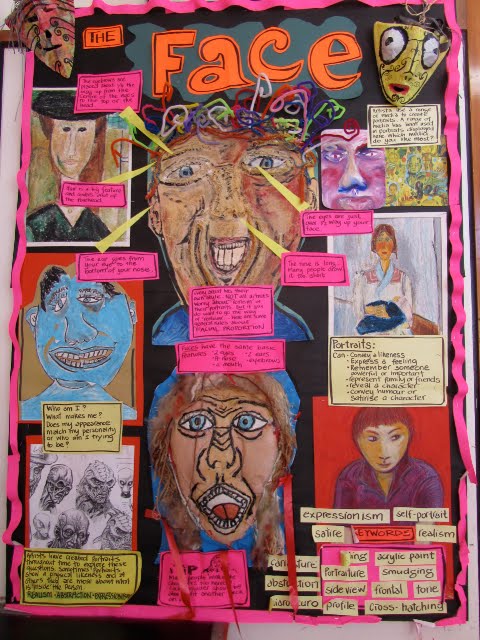
Personal narratives can be illustrated ( often for homework) but, if so, students need to be taught the skill of powerful drawing. Some students will have already decided that they are not artists and, if so, this is a chance to change their minds. One idea is to get them to complete a self portrait with their biros. First let them draw without instruction ( to see their 'prior' skills) and then guide them ( 'scaffold' them) through the process. This is another chance to introduce the idea of quality. Once again value individual differences. The lesson is outlined in the link on the previous blog.

One way to develop students drawing or illustrative skill is to base their drawing on a digital photo of themselves - possibly doing something exciting during their holidays. If so get them to focus on the dramatic aspects, or close up views, not long distance shots. Combine their portraits with them holding perhaps a fish or some food for example. Get them to include as much texture, or details, as they can.

Both the above can be expanded to develop as a major piece of art.

Another way is to get some school journals and then students to select an illustration they like and to copy it into their language book. It maybe be useful for them to copy only part of the drawing to introduce the idea of focus. When complete add the artists name. This is an excellent language activity and illustrates to the students wide range of artists styles and genres ( there lots of approaches to being an artist from the real to the bold). This is a fun activity to use whenever new journal arrive.

Observational drawing, a vital science/art skill, is a good activity to get students to do. Once again get then to draw an object ( kawakawa leaves are great) without instruction to assess their 'prior skill' and then instruct them to draw carefully, to go slow, and to take their time. The two efforts be compared and lessons drawn from the activity.If you are planning a small environmental study then this skill can be put to use. A 'mini study' of cicadas is one idea, or shells collected from the seashore during the holidays. Wild flowers, grasses or a flax study are possible studies.

A good idea for maths ( after you have surveyed their prior attitudes ) is to study what maths is and get them to research the history of number development through the ages. You could cover how different cultures have their own number system. Find out who developed the zero and why it is so important. It is important to humanize maths if all students are to gain a 'feeling for' the subject. Famous mathematicians can be researched. It pays to keep maths as applied as possible.

It might be useful to share with them the main ideas of each Learning Area covered in the New Zealand Curriculum if so make time to gain their collective 'prior ideas' first. The main ideas coud be copied into one of their books?

For writing,after you have assessed their handwriting abilities, it is fun for the class to research the development of writing from cave drawing to word processors. The history of writing ,and the various writing media, is a fascinating one.

One final thought.

All students buy a set of exercise books to begin the year. Some schools I know have reinvented these books as portfolios as they ought to show qualitative improvement (the Japanese call this continual small improvement 'kaizen'). The first days of school is the time to introduce students to this expectation. It is a good idea to introduce them to simple graphic presentation ideas. It is also a good idea to aim, by Easter, for all books to show improvement.In the schools that have developed their books as portfolios all books are sent home before parent interviews for their comments and later to discuss during interviews.

When a research study is undertaken students should be shown design or graphic 'scaffolds' to help them present their work. As with all 'scaffolds' it is important, that once in place, students be encouraged to show their individuality and creativity.

One you have thought out all the possibilities map out a programme for day one and week one. If you are in a proactive school your fellow team member will provide you with ideas to include.

Share your daily plan with the students at the beginning of the day. At the end of the day (and each activity) have reflective session to clarify what has been learnt. At the end of the day discuss with the class the three main things learnt during the day - their mothers will want to know!

Even if you don't use all the above suggestions they all remain available for later use. It is important to do fewer things well in depth.

The overall 'message' you want to leave with them is that you want them to do their best work - to aim for quality; you want then to to value their own 'voices', experiences, questions and ideas; and you want them to value their individuality and creativity. This is the essence of a learning community.

Best of all slowing their pace of work (many students will arrive with a 'first finished is best' attitude) will help you to get them to value perseverance and effort and to develop a concept of personal excellence.

Not a bad start.

Thursday, January 06, 2011

Beginning teaching - or starting a new year


Beginning the school year another blog to flick through


Beginning teachers face a dilemma.

It is obviously sensible to 'find out what is important around here' and to get on with doing it.

Good advice to start with but the danger is that it is all too easy to conform unthinkingly to bad habits as well.Compliance and conformity to school expectations ( for better or worse) is more the name of the game for new teachers.


For example there is a lot of talk about the importance of inquiry and creative learning - about integrating subject disciplines around relevant problems. However when school timetables are passed out it becomes pretty obvious schools are centred around two traditional areas - literacy and numeracy.

In fact it is hard to see where inquiry and creativity actually fit in.

The only solution, if you are a new teacher, is to do your best to develop literacy and numeracy skills that will be used to ensure deep and meaningful inquiry studies. Students should see inquiry learning as the most important thing.. They should see literacy and numeracy as a means to an end -as vital 'foundation skills'. They need to see the difference between 'real' maths and 'practice' maths.

This is easiest in literacy ( I prefer the heading 'language arts') by basing comprehension and information research skills on the current inquiry topic but most inquiry topics also need mathematical skills to be in place. And it is important for students to see the connections as well.

One task I would do is to get the class to complete an informal survey of attitudes, or feelings, towards all aspects of the school curriculum. Ask students to show their interest using a one to five scale or sad or smiley faces.

Developing a love of learning and developing a 'feeling for' each area is vital. If the results are less than wonderful then you will know where to place your effort as teacher.

It strikes me teachers spend hours each week on mathematics for little effect. At the end of schooling far too many students leave with a poor attitude ( and achievement level) in maths and this ought not to be the case. If you placed poetry on the list I bet not many students would say they liked it but I also bet that, with interesting teaching, all students would come to see poetry as a fun activity.

So what do your students think of various school subjects? The survey is a good first day activity. Better still if the list were drawn up by all teachers and used as an important assessment tool.

If you know about the mindset research of Carol Dweck add :

1 Do you think were are born as smart as you are ever going to be ( 'brains' or sports ability) and there are some things you just can't do ?

Or

2 Do you think you can get better at anything if you try hard and practice?

The first is a 'fixed mindset'.Low ability students get their lack of ability affirmed at school ( through ability grouping, national testing or streaming) and high achievers ( often girls) do not risk their status by new areas of learning becoming risk averse. Those with a 'growth mindset' just have a go at anything believing in effort and focused practice and see not succeeding as a challenge.This 'growth mindset' underpins the New Zealand Curriculum; ' have a go kids'


Click on the links below for some good advice to read before starting the school year.

Some activities to begin the year

Developing a stance as a teacher with your class

What attitudes about learning do your students bring with them?

Discussing how we learn with your class

Finding out what talents your students bring with them

A basis for planning a unit of work

More on planning an interactive unit

Sharing stories - personal writing

More on personal writing

The importance of teaching your class to observe

What do your students know about the Treaty of Waitangi?
More about the Treaty

Developing design presentation skills

More on presentation of student's ideas

Developing a stimulating room environment

A lesson Cicadas

A lesson on the flax plant


Make this the year to break out of traditional patterns and assumption and to develop active literacy, mathematics and inquiry programmes - ones that value students' 'voice' , questions, ideas and creativity.

There is no rush but don't be trapped by yesterdays timetables and expectations.

Remember the revised New Zealand Curriculum has as its vision for all students to be 'confident life long learners' ( or inquirers) and for them to have the competencies, or 'habits of mind', or 'learning power', to be 'seekers, users,and creators of their own knowledge'.

Few schools have achieved such a vision - yet! Or if they have the vision they have a reality gap between what is said and done!

Monday, January 03, 2011

Something old but still worth thinking about! And read John Edward's poem as well


Late in January there is going to be a major conference - 'The Inspired Impact Conference; Developing the whole child'. It is about challenging traditional curriculum delivery methods to prepare a place for creativity in classrooms. The conference has at its aim 'to delve deeply into learning and creativity'.

All I can say it is about time.

Creativity has been at risk the past decades as literacy and numeracy imperatives have all but eaten up all the school day. And with the National Standards it can only get worse. There is more compliance and formulaic 'best practice' conformity in our schools than creativity. All too often when you visit classrooms you see clone like art work.

Teachers need to have the courage to ensure all children develop all their talents and become the 'confident life long learners' ( or inquirers) that the 2007 New Zealand Curriculum asks of them. All children have the right to be 'seekers, users and creators of the own knowledge'.

Red flower

Once upon a time there was a little boy who studied at a big school.

One morning the teacher said "Today we’re going to draw."

"Good" thought the little boy.

He liked to draw lions, tigers, chickens, trains and boats.

He got his color-pencils and started drawing.

"Wait!! Don’t start yet." said the teacher.

She waited until all the students were ready and then said ...

"We’re going to draw flowers."

The little boy started drawing beautiful flowers with his pink, orange and blue pencils.

"Wait" said the teacher. "I’ll show you how to do it."

And the flower she drew was red with a green stem.

"Ok" said the teacher "now you can do it."

The little boy looked at the flower the teacher had drawn , looked at his own flowers and liked his best. He couldn't say that so he turned the sheet of paper over and drew a flower just like the one the teacher had drawn - red with a green stem.

Another day the students were having class outside and the teacher said ...

"Today we are going to play with clay."

"Great" the boy thought.

He liked to play with clay.

He could make things like elephants, mice, cars and trucks.

He started to take some clay in his hands and make a big ball.

Then the teacher said ... "Wait ! Don’t start yet."

She waited until all the students were ready.

"Now" she said "we’re going to make a plate."

"Good" thought the little boy.

He liked to make plates of different sizes and shapes.

The teacher said ... "Wait !! I’ll show you how to do it."

It was a soup-plate.

"Ok" she said "now you can start."

The little boy looked at the plate the teacher had made, looked at his own plate and liked his best. He couldn’t say it so he got his plate, made it into a big ball and started it again.

He made a soup-plate just like the one the teacher had made.

And since early in his life he learned not to do things by himself but to wait for a model.

And then the little boy went to another school.

This one was even bigger than the other one.

One day the new teacher said ... "Today we’re going to draw."

"Good" thought the little boy.

He waited to see what the teacher would draw.

The teacher didn’t draw anything.

She only walked around the room.

Then the teacher approached the little boy and asked "Don’t you like to draw?"

"Yes" he said "but what are we going to draw?"

"I don’t know" said the teacher "draw whatever you want."

"How can I do it?" he asked.

"Any way you want." said the teacher.
"But what colors should I use?" he asked.

"You choose. If everybody makes the same drawing with the same colors how can I know which drawing is yours?" she said.

"I don’t know" answered the boy.

And he draw a red flower with a green stem.

Many times we want our children, friends, relatives, people we love, to do things the way we believe is the correct one.

Are we right?

Other times we sit and wait until someone tells us what to do.

Is that right?

If you have time read the poem, 'What did you steal from your children today?' written by John Edwards one of the Inspired Impact Keynote speakers.

Friday, December 31, 2010

A few quick New Years resolutions!


This will be short and sweet.

I don't usually make , or keep, New Years resolutions but this year will be different!
So hear goes.

This year I will pull back from working in schools. Over the years, beginning in the sixties, I have worked with countless people, influenced some but only really worked with a dozen or so like minds - and most of these people a number of years ago. I will just keep up with my reading ,blogging and writing. I still have one major presentation to make late in January and will pick my presentations in the future.

I am going to put my energy into my garden which is becoming my latest enthusiasm - I have built several bridges and walkways and planted lots of new plants. I intend to spend an hour a day in my garden.

I am going to take up painting again -well I never really took it up but this year I will make a real effort.

That should be enough to keep me busy.

All the best to every one for the New Year!

Hell I turn 70 this month - others can hold up the creative teaching flag from now on!

Jan 1 2011

PS I said 'pulling back' not giving up - putting my energy where it counts most with those inspirational creative teachers; the future leaders.

Friday, December 17, 2010

The future lies with creative teachers!


The above photos were sent to me by a very creative teacher and are the result of on tern work with a year 3/4 class.

I am more convinced than ever that real educational progress depends almost entirely on tapping the originality and innovative thinking of such teachers.

Not curriculums developed by distant experts - they need to be kept as simple frameworks for teachers to work within.

Not principals - their job is to create the conditions to encourage 'their' teachers to take learning risks and try things out within agreed frameworks . Not all this ridiculous testing and accounting for 'achievement' - measuring never made the pig fatter . And not phonics.

Not college of education advisers - they are simply educational mercenaries passing on contracted 'best practices' they never used themselves.

Certainly not Ministry technocrats - who dance to the tune of whoever pays the piper and certainly not Education Review Office bureaucrats - whose careers have been one of toeing the line and saying yes to those in power. Not the Minister - who can only sing ( badly) one limited song.The Ministries role is to create the conditions to realise the energy of principals and teacher leaders and, in turn, the gifts and talents of all students

But finally only creative teachers make real changes! And there are so few. Thanks Deborah - rooms like yours cheer me up no end and give me a glimmer of hope.

Thursday, December 16, 2010

Time to stop all the standards nonsense - we are teachers not accountants.

This slide is directly from the Finland Ministry of Education.

This is from a USA teachers blog called: ( slightly abridged)
'Advice to student teachers :Hold fast to your dreams'.

I hope you remember what it’s like to be a kid because I think that’s just what we need to "make a difference."
It is all about human curiosity

Sometimes my three-year-old son, Max, complains about going to school. And I so passionately preach about how he needs to enjoy it while he can, while the scent of magic still lingers in the air. He creates without boundaries, he discovers without opinion, and he intrinsically cooperates. Most three-year-olds want to be in school. Damien Cooper, formative assessment guru, puts it like this: "Human beings come into this world innately wired to learn. We're curious. We are not innately wired to compete." But when kids advance through the grades something happens. Their natural curiosity about the world slowly shrinks and shrivels and is replaced with ( add your own words!)

A Political and business approach to education

The edge of the knife is on a direct course to core curriculum subjects like reading and writing. Math and science is all the rage nowadays. I'm sure you've heard. It seems like President Obama's pressure to improve science and math skills are outweighing language arts. Some states like New Jersey are going to extreme measures to make sure that math and science are top priority. I hope you are shaking your head -- it doesn't seem logical to me either. I do believe Albert Einstein (I think he was a scientist or something) said: "Imagination is more important than knowledge."

Where Does This Lead Us?

Here's a quick look at the science plan: Obama will work with governors and educators to ensure that state assessments measure test inquiry and higher-order thinking skills including inference, logic, data analysis and interpretation, forming questions, and communication. Improvements to assessments will also include developing tests that call for students to design and conduct investigations, analyze and present data, and write up and defend results.

I'm sure you figured out why I bolded most of those areas of improvement. Yes, you’re catching on here. They are all constantly practiced and honed while reading and writing and imagining. Right?

Think about it.

Do you think the President really wants our youth to think critically, analyze, and interpret or does he want to graduate more engineers than China? The latter will only promote the “How do I get the most points with doing the least amount of work” attitude. Is that how we’re going to change the world? Is that going to keep kids in school? Will the true thinkers, the real reformers, value what school has to offer? Better yet, will anyone even have a chance to think? As for the magic I mentioned earlier.

The New World

This is where it gets hairy. This is what you probably didn't learn in college. I'm not your boss, your teacher, or your mom so this is going to be sugarless. I want to stir your brains a bit. I don't mean to come at you at time of blissful joy. You are about to teach. But this burden you just inherited needs to be on your plate. Your dream of teaching will now be realized in a different world. The President means well. He wants the kids of America to succeed (I really do believe this). But maybe his idea of success is different from theirs and maybe his plan is one-sided. I don’t know. This may seem like a cry for the creative soul, but then again looks are deceiving. What I'm really talking about is beyond creativity. What I'm talking about is divergent thinking. You see there's more than one way to play a note, paint a picture, and write a story. Max thinks (creatively) divergently in pre-school every day.Does it have to stop?

By the time a child is in third grade we've just about bashed divergent thinking out of their psyche. And now with music, art, reading, and creative writing waiting in the gallows, it will happen sooner. Yes, math and science makes the world go round, but art makes us human.

And if the President believes that divergent thinking will emerge in math and science without art . . . well, then I'm not sure about the future of our country. Author, Donald Murray, states that we look to art for a meaning. Not the meaning, but a meaning. Real learning needs time to simmer. I'm not talking about lowering our standards. We need solid standards and we do have them, but maybe too many? We need time to find meaning within the standards and use the one that works for us. But what we're really doing is cramming years of information into months, which only leads to one-answer-one-way-fill-in-the-bubble-educational-reform. It's mediocre at best. Testing pushes teachers into sprint-and-cover mode, which does exactly that: It sprints over the deeper understandings to cover what's on the test. Teacher and Author, Kelly Gallagher warns of the this poisonous mode in his article, "Why I Will Not Teach to the Test."

Reality Check

And here's the biggest kicker of them all. If all of the politicians, celebrities, and movie makers are so concerned about the United States being number one in the world of education, then why is the current reform movement speeding in the opposite direction of number one, Finland. Check the diagram above.


I don’t think I need to explain this slide, do I? Yes, you will face resistance and feel the shackles of the standardization of American Education. There will be bouts of compromise, tears, and loads of questions. But when you finally chew through the crunchy, bitter crust, you'll find the magical stuff in the middle. That's the good stuff. Your students will always be waiting for you in the middle. You'll also find your dream: The one you might have had in Kindergarten where you proudly shouted, "I want to be a teacher!"

There is hope. Well . . . it's you, really.

Wednesday, December 15, 2010

Re -integrating language teaching with reality


In an inquiry based classroom every aspect of language teaching could well relate to the current study - reading to develop understanding, writing thoughts , descriptions and theories, and lots of oral language, drama , poetry. This was once the case in many schools until literacy become so dominant and largely divorced from the rest of the curriculum.

The need to express ideas is an evolutionary ability which made posible a wide range of diverse and creative human cultures.

It is this need to comprehend and express meaning that should underpin all language experiences in classrooms. Over the past decades the language experience approach, once a feature of New Zealand classrooms, has been reduced to formulaic literacy approaches. International tests have shown that literacy levels have not improved and that there is a 'tail' of low achieving students who are losing this vital means of being successful in our schools. Successful students bring with the 'cultural capital' to take advantage of current technical and measurable approaches. This situation will be worsened with the imposition of Literacy Standards and targets.

The answer may be to return to a language experience approach based on the belief that language development can only be gained when students are placed in meaningful contexts that recognise the reality of the students lives or cultures.

I believe we are now failing the very children we set out to help and in the process we are ignoring the linguistic prior learning experiences of such children.

Learning must begin with a thought provoking curriculum - one that recognises the lived reality of all students. Students need to offered the chance to use powerful forms of talk and writing in meaningful contexts leading to meaningful reading.

The children's own lives, their cultures, the sensory experiences gained exploring their immediate environment, and challenging class studies based on their own questions, need to provide the required meaningful contexts.

These approaches are restricted with the current politically inspired literacy approaches with their focus on reading.

Communication occurs naturally when students are involved in stimulating experiences. 'Curiosity is at the heart of all learning' as it says in the revised New Zealand Curriculum; we want all students to become 'seekers, users,and creators of their own knowledge'.

The teachers role ,as Jerome Bruner has written , 'is the canny art of intellectual temptation'. Teachers need to establish their classrooms as communities of scientists and artists exploring whatever captures their attention. And to do this all aspects of learning need to be integrated. Instead we are still focusing on a isolated curriculum centred approach. Even innovative schools I visit sadly keep literacy and numeracy separate from their inquiry programme.

Worst of all current 'best practice' approaches, and Education Office Review pressure, and even internal school bureaucracy are an attack on the autonomy of teachers. Conformity or consistency is being valued over teacher enterprise and creativity. Current approaches ignore the power of transformational experiences that give students 'feeling for' whatever they are learning. Current approaches all too often disassociate literacy and language from the real lives of children.

To really develop integrated approaches we need to celebrate the artistry and creativity of teachers not just the ideas of contracted advisers most of who may never applied what they are 'delivering'. Principals need to create the conditions for teacher leaders to feel safe to develop more creative ways of teaching that respects the learning identities of all the children they teach. Approaches that see students as producers rather than reproducers; approaches that result in rooms full of examples of the diversity of children's 'voices' and creativity as seen through their written language, inquiry research and their art.

Teachers need to be responsible for negotiating with their students a unique curriculum that is sensitive to their needs. For many students ( those lumped into the 'achievement tail') recognising and building on their culture and their lived experiences are important. Pioneer New Zealand teachers such as Elwyn Richardson and Sylvia Ashton Warner knew this as did many language arts teachers up until the technocratic curriculum imposed during the late 80s sidelined them. Paulo Freire, long ago, worked with illiterate peasants in Brazil and taught them to read and write by being interested in their thoughts. As they gained confidence in sharing their ideas he helped them write down key words and phrases. From these words the peasants learnt to read and write and gained liberating power in the process. All in eight weeks. An intensive language arts programme based on real purpose!! Not unfamiliar to approaches used by creative teachers such as Elwyn and Sylvia.

If we are to develop the language capability of all students we need to re-integrate literacy with our inquiry programmes. The inquiry topics should be the source of the creative energy of the classrooms. As part of this 'reframing' it is also time to rename the literacy time the language art block.

We now need to celebrate diversity in our classrooms and help all students achieve their personal best in all they do. We need to move away from the one dimensional classrooms that result from the current conformist undemocratic 'best practice' approaches. We need to 'scaffold' our help to children with care. Both teachers and students need freedom to learn in their own ways. Knowing the rules and criteria ought not constrain individuality and creativity.

Current approaches are marginalizing our students imagination; their individual ways of seeing and interpreting their experiences. By tapping into the real world of children, by valuing their thoughts, ideas and questions students could achieve so much more - beyond what can be easily measured or achieved.

Through developing their language capability children will become more powerful as individuals and learners. Through positive language experiences students develop a powerful positive sense of self; a sense of new possibilities for themselves. Education ought to be about chances for students to find out who theyare is and who they might be.

Learners currently placed in the 'achievement tail' need to be given the power to escape such a restrictive definition by experiencing equally powerful classroom cultures that build on their own cultures and experiences.

It is time to re-integrate language with the total classroom programme so all students can become 'seekers, users and creators of their own knowledge'.

Tuesday, December 14, 2010

Real Mathemetics


Is this work by Escher art or maths? Increasingly once fixed lines between subject areas are becoming blurred.

Over the years there have many attempts to develop a more active math programme but for all this far too many students leave school with anything but a positive feeling for the subject. The introduction of the mystery of algebra finishes most of us off.

With this in mind one wonders why maths takes up so much time in the primary school day. One reason is tradition - left over from the era of the three Rs. Another is that politicians seem fixated on literacy and numeracy as the key to success. No doubt they are important but they need to be seen as foundation skills to be used in learning contexts. And of course schools simply do what they have aways done without questioning the real purpose of mathematics and the time they give to it.

Recently I read a Intermediate School Maths scheme. The introduction was brilliant -all about linking math to real life contexts ( ideas lifted from the revised NZ Curriculum) but when I turned the page the programme was just a series of traditional maths topics.

For many students maths is a 'no mans land that has never quite yielded its secrets' according to Australian educationalist Garth Boomer. He continues saying like most teachers he, 'dwelt largely on the edges of this domain, secretly envious of the very few people...who are truly mathematicians.' I know the feeling; as do too many students.

Where many teachers now make use of their language times to develop ideas and skills to be used in their inquiry programme maths remains watertight. Maths is taught as cut and dried abstracted from real life; a matter of learning the predetermined processes and steps. Many teachers and students actually like this 'right/wrong' approach.

But maths can be so much more than this and many attempts have been made over the years to introduce a more active exploratory approach but these are lost as children grow older and teachers teach mathematics as this is how you do it. Boomer calls this way of teaching catechism - 'the act of asking questions to which one usually knows the answers and where answers are unchanging'. This kind of maths is 'school, learning' and not related to real life problems. No time for exploring, discovering hidden patterns and challenging ones understandings - more like following a pre-planned tourist guide book. This sort of teaching, Boomer writes, 'does not encourage teachers to leave the beaten track' and to use maths to explore and express ideas. Mathematics teachers, he writes, are among the most conservative of teachers.

Mathematics teaching seems decades behind the the teaching of the language arts and science ( although there is not much science to be seen). No matter what suggestion are made, teachers stick to traditional expectations, no doubt reinforced by expectations of parents, politicians and even the students.

Teachers will only change if their learning theory about teaching maths changes. They will need to change from teaching maths as catechism to one where where they see knowledge as being personally constructed and applied by each learners. This is reinforced in the New Zealand Curriculum which states that learners should be their own 'seekers, users and creators of their own knowledge'.

If teachers change their minds about maths students, in turn, will develop a more positive 'feeling for' mathematics. This needn't mean changing all mathematics. There will still be basic things that will need to be learnt until recall is automatic but for the rest a couple of ideas come to mind. The first is to introduce realistic maths experiences for students to explore (and where possible linked to the current inquiry study) and to do fewer things well. And, as well , if teachers do introduce an active maths programme them less time could be given to maths as it would be demanding to use all current time in such an active way. And maths will be a integral part of other curriculum areas.

One idea would be to make it clear to students the difference between 'practice maths' and 'real maths'. Mathematics is a great field to introduce inquiry learning processes. There are some excellent maths resources in schools to help teachers to begin such an active programme. Most physical science studies require mathematics to solve problems. The field of art provides wonderful areas to introduce aesthetic maths. Mathematics itself has plenty of interesting ideas to explore. Such things as number patterns, symmetry, history of zero, maths in other cultures, and so on. Every subject , once the right maths mindset has been established, involves realistic mathematics.

Such an active approach will need to involve collaborative group work. Students need to explore student questions, recording their findings, and then to share their knowledge. Some teachers might like to start with one group of 'real ' maths' while others are busy with 'practice' maths. Or maybe, now and then, a 'real ' maths study could replace the more formal programme.As such ideas are introduced the teachers role will also change. Teacher are already used to interacting with students, valuing students prior ideas and theories, in other areas.

Seymour Papert the computer educationalist has written that there should only be applied maths ( and science).Too much current maths is anything but applied and is only comprehended by students who appreciate the demands of 'pure' or abstract maths.

Another mathematician Dr Z P Dienes ( of dienes block fame) described the classroom situation when he said, 'It is suggested that we shift the emphasis from teaching to learning, from our experience to the children's, in fact, from our world to their world'.


We can't afford students who do not see maths as vital form of communication -a special but accessible language to help them make sense of their world. Currently some students gain a 'feeling for' maths the rest simply give up.

We need an education that sparks children's mathematical imaginations but first we must rekindle our own.

Monday, December 13, 2010

What is it all about? Future learning


Future learner need two attributes to soar into the future - to become the 'confident life long learners' of the New Zealand Curriculum - openness to new experiences and skepticism about whatever is presented to them. And to motivate them to fly they need their gifts and talents developed.


As the year winds up teachers and students will be facing up to leaving the communities they have established during the year. It will be both celebration of achievement and a time of sadness. And of course not all students will have committed themselves to being a full part of the class.

What will have made made positive learning communities will be based on the mutual respect developed between the teacher and each learner and the shared culture established that somehow tells each student 'what is expected around here'.

For those teachers with composite classes there will be at least some children who will bring to the next year class the shared expectations they have helped develop to sow the seeds to establish a new culture.

If teachers had taken a survey earlier in the year of their students attitudes towards the various aspects of the curriculum it would be interesting to see how their attitudes have changed during the year - hopefully students will now be more positive.

It is also interesting to ask your students to write out a note for next years students about: 'How to survive in my class next year'. Ask them to write about the kinds of things they think you are looking for, or don't like. You might ask them to write the best memories they will take with them from the class and/or the best things they did with you. This can be very enlightening, after all, they are the real experts about you as a teacher.

The big , often unasked, questions in the minds of all learners are:

Who am I ? Who do I want to be?

What do others think of me?

How am I doing? What am I good at? What do I need to do to get better?

Where am I going? What might I do in the future? What will it take to get there?

It is the answers to these questions that provide all if us with a sense of who we are - our identity. And it is the real role of any education system to help students develop positive answers to such questions.

It is also these questions that underpin the idea of a personalised inquiry based education. Education for the future will need to celebrate the uniqueness of each learner. To do this requires that schools need to recognise and uncover the special gifts and talents of all learners rather than, as at present, measuring them against some arbitrary standards and grading them as below , average, or above average, in selected areas of learning

Students need the opportunities to follow up their own questions and concerns and, with their teachers help, develop their own 'emergent' curriculum. To answer such questions they will need access to the traditional disciplines of learning. A personalised education will require new school structures and new roles for teachers as learning advisers.

Questions of identity are all about student self realisation. If students develop an unhealthy sense of identity trouble lies on the horizon.

All students need to leave your class, and eventually the school system, as positive , confident 'seekers, users and creators of their own knowledge'.

Tuesday, December 07, 2010

An inquiry based classroom


'How is your inquiry programme going?' seems to be a common question asked by principals these days.

Behind such a question seems the idea that inquiry is another programme to include in the school day along with literacy and numeracy.

Two things are wrong with this.

Firstly inquiry isn't a programme to simply be added to the daily programme rather it is a disposition ( their 'default' way of learning) that children are born with until it is 'flipped' by life experiences and by schooling.

Secondly the teachers I have admired over the years see inquiry as the basis for all learning - literacy and numeracy included. Today many teachers ( and schools) have allowed literacy and numeracy to all but 'gobble up' the entire school day. National Standards will further dissipate this missing inquiry dimension.


As the school year is drawing to a close I made the effort to make one last visit to a very creative teacher in local school to gather up a few photos.I almost arrived too late as the teacher, Deborah, was dismantling parts of her room. None the less I was able to take more photos in her room than many schools I have visited this year.

My visit reinforced three interrelated ideas that will hopefully become the alternative educational agenda for the new decade. An agenda to confront the 'big brother' top down National Standards demands of the Ministry of Education; a Ministry that has lost any educational integrity with its flip flops since the appointment of the new conservative government.

The first idea is to return to teachers the leadership role they deserve as idea developers ( not 'deliverers); the second is to to see the principals role as the creator of the conditions, the culture,and the agreed expectations for teachers to develop such ideas. The principal main role is to develop with all involved an agreed direction for the school - to define a vision and teaching beliefs for all to be accountable to.

This concept of 'parallel leadership', when combined with networking with other schools to share teacher strengths, makes the third idea. All combined the present a democratic educational agenda able to hold top down dictatorial mandates at bay.

For Deborah, the teacher I visited, there was no confusion over inquiry learning.It is just something she does. The room was full of interesting things for the class to 'inquire' into. She is a great example of what educationalist Jerome Bruner calls a teacher with the 'canny art of intellectual temptation'.

There were skeletons hanging around arising out of a study called 'Inside Out'. I just missed seeing a full size medical skeleton! Iam not sure where it came from but a body suit that children took turns to wear was popular - it had body parts velcroed for children to remove. This 'rich topic' had sparked (or 'generated') several lines of inquiry into a range of Learning Areas.I missed children exploring fish guts and the excitement of a fish eye, when cut into, squirting fluid across the room! This brings up the issue of planning. Inquiry learning is often going with the flow until study questions, or lines of inquiry, are defined. Predetermined planning and inquiry are contradictions - teacher artistry is required.

Bean plants climbed up the window wall with data being collected about rates of measurement and estimation of possible growth. Another maths display featured data about themselves. I was shown photos on the computer of the results of a study of mould that had 'emerged' and which developed into a major, if smelly, ( inquiry) study. The best inquiry classroom feature lots of 'emergent inquiries.

In the school foyer I saw clay animals that the children had created - the results of their 'inquiry' into clay . I was shown a 'wonder display' where children were encouraged to post things they were wondering about ( or 'inquiring') about . The wails were cover with art, language and science work - in particular an impressive spring display featuring - the centre piece being daffodils. There was also display based on parachute experiments following a school wide theme on transport( a helicopter had landed in the school grounds). I was also shown the results of studies arising out of a dead bird being brought to school -which encouraged a number of dead bird arriving at school.

I asked Deborah about her literacy programme and she replied that much of it related to developing ideas that contributed to the class inquiries. As for maths it was integrated where possible or there were mini math inquiry topics and she said the children also liked using text books as well.Variety, as ever, is the spice of life. The important thing, we agreed, is that children should see maths as another area to inquire into and get a 'feeling for'. Inquiry is about turning children on to learning - to ensure they become 'seekers, users,and creators of their own knowledge ' as it says in the New Zealand Curriculum. In other word 'life long learners' - or inquirers.

I am the first to admit that not all teachers are able to imitate Deborah's style but all teacher can move along a continuum toward a total inquiry based classroom. Other teacher might like more order and this is fine. Boundaries are important -even if only to break them.

Elwyn Richardson, New Zealand's pioneer creative inquiry based teacher ( he worked in the 1950s) classroom was once described as 'a community of scientists and artists' busy exploring their internal worlds and their immediate environment. Deborah continues this philosophy - integrating an electronic whiteboard and computers.

Teachers who plan one, or even two, enquiry studies a term have not really understood the concept of inquiry as a disposition. Such classrooms result in thin inquiry at best as literacy and numeracy still rule supreme. Not so with such teachers as Deborah. All the above inquiries are the result of one terms work!

Every school has 'stand out' teachers with skills to celebrate and share.

Such teachers are the real experts not the out of town consultants with PowerPoint's with step by step inquiry models to follow. We don't want our classrooms to be full of inquiry processes' and no real content which all too often seem to be the case. Nor do we want to become testers and educational accountants destroying the inquiry dispositions in our students , and ourselves, in the process.

If principals saw teacher as the key to real educational change, and if they saw their role as developing cultures to encourage such teachers, and if they were to network with other local schools we would have the beginning of a real educational transformation.

It is all about inspiring each other to become 'seekers, users and creators of our own knowledge'; for us all to be 'inquirers'.