Tuesday, March 28, 2006

C. A .T. says cat - or does it?

  Posted by Picasa The reading wars continue endlessly; ‘whole language’ versus phonics. The trouble is that the proponents of phonics seem to see the world in black and white!

Like everything in this interconnected world nothing is ever so clear.

A couple of day ago the debate was rerun on National Radio motivated, I would think, by a biased point of view of the interviewer.

The interviewer set the scenario. Phonics has just been mandated in all primary schools in the UK. California has thrown out ‘whole language’ (inspired by NZ educators in the 80s) and has also introduced phonics approach. And our 20% reading ‘achievement tail’ was produced as evidence that primary schools are failing to teach students to read and, of course, the simplistic notion that our scary prison population has resulted from reading failure. Not that our long ‘achievement tail’ is not a serious one.

The protagonists were Tom Nicholson, a rabid phonics fan who has just written a book on the subject, a pro phonics professor from Californians, and in the other corner our current Minister of Education.

It wasn’t such an uneven debate as might have seemed expected. A determined effort by the interviewer to force the Minister into mandating phonics in our schools didn't come off. Tom Nicholson stated no one had been taught to use phonics for three decades, that teachers were not allowed to, and that the ‘mixed’ NZ approach was not doing the trick as evidenced by the ‘achievement tail’ and the illiterate prison population.

The American professor admitted that whole language had been found wanting in California but that after phonics had been introduced the scores hadn’t changed. This he put down to immigration, cultural differences and poverty. Seemed like a clue to our ‘achievement tail’?

The Minister, fresh from seeing for himself the results of intensive literary training in a group of trial school which had shown remarkable success, was up to the occasion. He stated his belief in the NZ ‘balanced’ literacy approach, one which included phonics, while admitting teachers need a better understanding of literacy teaching including phonics.

While Nicholson (and the interviewer) wanted the Minister to follow the UK way and mandate phonics the American supported the Minister’s idea of providing phonics in realistic contexts as part of a balanced programme. He warned against simplistic solutions.

It was great to hear our Minister talking about the need for: a ‘personalized’ approach, the need for ‘rich’ language experiences, tailoring instruction through diagnostic teaching to the needs of the learner, as preferable to a ‘one size fits all’ mandated approach. He shared the ideas of ‘evidence based teaching’, he had just seen, where students and teachers could both articulate what they could do and what they need to learn or teach; and he shared impressive statistics to show how much these learners had progressed.

It is obvious that phonics is no ‘silver bullet’ but useful tool in decoding reading for students at risk. And worldwide there is research to indicate it would be mistake to mandate phonics as the number one way to teach reading.

The new draft NZ Curriculum includes grapho-phonics as an element of reading within the context of a language rich programme that challenges students to want to learn.

This is as it should be. We just have to do it better.

Monday, March 27, 2006

The earlier the better!

  Posted by Picasa Now and then common sense hits the newspapers about education.

Everyone has all sorts of cures for the number of casualties in our society particularly when it comes to schooling. Solutions for some seem as 'basic' as making phonics compulsory in all schools. If only it were so simple. Too many of our problems are already predetermined by our increasingly dysfunctional society before children get to school.

With this in mind it was great to read in an article in our local paper that we have a real cure already - one that has been largely overlooked or at best paid lip service to; the strategic significance of early intervention. It is common sense that the earlier you intervene in anything the better. And as the article said, ‘the magic time is well before they get to school. Wait till the kid’s turn eight and you’ve missed the bus.’

Scientists studying early brain development know that babies are born with unformed and plastic brain and that they start learning from the moment they are born and also that the success ( or otherwise) at this stage affects the cognitive and emotional skills they acquire which in turn affects their success in life.

The trick we are told lies in the interaction with their parents or caregivers and to be really 'mind growing' the environment needs to be ‘nourishing and stimulating intellectually and emotionally.’ ‘The earlier the seed is planted and watered, the faster and larger it grows.’

This dynamic support system can be lacking in homes disadvantaged by poverty and the absence of positive support systems. Families, not schools, are the major source of inequality in the performance of students. Gaps emerge early in student achievement but after eight research shows that the school environment plays only a small part in accounting for achievement gaps.

The lack of success of many students, it has been shown, were sown early in their lives and any help provided at later stages is problematic. Too often, the article states, ‘they strike after the die is cast’, but studies show that early interventions are highly effective. Many of these programmes were judged a failure at the time because initial gains had been lost but researchers, who followed these children into later life, found the students involved earlier more than three times more likely to be successful at High School compared to those who hadn’t been involved in such programmes; by 27, were four times more likely to earning a high wage; three times more likely to own their own home; and twice as likely not to have been on welfare or arrested.

So why did such programmes, deemed an early failure, produce such impressive results longer term? This is evidently because Americans place too much emphasis on cognitive ability (IQ) rather than on cognitive ability or emotional intelligence (EQ). EQ covers such things as getting on with other people, working with others and such things as perseverance and tenacity – attributes that help in many aspects of life.

It is common sense that taxpayer’s money, currently used helping many dysfunctional older learners and adults, would be better spent in ensuring all children get a good start in life.

And it is pretty clear as well that too much current education is centred on cognitive achievement rather than the wider dispositions and qualities necessary to be successful in life. As a result learner’s brains and their life potential are not fully realized – and as a result their creativity and contributions wasted.

Puting money into solving poverty and supporting early education for those 'at risk' pays off.

Maybe it is the wider society that is dysfunctional?

Thursday, March 23, 2006

The dark side of feedback!

  Posted by Picasa These days there are few teachers that don’t include in their teaching vocabulary the phrase ‘feedback’ and, to show they are on the ball, ‘feed forward’! And there are few rooms that don’t have written out (in ‘student friendly language’) ‘learning intentions’. And of course there are ‘negotiated criteria’ and ‘student self assessment’ to be developed. All these techniques are linked to the efficient sounding phrase ‘evidence based teaching’. All very technocratic if hardly original.

The proof is always in the results; in what students can demonstrate and do rather than recorded statistics and fancy graphs. And this ‘proof’, if it is required by those outside the classroom, ought to include attitudinal ‘data’ as well. All too often subjective aspects of learning, such as desire to continue with the activity, are missing.


Too often the processes have replaced substance; learning is essentially about every individual making their own meaning
.

All these ideas seem to come from literacy projects relating to the ideas about formative assessment led by people like John Hattie. Hattie’s basic research finding was that the single most important way to improve students learning is ‘oodles and oodles of feedback.’ Hardly an original insight; I have observed creative teachers, who really value what students think and can do, using these ideas for decades.

Creative teachers succeeded because of their focus on helping students achieve creative work required them to help with a 'light hand'!. The difference between what creative teachers want and the formative assessment ‘converts’ is this avoidance of conformity – the valuing of individual responses rather than imbedding a way of thinking. And to make things worse many teachers, by applying a heavy handed exemplar criteria based approach to areas such as art, are developing classrooms that reflect teacher’s ideas rather than the imagination of their students.

These dangers were pointed out by Noelene Alcorn, in NZCER Set 1 2005, who wrote that this emphasis on evidence based policy making and teaching, while having value, may as well lead to a narrowing of teaching possibilities. She says this narrow emphasis of issues of ‘evaluation, assessment, and measurement have become a major focus'. By placing student’s success or failure in the hands of the teachers skill of using such techniques could place unnecessary responsibity or ‘scape-goating’ on teachers.

She also mentions that there are a number of other exciting approaches to learning that are available that may be being neglected, and that this ‘new found faith in evidence based teaching needs tempering.’ She is concerned that evidence based teaching is at the expense of ‘creativity imagination and higher order understanding. Teacher creativity has also suffered.’ She continues, ‘imagination and mystery are integral part of our lives. Not all evidence is factual. Education is a life long process concerned with much more than achievement of specified knowledge and skills.’

And in respect to this faith in feedback research has shown that feedback can actually reduce ones capacity for honest self reflection by reinforcing our expectations that others will and should tell us how we are doing and therefore reducing self accountability and belief in ones own ideas.

All this is not to say that these ‘evidence based’ techniques are not valuable, it is just that they should be used with sensitivity and respect for the identity and voice of the students.

If teachers notices that their students writing, art and verbal responses, are becoming ‘clone like’ then it might be time to ‘lighten up’. We may be turning into ourselves into technicians and in the process sacrificing the artistry of teaching and the mystery of learning.

The future requires not just those who can learn efficiently but learners with their talents and passions developed; with the imagination and confidence to their live creatively.

Thinking from the inside out!

Teaching ‘thinking’ seems an important thing to do but paradoxically too much emphasis on ‘higher order thinking’ (HOT) can actually result in low level thinking!

Teachers can become so enamored with de Bono’s hats, Bloom’s taxonomy, Gardner’s multiple intelligences, graphic organizers, mind maps, Costa’s intelligent behaviors and endless inquiry learning models that the focus is taken off what it is the students are actually learning.

Not that anything is wrong with any of the above – they are all valuable ‘thinking process but they are a means to an end, students able to achieve real in-depth thinking about content felt to be important to the learner. As such they only work if driven by deep curiosity and a passion to find out something by the individual learner. All too often when I visit rooms I see walls full of posters outlining thinking skills but search in vain for quality results of all the processes. Such ‘thinking props’ ought to be placed in a ‘my thinking book’ book for students to refer to as necessary leaving the walls to celebrate student creativity.

It was great then to read in Mark Treadwell’s ‘A Thinking Framework’ Jan /Feb 2006 newsletter that the basis of thinking is personal and revolves around the question, ‘how do I know I am me?’ Thinking is an internal process of self invention; about developing our continually emerging mind by coming to understand ones personal world. It is developing in each learner a learning identity with a particular idiosyncratic voice.

By this process of self invention we all develop mental models which in turn help us interpret ant future experiences – for better or worse. What we think and do, and see other do, is limited by our internal world view. Our views are colored by our life experiences and interpretations. The room for misinterpretation is obvious

Rather than spending time teaching everyone a set of thinking strategies it would be wiser to pay attention to what students think and feel and to focus on what questions and queries they have, and to value their views, current theories and misconceptions.

Our minds are continually on the search to find patterns and meaning in whatever experiences we have. Humans are the only animals dedicated to ‘making meaning’ so as to change their environment suits their needs. It is this desire, or love of learning, that should take priority not imposing out of context think skills.

Helping students become aware of their ‘views’ and ‘thinking’ ought to be the focus of teaching – this awareness of ones own thinking is called meta-cognition and students who can achieve this are the real future thinkers. Encouraging such reflective thinking after any activity is vital if students are to ‘learn’ through their experiences.

The need to learn can be motivated by a number of things – curiosity, confusion, mystery, competition, identity and even fear. Really comprehending how students think is an elusive task but luckily the brain is equipped to process information and even has specialist areas for different modes (multiple intelligences). What is required is the provision of a stimulating environment full of intellectual challenges and a culture that encourages the use of intelligent behaviors (including learning through ‘failure’) to encourage the dispositions, or intellectual ‘habits’, to be life long learners. Any specific thinking skills should be called on appropriately to assist students make meaning. Inevitably whatever is learned is learnt because it has emotional meaning to the individual. Passionate teaching, linked to students needs to know, is vital.

So learning results from when students ‘mental model’ or ‘worldviews’ are challenged and modified. It is not as rational as providing a set of thinking skills. The model of teaching that best fits this approach is constructivism, or better still ‘co-constructivism’ where the teacher and learn together to ‘make up their minds’.

Teachers need to become skilled in establishing learning cultures or communities and in providing tempting learning challenges, and by using 'open', 'rich', or 'fertile' questions, assist their students think deeply about whatever has attracted their attention.

Whe need students when they leave formal schooling with their talents and passions developed, with positive learning values in place, and with the wisdom to be able to interact critically with whatever comes their way.

Monday, March 20, 2006

Which came first - the chicken or the egg?

  Posted by Picasa Does a school develop its vision first then set about putting it into practice, or does it decide that, since current reality is not working, to work towards something better and in the process develop a new vision? And does it really matter?

The most important thing is for a school to have a shared sense of direction that acts like a 'moral compass' helping all decide what are the ‘best’ actions to take. There will be no best actions but some are better than others.

A widespread realization is that a school should have a compelling vision of what it could become. But visions, without the 'buy in' of all staff members (or a critical mass), have no real power to change anything and are just a form of 'window dressing'. 'A vision without action is merely a dream.'

To develop a compelling vision that all 'buy into' requires a process where the ‘voice’ and concerns of all involved are recognised and valued. Every teacher, no matter how cynical, has an image of an ideal school somewhere in their mind and taking time to uncover this is well worthwhile. Even when a vision is 'drafted' out the hardest bit is actually defining what this new vision means in action. Everyone needs to be involved in thinking through what changes need to be made; most of all each individuals previously unexamined teaching habits! This requires courage and leadership by all because changing 'mindsets' is not easy. ‘A good past’, someone said, ‘is dangerous it makes us content with the present and so unprepared for the future.’

This is no easy process but done well it will result in a vision community owned by all.

In contrast schools that recognize that their school is failing their students, or who simply 'feel' their must be a better way, and then who set about exploring new ideas about how to teach and learn, can develop the ‘knowledge in action’ to develop a vision that, when realized, all will feel part of.

This idea of ‘growing a vision’, built out of the ideals of all involved, may be the most powerful process of all and ends up with a collective sense of direction owned by all.

One thing is for sure, there is no easy way to develop a powerful compelling vision. No way can you copy one, unless you do the hard work needed to ‘own it’.

Whatever way a school goes about developing a vision the process of shared dialogue is vital. The final proof will be seen in the actions and behaviors of all involved not in the paper work proudly displayed in the foyer. A vision lead school, no matter how the process begins, is an exciting diverse place to teach and learn in – a place of continual exploration and adventure; a true learning community full of good ideas, energy and hope.

'A vision with actions can change the world.'

As far as the 'chicken and egg' argument goes – my sense is that both are true. Teachers given the right conditions will always thrive and be creative.

Schools that fail are those with no shared vision.

From solitary play to collegiality.

  Posted by Picasa Relationships are the key to a quality school.

Relationship can range from vigorously healthy to dangerously competitive says Roland Barth, Director of the Leadership Centre Harvard University.

Strengthen relationships and you improve professional practice. The relationships between the teachers define all the other relationship in the school and determine the quality of the school culture.

Many schools, Barth writes, are full of ‘non discussables’- important matters seldom discussed. Such things as: poor leadership, issues of race, the underperforming teacher, the place of our own personal visions and, of course, the quality of relationships. Actually we do talk about them, Barth writes, but in the car park after staff meetings. The definition of a 'non discussable' is an issue of sufficient import that it commands our attention but is so incendiary that we cannot discuss it in polite society and they ‘lurk as land mines’.

Barth says there are various forms of relationships

1. Parallel play – a concept from pre school literature where young people play together alone, self obsessed and engrossed, not really sharing or collaborating. This seems a perfect description of how many teachers interact (the ‘self contained’ classroom) and also the relationships between adjoining schools – ‘we are all in this - alone’.

2. Adversarial relationships. This can be as simple of withholding information or not sharing ideas and insights (‘craft knowledge’); ‘guarding their tricks’.This can result in teachers continually repeating failed ideas. Often teachers who share ideas are subtly put down by their ‘colleagues’.

3. Congenial relationships. Such schools abound with positive interactive relationships but rarely about serious school issues. A place to drink and eat but not to think – ‘no talking about teaching in the staffroom’.

4. Collegial relationships. Of the four this is the most important and hardest to establish. ‘Schools are full of good players. Collegiality is about getting them to play together, having learning conversations, about growing a professional learning community.’ A professional learning community is built on continual discussion about what is important – the beliefs shared about teaching and learning. Simple ‘walk and talk’ staff meetings, sharing ideas, are a simple beginning.

Leadership is all about creating the conditions for teachers to share ideas and to foster collegial relationships; about making it clear what is important in the school; developing with the staff clear beliefs and clear expectations and protecting and celebrating those who engage in collegial behavior.

As Barth says, ‘Empowerment, recognition, satisfaction, and success come only from being an active participant within a masterful group – a group of colleagues.’

Thursday, March 16, 2006

Teachers can be prickly individuals

  Posted by Picasa


It does seem a paradox at times when teachers do not demonstrate enthusiasm for a new idea that would improve both their teaching and their student’s learning – and possibly make teaching more fun.

But it is also understandable as teachers over the years have been bombarded with ideas they ought to implement provided by distant, sometimes instant, 'experts'!

Some teachers, like their students, just find it easier to keep their heads down and play the game. This is a wise survival move particularly as no one seems that interested in the voice or concerns of the teachers

As a result many teachers seem to have adopted a few basic myths;

1. Some teachers believe that theory is not important to them as they are practical people and know what works for them. Asking teachers to articulate their theories, one observer writes, ‘Is akin to asking fish to examine water.’

2. Many teachers hold the view that teachers should be able to ‘do their own thing’ in the classroom as there is no one best way.

3. Some believe as ‘professionals’ they feel they ought to be trusted rather than be held accountable.

4. Some are delicate flowers very sensitive about perceived criticism, either direct or implied.

5. And of course there are the cynical and suspicious who have suffered at the hands of countless failed innovations. Many withdraw into their own world and in the worst of case become ‘cryogenics’; the ‘living dead’.

These are the ‘prickly teachers’ that are easily upset.

The challenge is to develop a school culture that can help such teachers reach past such counterproductive myths.

There are teachers in all schools who are open to new ideas that are there to help them if they were to ask but it difficult to change ingrained habits, particularly in traditional schools that reflect fragmented learning and privatization of teaching.

Another myth that gets in the way of school change is the putting down of teachers with ideas as ‘showing off’ and as a result such valuable teachers begin to downplay their expertise rather than evoking jealously from their peers.

All is not lost. Beyond such ‘defensive masks’ most teachers long to be part of a collegial community; one that values each persons uniqueness and contribution.

The first step would be to begin a conversation about what would make an ideal school for both teachers and learners. A number of issues would arise and teachers could themselves start to decide for themselves what needs to be done.

Teacher designed schools, teachers as learners – now that is a vision worth fighting for.

Wednesday, March 15, 2006

Time to throw a spanner in the works!

  Posted by Picasa It is not hard to see secondary schools as artifacts of the 19th C .They so much resemble the Industrial Revolution on which they were based. They may be kinder gentler places today – for some students that is debatable, but they retain the features of a true industrial aged hierarchial organization or, worse still, a factory!

Bells ring, students are passed from teacher to teachers to have information fed to them and they are tested and marked accordingly at the end of the assembly. There has been at least some cosmetic improvement – rather than 50% failing (a common practice within living memory) all students are now placed on some sort of achievement continuum - 20% leaving with litle to show for their time.

It is all about standardization, control and obedience, the very attributes young learners most need not to learn if they are to succeed in an age of creativity, ideas and imagination.

It is about time to throw a spanner in the works of such archaic organizations and to develop schools as democratic learning communities based on shared values that focus on developing the talents and creativity of all learners.

Customization or personalization of learning needs to replace the current ‘one size fits all’ approach.

A country can no longer afford to waste such valuable intellectual resources. We now know enough about teaching and learning that no student need fail but only if we change our minds and our schools first.

Pass around the spanners.

Tuesday, March 14, 2006

No strategy plan for the future!

  Posted by Picasa There is no doubt when you look around the various Ministries and Education Departments around the world the dinosaurs are alive and well.

The world at the beginning of the 21stC seems to have much in common with the age of the dinosaurs. The comet is on the horizon and climatic change is upon us but like dinosaurs we all happily go on as if nothing could ever change.

And, like the dinosaurs unable to change, we seem doomed for extinction. Quite the contrary we seem determined to use whatever resources we have in a frenzy of greed – nations fight over the last drop of oil ( under the name of freedom of course!) .Locally we buy up beach land and build monuments to ourselves and generally pollute our environment.

There are a few who can see beyond expediency and are beginning to worry that it can’t go on as it is – the industrial age has all but destroyed itself and its institutions like school are caught in the same trap.

But who is listening?

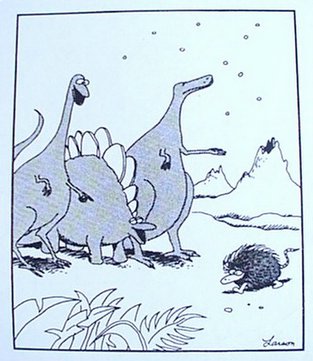
In the meantime, out of view, ideas are emerging like the placental mammals in dinosaurs days, that, although they maybe smaller, are more adaptable and flexible. It would be hard for the dinosaurs to believe that they will become the dominant form of the future.

Of course dinosaurs couldn't think and it seems the same could be applied to the current educational dinosaurs.

Who will know what will emerge but one thing we can be sure of – it won’t be because of the current educational ‘elites’: strategy plans, targets, curriculums, contracts and guidelines. These ancient ideas are the last dance of the dinosaurs creaky bones, about as valuable as rain dances in these fast moving times.

Like the old dinosaurs before them the 'educational dinosours, when the future arrives, won't know what hit them! And those that replace them won’t even care except to place them in museums of failed ideas!

If you want to survive keep an eye open for some crazy new ideas!

Monday, March 06, 2006

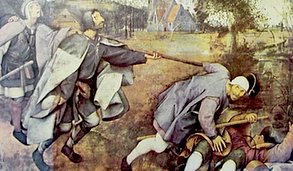
Stumbling into the future; the blind leading the blind

  Posted by Picasa

As a country we continue to stumble our way into the future led by politicians who seem to believe that the future will some sort of extension of the past when, in reality, we need some new visionary thinking.

It is not as if there are no signs that things aren’t working out. Almost all our organizations and institutions are failing to do their task as designed – our health system, the justice system, our roads, our industries, our prisons and our schools. The trouble is they were all planned in a past simplistic industrial age where people at the top new best. Add to this environmental problem and the oil crisis and it would seem new thinking would be obvious.

The trouble is our current government is bogged down in the status quo. They need to realize it is time to at least begin a dialogue on worrying issues but they seem bereft of any idea of what is required and simply drift from crisis to crisis. And the opposition is no better.

The future will be different and not a linear extension of the past. We are in the middle of a major change from an industrial society to one based on ideas and creativity. To thrive in this new, as yet undefined world, we will need to rethink all our organizations and, in particular, schools if we are to develop ‘new minds for a new millennium’. The status quo needs to be interrogated and hidden faulty assumptions uncovered if we are to break the unthinking habits that tie us to the past if we are to live with ease in changing world.

As a country we deserve better but too many citizens are all too focused on their own personal needs (survival or greed) to consider the bigger picture. It is the blind leading the blind!

Would it be great if out ‘lame duck’ government faced up to the situation and, realizing that they have little chance of being re-elected, actually started the process of developing a new sense of direction for us all; one that we all could aligning our creative efforts behind. It is about the power of vision.

The reality of the failing current situation needs to be placed in front of all citizens so they can consider the various options available. Until this is done we will remain stuck in either or arguments when what we need is a range of options to think about – and with the thought there is no one right answer. The future will require constant rethinking.

Out of this national dialogue/conversation a new vision could be created. Or at least it would be a start.

What we need is some inspirational thinking from out politicians if we are to transform our country. Transformation is a word politician’s love to use but action is now required. Actions mean change. Change means upsetting the status quo. Upsetting the status quo requires courage.

The trouble is our government has become insulated from the needs of people and is too busy listening to their political analysts, advisers and ‘spin doctor’s, all of whom are employed to tell the government what they want to hear!

We need to reinvent ourselves. Other countries have done it: Singapore, Ireland and Finland.

So far there is no real need for change coming from anywhere. We are all too blind to see we can’t keep going on as we are but eventually the signs of trouble bubbling away in our complacent society will become too great to ignore. Change will be forced on us; but by then it might be too late.

Far better to control our own destiny.

Sunday, March 05, 2006

The Big Count : Census 2006

  Posted by Picasa No doubt teachers throughout New Zealand will be focusing on the census this week? The big count!

The five- yearly Census of Population is the largest official survey taken in New Zealand to see who where are as a country. It will go out to 4.2 million people and 1.6 million dwellings and will cost 70 million dollars

Every person and household will be involved and so it will affect all our students.

What a great chance to involve students in authentic research and to involve them in important social issues.

Students could research why we need to have a census.

Where does the word census come from?

Who might use the data?

Why does the census have to be compulsory?

As well it is great opportunity to consider how New Zealand, their local community or their school, has changed over the years. Students could draw up a set of their own question to ask of their parents?

Then they will need to decide how they are going to present their findings.

Our local paper provides information about how the population has grown since the 1901 census. The changing figures make an interesting graph and the basis for all sorts of discussions. The 1901 census asked how many servants households had! In 1926 they asked how many chickens people owned! The number of people living in the country and the town has changed dramatically over the years. Now people are asked about numbers of cars and their ethnic nationality groups. A new question this year is about the number of people who smoke!

Schools will have been sent information packs for teachers to use and, if not, the official NZ Census site might be worth a look? Also look up Statistics New Zealand.

Be great if citizens were to be asked to comment on what kind of country we want New Zealand to become – it doesn’t seem right to let the direction of our country to be left in the hands of politicians and technocrats.

May be we need a new survey – a national conversation about what kind of country we want to be seen as?

Where are we going is just as important as where we are now and where we have come from.

Wednesday, March 01, 2006

Walking through your classrooms

  Posted by Picasa It is early days yet in our classrooms but not too early to get a picture of what has been achieved so far by individual teachers.

Perceptive teachers will by now have developed environments that clearly indicate the important messages they want their students to gain while in their classroom. Equally perceptive principals – that is if they are educational leaders – will have indicated agreed school expectations to all teachers.

Take a quick walk around the classrooms at your school to see what impressions they give to you – a good idea is to pretend you are taking around a group of new parents or visitors.

This is not as superficial as you would think. Malcolm Gladwell in his book ‘Blink’ talks about ‘thin slicing’ – the ability to gather a lot of information in a glance. Of course the quality of the information depends on the expertise of the individual. Wine connoisseurs can tell at a sip the quality of a wine while others of us are none the wiser after a bottle!

So what does your room environments tell about what the school values?

Before you say it is to early – think if you were opening a new shop in the local mall – would you leave first impressions to chance?

Are the room’s colourful, exhibiting student’s art and examples of work from their projects? By now the first class unit of the year ought to be coming to fruition. Does the room reflect the key questions for the unit and outline expected tasks?

Do the class whiteboards / blackboards illustrate teacher planning and management?

And do the student books that are in view show an effort to inculcate appropriate design and presentation standards – by Easter the student’s book work should be showing qualitative improvement in design and content but only if that is the teacher and school expectation.

Is their evidence of negotiated class rules and behavior expectations to be seen?

All this can be taken in by an expert 'blink' – the power of 'thin slicing'. Equally for those without the expertise the room could be patchy, flat, and dull, and not even be noticed.

If I were a parent I would avoid such rooms – but luckily most parents are not so aware - or are they?

For a teacher who understands the power of design and emotions it is a great point of differentiation. It I were a teacher today I know what you would see if you came into my room – I wouldn’t leave it to chance! And I would have to tell you – you would see it at a glance.

Ideas to halp:

Classroom criteria
Presentation of student work
Developing a sense of quality
Classroom display for unit of work

Monday, February 27, 2006

Wanted: the courage to explore new ideas.

  Posted by Picasa We all know that Christopher Columbus had the courage to sail in to the unknown and ‘discover’ the Americas. What is not so well known is his discovery allowed European cultures to ‘gather’ the resources to enable them to revive their failing economies.

What we need now – now that the world natural resources have all but been despoiled, is to leave the well known tracks and have the courage to develop some new ideas of how to develop a sustainable world as there are few natural resources left to discover that will save us.

Wouldn’t it be great if New Zealand were to lead the way? The problem is since 1984 the world wide epidemic of monetarist 'market forces' has captured the minds of our politicians and the chance of new ideas emerging is going to be difficult. Today short term greedy self interest infects us all as we turn a blind eye to the disastrous effects we are collectively are having on our environment. The greedy lack of ethics of the business world rule almost unchallenged and politicians are to busy softening the effects of ‘right wing’ thinking to think of real alternatives.

And this is all the more difficult in New Zealand because, since 1984, our country has been seen a ‘leader’ in implementing the ‘market forces’ mentality, dismantling everything in its way to create efficiency and wealth for the few.

As a result we now have a society of a few winners and lots of losers and the gap widens everyday, and this is ‘echoed’ throughout the world – where a few people own more than some countries and there are more people in the world starving than ever before!

Add to this the inevitable end of ‘big oil’, the effects of man-made climatic changes, and world overpopulation, which currently stands at 6 billion – the last 200 million arriving the past 3 years, and we are all in big trouble.

In the meantime we wait vainly in hope for the myth of progress to solve the problems for us.

Some courageous thinking is required not collective blindness!

New Zealand, a country with the least spoiled natural environment (which says something for the other countries) could take the lead to develop a new vision; a new sense of direction; a vision one that could inspire other countries to put a sustainability ethic above national or financial interests.

I guess you would have to be a supreme optimist to believe our current politicians could rise to the occasion but if they did what a great opportunity.

At the very least the government could start the debate about the kind of country ‘we’ want to be; what is the collective identity we want to develop for ourselves; how do we want to be seen? Maybe this could be introduced as part of republican debate or even a new flag?

Democracy, as we currently experience it, is a ‘thin’ experience. We need to debate how we can develop a more expansive form of democracy by pushing responsibility down to community levels leaving the ‘big picture’ for the national government? And we need to debate the need to value our cultural diversity – we are no longer a British Colony in the South Pacific!

We also need to debate as to what values should underpin our society to replace the individualism, the corrosive hedonism and greed, that seems to be the current ethic? There must be more to life than market forces and materialism? Certainly we need something to replace the powerlessness and alienation that too many current citizens currently feel.

How can we redesign education, welfare and local government so that they provide personalized services, placing responsibity in the hands of the people concerned – and in this process develop new helping roles for those who provide the services?

For our economic survival what do we need to produce as a country? In a world of low cost mass produced goods we need to tap into every person’s innate creativity to develop well designed imaginative products. How can we lead in the area of developing sustainable industries?

How can we transform education to play a central role in developing all students’ talents and love of learning so as to develop inventive, caring and creative citizens?

The answers to such ideas provide an opportunity to shape our own destiny – rather than being passively shaped by globalization, ‘market forces’ and other outside influences.

It would seem to me that by having such conversation, and by spreading such ideas, New Zealand could become a world leader?

Monday, February 20, 2006

The Big Picture

 The myth of progressPosted by Picasa This book by Ronald Wright is one everyone should read.

After hearing the author discuss his ideas on National Radio (Canadian Massey Lectures) I was tempted to buy the book from Amazon; it was well worth it!

If you want the big picture about the history of human civilization, and a pessimist but realistic criticism of the myth that technological progress will solve our current problems, this is the book for you.

It is a mind changing read. Wright is a respected historical philosopher with an easy writing style with ‘a profound understanding of other cultures’.

His book is written around the three questions artist Paul Gauguin expressed in one his last major paintings: ‘Where do we come from? What are we? And where do we go from here?’ Gauguin, after fleeing from a depressing European industrial society, was in the end disenchanted himself with the ideal society he believed existed in the South Pacific.

But the questions he asked, Wright believes, are even more valid today. Where are we going is the key question and Wright believes the answers lies in the history of previous, now crumbled, civilizations. And he believes we will suffer the same fate unless we learn lessons from the past; he not hopeful.

History, as the cliché goes, repeats itself and each time with greater destructive impact. With our blind faith in progress ‘we’ believe thus will not happen to us. In earlier days a civilization could collapse without impacting greatly on other cultures. Today if Western civilization were to collapses the fate of humankind would be at risk. The planet will continue to evolve with us!

The problem is what Wright calls the ‘progress trap’ which, as a result of technological advances, cultures eventually consume all their resource and literally fall apart – victims of their own success.

Advanced technology, from the earliest days, is a double edged sword enabling man to grow and consume more than can be supported; that growth creates its own problems. Today resources are being consumed in a way, and technology so powerful, that there is a very real possibility that the 10000 year experiment of civilization could come to and end. ‘We are clever devils’, Wright quotes, ‘but seldom wise’.

Technological advances has seen the world population expand from 200 million at the height of the Roman Empire ( 200AD); 400 by 1500; 1 billion by 1825; 2 billion by 1925; 6 billion by 2000 .The last 200 million took only three years, and, although the rate is slowing, it will reach 9 million by 2080. And as well there is more poverty in the word today than at any earlier time.

Sustaining the world’s resources is the vital issue of the future. Wright believes we now have the means to share world resources wisely, to clean up pollution, to provide better health for all, and most importantly to set economic limits in line with natural ones.

This is he believes, ‘our last chance to get it right.’ But he is not altogether optimistic as we seem to have learnt little from the lessons of the past. He quotes that Hitler once gleefully exclaimed, ‘What luck for rulers that people do not think’ and Wright adds, ‘What can we do when rulers will not think’?

The current materialistic ‘Market Forces’ mentality is destroying the resources of the world and, as Wright explains in his book, every empire finally fails because it despoiled its environment. The simplest and clearest example of this, he writes about, is Easter Island where, in the process of erecting monumental carvings, they felled all their trees. Easter Island is an isolated metaphor for the price cultures pay for ‘progress’. With our advanced technology and greed , and our false hope that progress will solve all our current problems, all the worlds civilizations are now at risk.

There is hope, Wright says, but only if: we change our minds about the myth of progress; learn from the failures of earlier civilizations; and learn to protect the environment that sustains us. He writes that it is up to us develop a sustainability consciousnesses about our world so as ‘to shape it and look after it’.

Developing this consciousness ought to be the vital role of our education system?

A powerful read.

Saturday, February 18, 2006

Learning through confusion.

  Posted by Picasa The challenge of being a new principal.

Starting a new job as a school principal is an important event but it can also be a confusing time for all. All too often the new principal rides into town, like the Lone Ranger, to solve all problems.

The simple truth is that is all too easy to start off on the wrong foot due to a lack of appreciation of the reality of the situation added to by the often confusing agenda of those involved in the school.

New beginnings are difficult in any organization because of inflated expectations of the new leader and conflicting demands of those who made the appointment. A number of mixed messages can easily occur as new leaders are expected to act quickly while at the same time they are not quite sure who to trust; what to continue with and what to change. All too often new appointees pretend to look as of they know what they are doing while at the same time drowning on events.

This can easily lead to exhaustion, stress and a ‘fighting fires’ approach.

On good idea to avoid this situation and to use this confusion to your advantage is to create an Entry Plan so that rather than hitting the school running you can hit it learning. A well thought out Entry Plan gives the new leader time to build relationships with all the key people involved and signals the type of leadership you want to develop.

An Entry Plan is premised on utilizing the confusion of the transition period by using it as creative starting point for learning. It is a plan structured to enable joint inquiry prior to making any changes and allows the new leader to use the process to uncover current strengths and possible new directions.

The plan is designed to slow things down so the appointee can learn about the deeper culture of the school and to develop collective approach to developing new directions.

The first step is to draft ideas about an Entry Plan to share with the BOT and the staff; this draft plan outlines who the new leader will meet, about what, when, where, and why. The most important things is to define the most important questions and issues as you see them you want to explore with them and to indicate that no major changes will be made until all the information form the Entry Plan has been processed. This will let all involved know that they will all have a chance to have their say.

It would be a good idea to share the draft with key people before you make it public. They may have ideas that would be useful before you make your final plan.

The final Entry Plan should include a statement outlining the point and purpose of the plan – the process, and what it is hoped it will deliver.

Following the discussion with key people and meetings with the BOT and staff, which will possibly uncover new questions for you to consider, the leader draws up the findings and challenges ahead for the school.

The key issues and findings are then presented back to the BOT and staff to gain further input. At this stage there ought to be no expectation to gain consensus.

At the end of the process the principal draws up a future School Development Plan that lists the actions that will need to be taken or researched. A useful idea would be to set up a School Development Team to share responsibity for implementing the plan.

As a result of this process the BOT and staff make decisions to put into practices areas of agreement and to instigate ‘action research’ to explore other issues.

At this point, by taking ones time to work through the confusion, all involved will begin to appreciate the empowering leadership style implied in the approach and that the responsibly for action involves everyone.

The whole point of the Entry Plan is to develop a common understanding of the reality and challenges ahead but most of all to develop a ‘we are all in this together’ attitude.

The process begins with the acknowledgment of confusion of a new beginnings; it challenges current assumptions, and ends up with agreed action plans to ensure new ways of thinking are translated into new behaviors.

Such an Entry Plan has the potential to position new leaders for success right from the start by establishing a culture of self examination and it develops a leadership approach which is both ‘top down’ and ‘bottom up’.

And through this process a new vision for the school can be forged.

Worth a try?

At the very least a good idea is to develop a ‘Position Paper’ outlining the new principal’s views on all issues because this at least will let the staff no where you are coming from!

Friday, February 17, 2006

Power of Vision, Mission and alignment

  Posted by Picasa There seems to be a lot of confusion around about what exactly are vision and missions, how are they different, and even if they are worth the effort?

I think this has occurred because missions were imposed on many organizations and were done as form of compliance. As a result they may have lost whatever prestige they may have had. Often they not even able to be articulated, let alone actioned, by staff members!

If schools are in this situation perhaps it is time for them to reflect about what their schools stands for and to ‘revision’ it’s purpose. To do this properly all in the school need to be involved if it to be actioned. If it doesn’t’ attract the ‘hearts and minds’ of all as worthwhile why would they bother?

There are too many examples of highly successful organizations that have tapped the power of a shared vision to dismiss the idea. Toyota is but one example that exemplifies what it means to pull together under a single vision and mission. Such organizations are not only focused on the future they are equally focused on creating the conditions for future growth within – they are, to use another maligned idea, a ‘learning organization’.

Visions are often reduced to a memorable phrase, or metaphor but without action they are only dreams. And the dream must connect emotionally with all those who are involved in the organization and not be the product of a few selected thinkers. Often the vision will ‘emerge’ as part of the process of ‘visioning’.

Visions are often followed by a statement outlining agreed Core Values and Beliefs

Vision by itself is not enough, you also have to know how to get there and this is the mission – and from the mission flow actions, goals, strategies and professional development.

The Mission Statement outlines what the organization does to realize its vision.

All the above need not be more than a page or so – there is no advantage it seems in wordy documents

Alignment is vital. Alignment is where vision meets reality. Alignment is the secret ingredient that holds any enterprise together as in a good football team. In any game the vision is to win, and the mission is to win with the mix of talents and skills that the players possess. And when things ‘click’ you have alignment.

But at the same time, paradoxically, an organization has to listen to those with contrary views and be open to new ideas if it is to grow. And new ideas often come from the edge!

The leader’s role in a modern organization is to keep the vision, the picture of the ideal future, clear in everyone’s mind, and to create the conditions to make use of all the talents of staff members. This involves negotiating core beliefs and expectations with everyone to define the boundaries within which staff members can exercise their individual creativity.

In the school setting this equally applies to every individual teacher and their students.

Leadership at all levels is vital to ensure to the integrity of the organization, as determined by the vision, is kept to the forefront. Without leadership organizations too easily lose their sense of direction and purpose and become wound up in processes and procedures. When the focus of vision is lost organisations become controlled by regulations and compliance. This can also happen when imposed targets are set, as worthy as they are, that replace the vision as the priority. The targets may well be achieved but often at the sacrifice of the philosophy and beliefs of those involved.

Vision can also be lost when accountability measures inadvertently make people focus on easily achieved results at the expense of the visionary aspirations. Too few measures focus on the important aspects of life and learning – on the core beliefs, philosophy and relationships that are so important in any organizations.

When vision is lost the status quo reigns and a conformist compliance non risk culture is established – and this leads to the death of any organization. In a frenetic world of fast unpredictable changes and imposed expectations it is all too easy to lose track of the big picture.

When organizations are clear about the direction they want to go in, are aware of the challenges, and are clear about what they have to do, open to new ideas, a learning culture is established.

Culture is what holds a ‘learning organization’ together, not rules and regulations. The stronger the culture the more the people will get behind the vision. Culture counts. It defines ‘what is important around here’; what behaviors are, or are not, accepted. It is the sum of the norms, behaviors, guidelines and values held by any organization. It is about how we treat people.

As the vision defines where we want to go, the mission what we do, the culture defines who we are.

Like vision culture cannot be imposed from the top – both are ongoing interrelated processes. Lasting commitment evolves when everybody has been involved in setting the direction and mission of the school. Ownership is vital – people generally support what they have had a hand in developing. Compliance comes from being told what to do; commitment comes from a shared vision.

And the measure of all alignment should be against the vision. If people get behind the vision there is a good chance of success. There will always be resistance and challenges but if the vision is inspirational they will be reduced to experiences to learn from

It is the power of alignment behind the shared vision, mision, values and beliefs that drive the learning process forwards.

Tuesday, February 14, 2006

Inspired by Albert Einstein

 
 Posted by Picasa Einstein is an individual whose thinking changed the world putting paid to the fixed measured world of Newton with his theory of relativity.

It is interesting that he is another who had a shaky start in formal education. He wrote that it was a miracle that modern education had not altogether killed the magic power of a childs sense of wonder. His concern continues to this day with our system's obsessive focus on fragmented student’s achievement rather than developing a learner's curiosity, talents and, most of all, a passion for learning; all to hard to measure I guess.

'Imagination is more important than knowledge' Einstein

Learners are curious. To be the best you have to be curious about everything and take nothing for granted. Einstein described himself as ‘neither especially clever nor especially gifted, I am only very, very curious.’

It is this curiosity, this sense of wonder, that our education system should protect above all other objectives otherwise it is only ‘schooling’ or training. Most education ends up as schooling; jumping through prescribed hoops and measuring how far you can jump.

Education has lost the big picture that so impressed Einstein. Rather than the exciting pursuit of the strange, the challenging, the interesting, it is now all about ‘evidence based teaching’ and an obsession with detail, measurement and data collection. And to make it worse data collection which excludes the very curiosity and imagination that drives true learning.

'It would be possible to descibe everything scientifically, but it would make no sense, it would be without meaning, as if you described a Beethoven symphony as a variation of wave pressure' Einstein

Education has been taken over by a ‘metric mania’ – measuring and graphing, and graphing that is made worse by the misuse of the power of the computer. ‘Data, data, everywhere and not thought to think’! Learning is about working at the edge of ones competence no matter the age of the learner.

Looking at numbers and data is not what education is all about no matter what the technocrats think. It is more a about a relationship between the learner, the teacher and some exciting content that has captured the learners imagination. Without this relationship knowledge is trivial, or inert, useful only to prove you have achieved some prescribed level or other. Learning isn’t above incremental change, achieved in isolated subjects, it is about individual leaps of the imaginations new ideas are comprehended.

And what count the cost of all the time wasted in compiling these irrelevant reports of bland achievement? How many students leave our system with their learning per intact is more to the point?

'As far as the laws of mathematics refer to reality, they are not certain, as far as they certain they do not refer to reality.' Einstein

Learning is a search to make meaning – about seeing connections and being curious about the mysteries that life throws in our way. It is not about consuming little bits and pieces without being aware of the big picture.

Learning is about finding about things that we don’t know; about things that are meaningful to us. Once we are aware of a problem then we need to do the thinking and the research and to express what it is we have found in whatever way is appropriate.

How this can be planned and assessed by distant experts without losing the spirit of learning is beyond me.

We should instead focus on what inspired Einstein.

Sunday, February 12, 2006

Evolutionary thoughts!

 
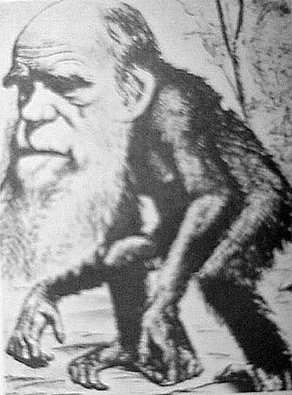
 Posted by Picasa Charles Darwin born Feb 13 1809

Charles Darwin is one individual that changed how we think about ourselves forever.

He hardly had an auspicious start in life which is reassuring for those who have yet to discover their destiny. Darwin however might not agree with the idea of destiny!

Having achieved little of note he joined the crew of the 'H M S 'Beagle' in his late twenties. During this journey he put together his thoughts that were later to be published as the ‘Origins of the Species.’ While other scientists were busy collecting and classifying things Darwin was more concerned with relationship between animals he observed and earlier forms.

What he worked out, based on his observation, has forever changed how we see human life. Up until this point the world was believed to have unfolded according to God’s plan but Darwin reduced mankind to just another successful species evolving from earlier ape like forms – and even more worrying that mankind was just another species that would continue to evolve by chance and mutation.

The thought of an accidental evolution, separate from all an guiding and powerful god, worried Darwin as well and he was reluctant to publish his findings for fear of ridicule. He finally published his seminal book before another naturalist (Wallace) published similar thoughts.

If you believed in Darwin’s theory then you had to believe that mankind (particularly Europeans) had no superior God given rights. To this day there are those who refuse to accept such ideas. Many American Schools have been forced to include in their 'science' teaching a pre –Darwinian alternative theory called ‘Intelligent Design’.

And as well, if you believe in Darwin, mankind does not have a guaranteed future having only been around a mere 10000 years – a mere blink in the history of our planet. Dinosaurs lasted longer!

Mankind is currently doing a great job of despoiling the resources of the planet we live on. Part of the myth of western civilization is a belief that progress will solve all problems. Today some believe in what is often called ‘social Darwinism, the rule of ‘tooth an claw’, based on survival of the fittest. Darwin’s theory favoured survival of the adaptable and the flexible, not the biggest and greediest. Successful species often arise from odd but successful mutants; strange, small, hairy manuals eventfully replaced the dinosaurs and some evolved into early humans.

Mankind has no guarantee of survival but the world will continue to evolve with or without them.This is Darwin's legacy.

We have the power to destroy the resources of the world and today this is a real possibility. As Thomas Huxley wrote many years ago ‘Where is the man that has so much that he is out of danger?’

A belief in progress may be our final undoing unless we develop new ecological mindsets to match Darwin’s insights. We have a lot to learn from the indigenous cultures that have learnt, through experience, to live in harmony with their environments.

New sustainability orientated mindsets will be needed; transformed schools based on developing such future focused students could be the solution.

So far it has been too much hoping for the best and not enough facing up to the worst.

We are running out of time.

A great site to study Darwin

Wednesday, February 08, 2006

Observation - a basic learning skill

 
 Posted by Picasa Observation as a skill is hardly taken seriously in our print orientated schools.

Too many teachers forget that the language facility schools value so much develops naturally before school as a bi- product of conversations with others and through a curiosity open to exploring the environment through the senses.

School need to tap into student's curiosity and need to express ideas. It is this sensory resource of impressions that is called upon by learners when they come to read. Better still such experiences inspire students to talk, draw, write and then to read their own ideas. Before the word the experience is a simple enough idea - the more you notice the more words and ideas you will develop.

So looking and noticing, and wanting to find out about things, and express what is found out, are the real basics of learning.

Creative teachers who focus on uncovering and expanding student’s natural talents value observation. Such teachers take students into the environment to help them further develop their sensory awareness. They help their students take their time to see things, to notice patterns, movements, colours, and to observe small moments of drama that nature provides.

Both in the field, and back in class, students can record their impressions through words, drawing and these days with digital cameras. Learners will need assistance to be able to do this but most of all they need to be with teachers who exemplify this kind of awareness and who model the kind of imaginative responses their students will come to reflect.

It is such experiences that keep studnets ‘learning spirit’ and ‘sense of wonder’ alive.

Observation of and expression about the natural world is the basis of literacy and imagination.

Learning to observe through drawing is a great way to start. All that is needed is to get students to ‘slow the pace of their work’, to take the time to look, and to draw what they see, continually looking back to the item being drawn to keep the image alive. The simple strategy is to ‘look, draw, look’. To start choose simple items or get students to focus on interesting aspects and use small pieces of paper; later ideas can be enlarged and coloured.

Observational drawings (every child’s interpretation will be different - or ought to be) can be later extended into the imagination and, through use of metaphor, interesting language ideas can be encouraged. And, as well, questions will emerge for students to research and read about.

When displayed students work will celebrate their ideas, observation and imagination.

All too often, in our mad rush to get students to read, we bi-pass this natural basis for learning and we demean our students in the process

For practical ideas:

Developing environmental awareness
The environment as a learning resource
The drawing process
Slowing the pace

Tuesday, February 07, 2006

What was the best thing you did in the holidays?

 
 Posted by Picasa Reclaiming the power of writing.

It is a cliché about school that the first task teachers give their students is to write an essay about ‘What you did in the holidays’!

Few teachers today would think of doing such a thing. This is a shame because their students have just returned from having a range of experiences that they were fully involved in and that will remain with them for their lives.

We are the stories we tell about ourselves. Stories contribute to our identity and sense of self. What did you do in your holidays we ask others and most of us are happy to tell our stories to those who ask.

The trouble comes when we are asked to write out such stories.

With clever teaching this needn’t be the case.

A simple process that many teachers have found useful is to ask their students to share orally in small groups what they got up to and /or to make list or ‘mind map’ of all the sorts of adventures they had. This works best if the teachers model one or two incidents from their own holiday experiences to illustrate that all that is required is a small memorable incident. Model your story: what happened, what you saw, how you felt and talk as if you were there. Make sure they understand what you want is a quality story – a lot about a little not a little about a lot.

After the students have the opportunity to share a few ideas get the students to choose one that would make great idea to share. Get them to imagine that they were back in the experience and then to write what they were thinking at the time, what they saw and felt and what other said. The best writing is if what they write is much as if they talk. Encourage them to start with a powerful first sentence that attracts the reader and also to invent a heading for their story that doesn’t give the game away! After writing a draft they could share in small groups.

Over the next few days students could write out finished copies. Some may be able to use the word processor. Reluctant students, or very young children, might need their thoughts scribed by the teacher; the teacher asking questions and writing responses.

If an illustration is to be added the children need to understand the need to give such a drawing a real focus on the important aspect of their story. They might be able to import a digital photograph of the incident.

The work needs to be valued by the teachers and every week students chosen to share with the class. Perhaps a display of writing could be arranged with a suitable heading ‘Our holiday adventures.’

This writing for its own sake – to tell a personal story but as well such writing could well be the basis of real literacy – reading their own stories; being their own authors but most of all valuing their own sense of voice and identity.

This uis all about helping students see the power of writing!

For ideas about the process.

For themes to help begin the process.

For helping very young children