Monday, April 24, 2006

ANZAC Day

  Posted by Picasa

The other side of ANZAC Day are the effects war had on those left at home.

Students might like to imagine what it would like to say farewell to tkeir loved ones that they might never see again?

What did those at home do to help the war effort and keep the country running?

How would it feel not to be able to hear from those who went away for long periods?

And worse still what it would be like to hear their loved ones had been lost in battle?

Students might think about why, when the men returned, they spoke little of their experiences?

And how would small communities throughout New Zealand be different because of the loss of so many in the war? What were the effects for young chidren who would never see ther tather again?

The answers to these questions might easily be made into a thought poem and shared at an assembly or with student's parents.

Sunday, April 23, 2006

The 'Right Stuff'.

  Posted by Picasa With ANZAC Day tomorrow I thought it an idea to think about the 'right stuff' required for courageous teachers if they are to transform our education system – or just to make their current school better.

There is no doubt that it is the qualities of the teacher that makes the difference as to the degree students gain success at school. Of course it goes without saying that the collective power of the teachers can only be fully capitalized on if the conditions are ‘right’ and they are all aligned behind a shared vision of teaching and learning.

All these condition are automatic in times of war but in peaceful times this sense of urgency is replaced by the conservative power of the ‘status quo’. Leadership is thus vital to inspire a worthwhile sense of an alternative future to focus all actions.

So leaders need to be on the lookout for staff with the ‘right stuff’.

Teachers who:

1. Have a passionate belief that all students with appropriate help and time can learn
2 Who can articulate their learning beliefs and are open to new ideas.
3 Can imagine a better learning environment and can see the problems of current reality clearly.
4 Take initiative as a default mode rather than being passive or reactive
5 Make and keep commitments when agreements are made.
6 Cooperate with others.
7 Are accountable for their decisions.
8 Try out new ideas and learn from their mistakes
9 Are curious about new ideas and have sense of imagination.
10 Have integrity and make judgments ethically
11 Have the character and courage to stand up to those who let down the team

Not a bad list.

It is interesting to state them negatively and see how many apply to your staff. With all these in place there is every chance you school will become a 'learning community' well able to win the 'battle' against the so called 'achievement tail'.

A More Informed Vision of Education for the 21stC

  Posted by Picasa The draft of the, yet to be released NZ Curriculum, has moved a long way from the ‘mile wide and an inch deep’ almost incomprehensible curriculums based on strands, levels and countless learning objectives, all originally to be taught , assessed and recorded.

While the new document, in its draft form anyway, does provide considerable freedom to school and teachers, it doesn’t really face up to the real issues facing our school system - namely the gap in ‘mindsets’ between primary and secondary teaching and teachers.

This hidden issue results in many students failing to survive the transition beween such different organisations and, for such students, it must be like visiting an unfriendly foreign country – or the way secondary schools are structured, several foreign countries.

There is an urgent need for a debate about what are the differences, why they have arisen and what might be done to solve the problems. Some writers have the issue called the issue the ‘half finished revolution’ referring to the idea that humane and progressive ideas have transformed education for the early years but have not yet had any effect of the more traditionally entrenched secondary schools.

It is the age old issue of progressive ‘child centred’ versus traditional ‘transmission ‘subject centred’ teaching. Creativity and joy of learning versus discipline and rigor, or self indulgent ‘softness’ versus 'minimum security prisons', depending on ones point of view.

What we need to do is to move past these 'either/ or' positions and develop shared beliefs that combine the best of both worlds – 'A More Informed Vision for the 21stC'. This is preferable to half baked calls solve all problems by a simplistic focus on literacy and numeracy - a modern version of 'back to basics'.

Such a synthesis would retain the spontaneity and absorption of the ‘child centred’ approach (the more acceptable word these days is ‘personalization’) and add the rigor and depth of secondary teaching so learners can penetrate their learning experiences deeply.

We want to develop students with an informed human vision – students who develop an involvement in and commitment to developing a better word. This would be in contrast with a growing sense of alienation that we see signs of in early secondary schools and an unhealthy sense of self centred individualism generally.

The main theme we need to be concerned with is developing in each learners sense of responsible autonomy to help them fashion their own lives through making significant choices . This can only be achieved by students experiencing democracy in action through active involvement in ‘rich teal and relevant’ issues.

If the super- ordinate purpose of education is to optimize learner’s capacity to conduct their own learning and to eventually become their own teachers this can only be achieved by working with other students and teachers (now ‘learning advisers’)and by being involved with real tasks. Both process of learning, and selective adult diagnostic feedback, and the 'product' are vitally important.

This takes the debate well away from ‘fuzzy’ primary or ‘deadening’ secondary subject teaching both of which fail too many students. The teachers role is vital to help students over ‘learning bumps’ and to help them develop the resilience to sustain absorption and to achieve well beyond their expectations; in the process, giving students the confidence to try even harder. Relationships between ‘advisers’ and learners are vital if experiences are to be transformed into true understanding.

It is the artistry of the teachers and their understanding of subject matter that are the real issues if students are to be helped to capitalize on their inbuilt need to make meaning.

Learning is never about simple transmission; what students bring to any learning experience, and their individual differences, needs to be valued. Appropriate interventions ( sometimes formal often incidental) are of supreme importance to ensure all students become autonomous learners, thinking their own thoughts, developing their particular set of talents and gifts, and able to make full use of their powers of self expression.

A ‘more informed vision’ would require radical transformation of our schools - particularly secondary schools where student disengagement is growing. There is an urgent need to redesign and enrich the entire learning environment, both culture and structure, if we are to develop 'learning organistionss'to help each student develop their rights - a positive learning identity.

When governments, teachers and schools face up to the need to develop such a ‘more informed vision’, and then have the courage to put it into practice, then the, so called ‘achievement gap’, will disappear.

Visit our site for ideas to assist.

Friday, April 21, 2006

So what has changed?

  Posted by Picasa I have just been trying to sort out all the notes I have collected over the years when I came some across some discussion notes I wrote for a school inspection when I was a leader of a year 5 and 6 teaching team in 1978!

They were also written to clarify my own philosophy at the time and to share with the other teachers in the team. After reading them I realized that ones basic philosophy changes little.

The notes began by saying that education is about developing the full potential of all students – not just in literacy and numeracy. The emphasis was on teaching a basic inquiry approach and to value each learner’s particular interests and talents. As well there was a strong emphasis on developing an appreciation of their natural environment and the importance of the creative arts. Attitudes of children toward learning were to be seen as vital; personal attributes more important than numbers and scores.

The number one task was to develop students with healthy self concepts as learners, able to work happily with each other. Our skills in helping children do the best they can are the key to helping difficult children and that we should be thankful for even the smallest sign of growth.

To do this we had to develop a personalized programme and help all children at their own level of need believing that all learners like to feel competent and will thrive on success – or doing something well.

A reality we had to face up to was to achieve this with thirty plus children, many of whom already had developed negative attitudes to many aspects of schooling.

To achieve our aims we needed to present programmes that provided security as well as being flexible enough to provide students with choices and what ever we do our children should know what is expected of them. Our morning would be structured around the more traditional areas and the afternoon around class studies but we would do our best to ensure that the children could see the links between them. Class blackboards need to make clear the tasks we want children to undertake.

Some points we were to keep in mind were:

1. To make use of the children’s own experiences and feelings as the basis of as much work as possible – particularly in personal language and art. During the year we would give plenty of opportunity for students to select their own areas of study as well as providing choices in current studies.

2. Student would keep personal books to write and illustrate focused stories based on their ‘felt experiences’ arising from their own lives. These books would be a important means to show growth in quality throughout the year.

3. The main motivation for class studies would relate to the immediate environment – local history, Maori history, natural science, geology, architecture. Other topics would be chosen from social studies to provide an insight into cultures past and present.

4. Such studies would allow us to teach observational and inquiry skills – formulating problems, gathering information and presenting findings. In addition studies would provide motivation for creative expression in language and art.

5. Students will keep topic books to record idea and thought about their studies and also summaries of main ideas of each study. Most studies will be recorded on individual booklets or charts. These books will also illustrate growth in student thinking and presentation.

6. A very important idea will be to ‘slow down the pace’ of students work as too many children rush and spoil their work and, in the process, gain little sense of achievement and pride. To do this we need to help then extend and elaborate whatever they are doing and to teach students basic presentation skills. We want our children to realize that a job worth doing is worth doing well.

7. Skills will be important but they must be taught in realistic situations as and when children need them. As teacher we should be on the alert for opportunities to help students gain appropriate skills.

As for the so called ‘basic skills’ reading was to be seen as reading – for fun or to gather information. We need to create situations where children want or need to read and help those who have difficulty. Children’s own writing is to be seen an excellent way to help students who are having difficulty helping them appreciate the link between experience, writing and reading.

Our language programme will be catered for as part of our studies but we need to develop language skills (in realistic ways) so students can use them in their study work. Regular handwriting is still important develop attractive work and to teach layout skills and spelling will be related to words required in personal writing or current study.

Mathematic is an area many children develop poor attitudes about. We will do everything we can to introduce maths as an exciting area of study in its own right and integrate maths into out current studies as we see opportunities. It is important that we ensure all students have a good recall of basic number facts but this will be best achieved if children learn to see maths as a form of language with its’ own patterns and beauty.

All our classroom activities will focus on developing high personal standards in all our children and to help them take responsibity, through making choices, for their own growth. Our expectations and helping skill are vital. We want all our students to learn to take pride in what they do.

As a result of our approach our room environments will feature the studies we are involved in and celebrate the depth of thinking and creativity of all our students. We need to take real care in displaying our students work as this will be seen as a sign of respect for the efforts of our students.

Don’t think I would change much today?

Wednesday, April 19, 2006

The beginnings of creative teaching.

  Posted by Picasa The Northern Maori Project

Long forgotten by all but the oldest of teachers was a wonderful experiment undertaken in the 1950s, in the far North, by a group of Maori schools directed by Art Advisers under the leadership of the then National Art Adviser Gordon Tovey.

It was as attempt to use the inspiration of the children immediate environment and inner thoughts to help the children create works of personal expression that would illustrate the power of student creativity.

Considering the traditional school environment of the era it was amazing experiment and whose effects spread, with time, through all primary classes in New Zealand. Today it would be equivalent to transforming a secondary school into a personalized learning environment ensuring all students were able to develop their creativity in a collaborative setting!


The project had five main aims in seeking ways through which creative activities, motivated through child imagination, could be used. The aims seem just as relevant today.

1. To foster personal and individual achievement, pride in, and confidence from tangible and rewarding accomplishment.

2. To learn to work with others so as to ensure satisfying collective statements.

3. To come to know and understand the environment, and through imaginative expression, become a responsive and organic part of it.

4. To come to understand the need to continually seek mastery over tools, techniques and grammatical devices, and to value these as a vital essential parts of expression.

5. Through the above to foster self reliance based on firmly based attitudes and abilities so as to enable the recurring challenges of change to be met as an inevitable and acceptable part of growth.

They seem just as worthy today.

Through such activity the students began to experience the unifying strength, purpose, and satisfaction of collective identity. While strongly individualistic, the teachers and students came to honour and meet the needs of communal efforts.

As a result behavior problems disappeared as energies were concentrated on worthwhile tasks and in helping others and as well every other aspect of schoolwork improved.

The idea of tapping into student’s strengths and talents, making use of the immediate environment, to help all student produce work of quality, and to ensure both students and schools worked together are as relevant today as ever.

The big challenge today would be to attempt such a creative approach at the secondary level as this is where behaviour and disengagement of learning is a real problem.

Monday, April 17, 2006

Observation and imagination

  Posted by PicasaObservation has been an important feature of the classrooms of the creative teachers I have worked with over the years.

An awareness of the environment is a basic evolutionary trait of all humans. Learning about patterns of behavior, cycles, rhythms and seasons was once important to survival. Today, in this brave new fast world of cyberspace, this understanding has gone, and our relationship to our environment with it.

An understanding and appreciation of the environment is more important today for all sorts of reasons.

Students who are taught to observe the intimate world of their immediate environment not only see more, and have more to wonder and talk about but, in the process, develop a wider vocabulary and ask more questions. From this wealth of sensory experiences arises the source for talking, drawing and early writing.

As children experience their natural world, with a sensitive adult or teacher, they make full use of their senses – each demanding of the learner different ways of experiencing and interpreting what they notice. And all contribute to the learner developing an emotional connection with the world around them.

It a lack of these basic sensory experiences that is delivering to our school children with limited language abilities and the answer to this deprivation is equally obvious. It is not early literacy through books that is required but immersion in rich sensory experiences with a caring adult ever ready to point out things of interest and to listen to children’s responses. For the children, who have lost this ability to notice, they will need sensitive teaching.

Young children are naturally poetic and metaphoric but, if this is lost, it needs to be ‘recovered’. Children’s writing about their environment, and their own personal experiences, ought to be the basis of literacy programmes. From children’s own writing, introduced in tandem with books written for children, a powerful literacy programme evolves. Creative teachers know this.

Perhaps more important, to develop involvement and curiosity, is the simple art of drawing. In the minds of too many teachers drawing is a minor art compared to reading but creative teachers appreciate that, not only that the experience comes before the word, but drawing is a vital way of capturing this experience in a tangible form. All that is required is to encourage children to look hard and to draw what they see. An added advantage of drawing, if taught well, is that it allows teachers to ‘slow the pace’ of their student’s work so as to develop a sense of personal excellence and, as well, provides time for teachers to interact and assist. Far too many of our students think that ‘first finished is best’ and as a result, if not countered, much of what is produced is ‘thin’ learning.

One students have enriched their perception they are the in a position to develop their ideas imaginatively moving from carefully observed butterflies to the magic of imaginative interpretations. Rather than conforming to imposed criteria every piece of work should reflect the individual who created it.

From such simple environmental beginnings a rich world of student creativity emerges and, as a bi - product, basic skills of literacy, as well as science and art, are put in place. A curriculum ‘emerges’ from students questions.

The best ‘evidence’ of creative teaching can be seen by examples of student thoughts drawings and art, and in their answer to questions they have researched as part of the process. The entire room will both inform and celebrate students ‘voice’ and creativity.

The most important observation for any visitor to see will be the atmosphere of joy and excitement and by the way the students ‘see’ themselves as ‘in charge’ of their own learning.

This is in contrast to the harried atmosphere of teachers who are trying to implement ideas imposed from a distance, trying to prove achievement with ‘evidence based teaching’, exemplars and preplanned teaching intentions; all as worthy as they are can obstruct real student creativity. They all need to be used with care by teachers; by trying to implement and document such distractions too seriously they may be losing the excitement and power of being creative teachers.

Give me team of aligned creative teachers any day – I would have faith in their professionalism to keep the thrill of learning alive – the only ‘target’ that finally counts.


Drawing process
Developing awareness

The Creative World

  Posted by Picasa While working recently with teachers I shared with them some of the influences that had created my own particular ‘point of view', or ‘stance’, about teaching. I then asked them to reflect and share their own ‘stories’. Without exception the main influences in ther teaching were other people they had been associated with over the years. I guess we call such people our mentors?

‘Stance’ is the most important thing a teacher has. It is what you stand for. Without ‘stance’ you could fall for anything.

I the early 60s I took part in a course run by the late Gordon Tovey, who was then the National Adviser of Art and Craft This course transformed my concept of teaching and learning. It was in today’s jargon a ‘rich experience’.

During this course we explored the immediate environment, responded to myths and legends, selected classical music and expressed our ideas through drawing, painting, dance, movement and creative language. This was to be the beginning of what came to be called integrated or related art studies. Pioneer teachers in the 50s, such as Elwyn Richardson, had previously led the way.

During infrequent reflective periods, and through ongoing conversations, Gordon elaborated the philosophy behind the course which was one of a series held throughout New Zealand. In reality the activities made the point for him.

Gordon explained that schools too often worked too formally and in the process excluded the imaginative worlds of the learner. Gordon believed strongly in tapping into the creative and poetic powers of inherent in all students while at the same time not discounting more formal traditional approaches. At this time schooling focused largely on an unimaginative approach to reading and maths with other curriculum areas each having their own assigned timetabled time. It was largely a verbal instructional way of learning.

Traditional teaching, Gordon believed, favoured those with verbal and logical capabilities while those with equally strong abilities, personal and collective, were ignored. In many ways the problem persists to this day.

Gordon called these neglected areas the 'creative world' of the learner. He introduced the ideas of philosopher Karl Popper who said there were three worlds:

1 The objective verbal world of things
2 The second world of the inner self
3 The third world of created meanings – the works of creation themselves.

The first world is the verbal word, the second the inner world of thinking; a means of processing ideas; methods by means of which meaning is revealed.

The third is the world of artifacts, or ‘treasures,’ that any civilization leaves behind and were, Gordon believed, to be seen in completed children’s creative expressions.

When a work has been created, in any area of learning, it stands apart from the creator and others can delight in the creativity on display. The creator feels great satisfaction and pride and the 'spur' to continue with further explorations.

For the creator they provides clues for their further growth and are seen as important milestones of their progress but, most of all, they provide children with a sense of mastery and pride of achievement.

These artifacts are completed meanings and are not to be seen as wall decoration. For creative teachers these idiosyncratic creations represent the pinnacle of their teaching. They are tangible reflection of the creative power of their students. Without this sense of power no real learning is possible.

This aesthetic approach to learning is a far cry from what passes as creativity in many classrooms today.

The so ‘called achievement gap’ ( which focuses on the 'first world’) would be solved by an education that focuses on ensuring each individual learner is able to create satisfying ‘artifacts’ in any area of learning. This ‘holistic’approach learning is preferable to the fragmented, overly process oriented, criteria based learning that is all too common today. Poor old Vincent van Gogh wouldn’t have lasted long in our current art classes!

The Ministy thankfully has moved away from it's technocratic standardized curriculum (with all their defined standards, levels and learning objectives) but they still have along way to go to create conditions to allow true student and teacher creativity to flower.

'Their' new Curriculum Document, arriving soon, provides the 'seeds' to encourage freedom and flexibility in 'our' schools. In a way it 'back to the future! Creative teachers need to take advantage of this opportunity. It even mentions a need to develop 'love of learning'.

I wonder which school will be brave enough to make'love of learning' their only ‘target’ for the school?

Such schools would be recognized by the wonderful things the students have created or can do; by the artifacts, the products, of the ‘civilization’ they have together created. This of course would include the students themselves. The technocratic phrase ‘achievement gap’ would now be forgotten as all students would have their talents recognized and valued.

Tovey, in one of his writings, said that such an education would fulfill Einstein’s dictum that the role of schools is not to produce scholars but human beings. Human beings armed with the discipline that they have gained through their own creativity able to resist the ‘soft kiss of permissiveness’.

Sunday, April 16, 2006

Creativity: process or product?

  Posted by Picasa What’s often missing when I visit classrooms are the ‘voices’ and personal creativity of the students.

In my mind education is relatively simple – to value the questions, concerns and queries that the students have about their lives and experiences and then to help them express their thoughts, ideas, current understandings as deeply as possible. As part of this process, the teacher’s role is to assist students to learn more, to complete research, and to express their idea through the expressive arts.

And, from all this focused purposeful activity, basic literacy and numeracy skills will be required, as well as providing rich areas to explore in their own right.

All too often what the classroom reflects are student’s responses to teacher’s requests and questions. Currently teachers seem obsessed with talking about criteria and exemplars and ensuring students are able to articulate why they are doing any activity; students who are able to self assess their progress and set new goals. Teachers 'teach' using ‘intentional teaching’ (in ‘student friendly’ language naturally) and assist by providing ‘feedback’ and ‘feed-forward’.

As well , many teachers, clambering on board the higher order thinking bandwagon, cover their walls with overlarge charts explaining de Bono’s hats, Costa’s ‘intelligent behaviors’, Bloom’s taxonomy ( in student language) and endless graphic organizers. These are best keep in student ‘How to Learn’ books?

As a result we now see the process orientated classroom. Technique, or skills teaching, has almost completely destroyed any sense of individual student’s creativity or ‘product’.

It has been ‘higher order thinking’ for ‘thin’ learning.

Such teachers , suffering from an overdose of pedagogy, do not understand that the point of the creative process is for each student to produce a piece of work ( research, poetry, art or dance) that represents the best a learner can do; a piece of work or performance to be proud of. We are what we create to a degree.

They do not understand that to develop such creative work thy need to do 'fewer things well' to allow their students to 'dig deeply' into any experience and then to express what they discover with individual creativity.

And if they were do this then ‘their’ rooms would reflect the individuality of their students.

You would see evidence of the latest ‘open ended’ study, or ‘rich topic’, the class was researching including: their focused ‘key’ questions, their prior ideas, and their ongoing research. And what is on display would be aesthetically presented - both the individual students work and the whole display. And, although the students would have been ‘taught’ graphic skills, each students work would reflect each individual’s style. All too often they look as if they were the work of clones.

Creative language on display would be, insightful personal stories, response to environmental experiences or part of the current study. What would be valued in every piece would be each learners ‘voice’, or writing ‘power’, not a dull composition reflecting an imposed set of criteria based on displayed exemplars.

And the most impressive aspect of a creative classroom would be examples from the creative arts. All the art work on display would celebrate student’s individuality rather than, once again, have that 'clone like' look of being interfered too much by a teacher following some criteria about art.

It is not that the various thinking skills, intentional teaching, criteria and exemplars are a bad thing but used excessively, or exclusively, they become techniques that destroy creativity.

All a teacher has to do is to come alongside the learners and to gently provide assistance without restricting students own learning power. Teaching is a delicate act, an artistic endeavor, and the proof of any teachers skill will always be seen in the variety and creativity of the students ‘products’: demonstrated or performed, in their book work, or on display. Most of all by the attitudes of students towards their own learning.


The teachers as an artist is simple idea but one requiring great skill and sensitivity.


Techniques, or process skills, are important but only if they contribute to the individual creativity of the learner.


A ‘criteria’ to assess your classroom!

Saturday, April 15, 2006

Lets focus on developing the talents of all students.

  Posted by Picasa Can you name the individuals and the eight intelligences they represent? All the intelligences are represented in our schools but few are identified and nurtured.


We now know enough about how students learn to be able to develop the talents of all students but we have a ‘knowing and action gap’.

You would have thought breaching this gap so as to develop the talents of all students would be the number one priority of ‘our’ Ministry of Education?

Not so it seems.

I have just had a chance to take a quick look at the Ministry of Education’s current document about their new organizational plan to improve themselves. It seems, according to the Education Secretary, that the Ministry is full of passionate people but unfortunately no one seems to know of this because of the way they are organized. To make things worse their feedback says the Ministry is difficult to communicate with and that different parts act without knowing what the others are doing. Most of all, it seems, that few people know what they stand for.


To solve these dilemmas they are ‘regrouping’ with the intention of everyone being able to know what they are all doing and saying. And the focus behind this endeavor is to be able to deliver ‘evidence’ that the ‘achievement gap’, their negative vision, has been bridged.

All sounds like 'rearranging the deck chairs on the Titanic' to me.

The real need in our country in the 21stC is to develop the creative capital of every young person in our education system; students need to be knowledge creators not consumers.

Without demeaning literacy and numeracy (which is how the ‘gap’ in educational achievement is measured) there ought to be a more inspirational focus for all involved in education to focus on.

What is missing in the learners included in this so called ‘achievement tail’ is a desire to learn. So called 'failing' students have lost the ‘spark’ to learn; their inborn curiosity to make sense of their experiences is dulled; the sense that they are in control of their own learning is lost. These are the real gaps!

Wouldn’t it be great if ‘our’ Ministry of Education lead the charge to develop the talents of all students and not to get bogged down in measurable literacy and numeracy targets? Such a focus is just too simplistic in such a complex interrelated world.

Rather than changing their ‘shape’ they ought to be focusing on how to create the conditions to encourage the schools to develop the talents of all their students.

Talents and creativity are ‘habits’ that can be encouraged or discouraged. You can’t ‘force feed’ creativity but you can create environments that inspire it. The Ministry needs to appreciate that students enter ‘our’ school system curious; open to ideas and a faith in their own ability to learn.

What happens to the creative and talented? Too many students begin to feel the school system is not for them and they retreat into their own minds or express their unhappiness through ‘bad’ behavior.

As students move through ‘our’ system they go from a relatively ‘student centered’ environment to an archaic fragmented subject centred secondary system. In the process they receive an ‘education’ that is the antitheses of experiences suited to the development of student engagement and creativity.

And, ironically, the Ministry’s current emphasis on ‘evidence based teaching’ and ‘measurable outcomes’ are part of the problem, creating a risk averse compliance culture that effects all levels of teaching.

Much that currently passes for education is schooling for a past industrial era and very little focuses on helping all students tap into their dreams, passions and talents. If we want to be a successful future country we need to develop in all students an identity as self motivated life long learners. Even our ‘successful’ students are too often ‘maimed’ by the process and are left to themselves to develop their real talents.

I do agree with the Secretary of Education that the current ‘status quo’ is no place to be but if we want to encourage creativity in our schools, and in turn all our students, he needs to lead the charge to ‘re-imagine ’ schools.

This means more than ‘rearranging the deck chairs’ and trying to sort out the ‘achievement gap’ it means thinking about the true purposes of education in the 21stC.

Until then too many students will leave without their talents developed.

School will have failed them. It is the school system that is dysfunctional not the learners.

Bridging the ‘gap’ between what we know about learning and the sad reality for too many students is the challenge.

Friday, April 07, 2006

Winners and losers at school.

  Posted by Picasa Our Sunday paper had an article about why some students do well at school. Forgetting for the moment that many secondary schools are not suited for many students, until they change, success in them is still important.

The Competent Children study, now in it’s thirteenth year, led by the NZ Council for Educational Research’s Dr Cathy Wylie, ‘breaks new ground in solving the mystery of why some kids do better than others.’

The research givers a big tick to the middle class parents obsession for providing their children out of school experiences – music, dance and sports etc. The research shows that children with diverse and challenging out-of-school experiences are building important qualities such as perseverance and self management. ‘What you do out of school is really important to how you approach school and the kind of knowledge that you’re bringing in’, Wylie says. ‘These activities involve persistence, and they have goals. It’s about firing on all cylinders.’

The warning in the research is about students who do little but immerse themselves in electronic gaming. These children, it seems are heading for trouble, academically and socially. Such activities are not a worry if children have other interests as well.

Children at 14 are beginning to become divided into two groups, those that look like they will do well in life, and those that will not. Two thirds of them are engaged in school and the others find the experiences less than engaging. There are a lot of reasons for student’s success at school: parental expectations and support, early childhood education, exposure to reading at home. These of course are more likely in affluent middle class homes.

Unfortunately for many students without such experiences school must be like going into another world.

The research found that at fourteen the 'all rounders', taking part in the arts and sports activities, were also doing well in their learning and in their social and communication skills.

What the research is saying is that it is important for kids to have experiences that get them to use language, or that challenge them, so they don’t just take their own world for granted. ‘They are trying to master something’, Wylie says. Such kids were ‘topping up communication abilities, curiosity, self management and social skills.’

At the other extreme were the children who said either that electronic games were their main interest or that they had no interest, or spent too long watching TV; about a quarter of the students. Such students were more likely to not to enjoy reading and to be at risk of disengagement from school. The time to worry is when electronic gaming becomes all-absorbing - when there is nothing else.

Parents need to provide rich experiences for children and this not need to be expensive options. Taking children tramping or fishing, going for a walk, or giving children responsibity around the home, or encouraging a hobby, a sport, and drama – anything that challenges children and encourages them to articulate their thoughts, to enter into conversations, and develop social and other skills.

‘Boredom is the big sign if my kid is monosyllabic and I can’t see anything deeply intriguing them, there is something not right’, says Dr Wylie.

‘Unfortunately there are homes where you realize there is very little use of language going on’ and she continues, ‘those kids are so disadvantaged’. Learning how to have conversations with children, reading to them, and to encourage children’s interests are a start but it is hard to compete with the electronic universe of monsters, heroes and villains and exciting computer games.

Changing such habits will not be easy.

Wylie said, ‘the research raised questions about how to enrich the lives of students from children of the poorest backgrounds. If their homes did not provide enough enrichment maybe society should.’ She suggested decile 1 and 2 schools be given resources to offer extra activities, such as drama productions or music lessons.

Schools would welcome this as Wylie’s research found children of low decile schools much less engaged and less confident and often such students disrupt others who are ready to learn.

It is not as simple as saying teachers should have higher expectations . In these schools teaching and learning was a lot harder as students in such school are easily bored and easily distracted ;and they enter with less motivation and without adequate literacy and numeracy skills. And as the work got harder they struggled Wylie says.

The strongest message to come form the research, Wylie said, was that no child was preordained to turn out one way or the other. ‘That gives parents and teachers ground for hope- and also continuing responsibility.’

It would be great if schools were to place all their efforts towards building a learning environment that exposed all their students to a range of creative and physical activities.If this were done the teachers role would be to tap into, and amplify, the interests and passions of all students, and to do this in concert with the parents and the wider community.

To engage all students schools would have to change dramatically – particularly those catering for students at the age of 14!

Sunday, April 02, 2006

Ways of exploring a bridge

  Posted by Picasa There is a lot of talk these about the importance of ‘higher order thinking’ and ‘inquiry learning’; that process is more important than product, but this can’t be true? Real learning needs something to process and inquire about; real learning needs to be driven by learner’s passion of a need to know or to express personal responses about. It is this drive to make meaning, and to express it in an in-depth way, that schools need to protect and value above all else.

Many classrooms have diagrams about ‘multiple intelligences’ on display and try to integrate them into the studies they do with their children. This is a valuable idea but unless students produce in depth research or focused artistic expression about what they are exploring it adds little. Even in schools that profess to use ‘thinking skills’ and ‘multiple intelligences’ etc they still focus most of their efforts on literacy and numeracy, or only two of the ‘intelligences’.

An idea that was around well before the idea of 'multiple intelligences' emerged was to encourage children to explore and interpret their environment using a number of frameworks or viewpoints; the more frameworks, or ways of seeing, the bigger their ‘net’ to capture experiences.

For students to interpret their experiences in such a range of ways teachers need to have similar diverse, yet integrated, ‘mindsets’. Unfortunately how we ‘see’ is shaped by our previous experiences and if our minds are closed to diverse interpretations wonderful opportunities to learn are missing. This is the case for many teachers through no fault of their own.

Take for example the experience of exploring a bridge; most schools have a bridge nearby they could visit.

A bridge can be interpreted in many ways. It can be perceived as structure appealing to the architect, scientist, engineer, or mathematician and, as a result, become the inspiration for a great science unit resulting in lot of measuring and modeling to test strength of shapes. For an artist however the lines, colour, shapes and patterns might appeal. For those with a poetic ‘mindset’ all sorts of thoughts might be inspired - the bridge itself could be seen as a metaphor about crossing over into something new. Years ago I observed a sensitive teacher spend thirty minutes or more letting young children just explore a swing bridge through their senses and emotions. Back in class these five year olds were full of thoughts to express in talk, drama, writing and art. No doubt those with musical or drama background would find some way to express their ideas about a bridge in their own way. And of course a local bridge provides an entry point for students to research famous bridges around the world and historian will know of stories to share – Horatio at the bridge comes to mind from my own school days.

Each way of seeing and interpreting has its own particular set of skills to employ. Each person will have particular strengths that will make certain aspects appeal to them. This is as it should be. To appreciate that there are a range of ways to interpret and express any experience is a valuable insight all students need to gain if they are to really appreciate the wonders of their world.

The true value of any experience involves depth of thought and expression. If such an approach results in a range of mediocre products then it would be a shame for it is the quality of the thinking and the quality of whatever is created that is the key to developing lasting attitudes toward learning. It comes down to ‘doing a few things really well’ because whatever is produced is a reflection of the learners worth in their own minds as well as in the minds of an observer.

It takes a creative teacher to understand the power of such learning.

Developing real literacy : Margaret Mahy

  Posted by Picasa

I once read an article by Mem Fox, an Australian children’s author, who was talking about the phonics versus whole language debate. She said that those arguing were missing the point. The key to a child learning to read was the relationship between the learner and the helper. If positive respectful relationships were in place then of course she would go with a whole language approach.

To my way of thinking the key to develop powerful readers is to begin with each learners own experiences and identity and, through these, to help each learner develop a sense of ‘voice’ and of themselves as learners.

All learning is about developing a sense of personal competence and power but all too often technical process of being able to read is seen as an end in itself.

And it is just not good enough to acknowledge a students experience, or to simply provide experiences to write about, just to get them to write something for them to later read. If they are ever to really appreciate the power of story telling, or reading to learn something, then they must tell their own stories and learn about things they are interested in.

Margaret Mahy, one of New Zealand’s most accomplished children’s writers, in her biography written by Tessa Duder, says we are not changed by experiences as common wisdom has it. What changes us are the stories we tell about our experiences. ‘Unless we have formed our lives into story, structured it with words, we can’t contemplate the meaning of our lived experience’ This is done by turning the raw material of our life into stories, and in the process, ‘it can be creatively transformed and given meaning’.

Teachers by valuing this approach can help all their students, develop a sense of self, realize the power of story telling and develop ‘real’ material for the individual student, and their classmates, to read.

The best way into reading is to tap the emotions, the sensory impressions and the insights that emerge from the experiences, real or remembered, of each individual learner. From these powerful stories can be written, or scribed, to become the basis of first reading .When students read other books written for them they will be able to comprehend that they too are authors – authors of their own lives.

Many parents write out, or share orally, such real or imagined stories of their children well before the students come to school – appreciating such activities are more valuable than resorting to flash cards and phonics.

Student centred teachers, if they really value personalized learning, ought to have rooms full of students' stories, questions and ideas. Struggling readers need sensitive adults who after lots of talking and sharing can scribe out, or help students write out, their own stories to read. If this were to be done the emphasis needs to be on developing the students identity as writers and not just to get then to read something; artistic expression could be part of the process.

Teachers need to see their students as professional 'meaning makers' with lots of exciting stories and ideas to share and to develop their classroom into learning communities. Kids would then grow into reading, and all other areas of learning, as a natural process of self discovery.


Tuesday, March 28, 2006

C. A .T. says cat - or does it?

  Posted by Picasa The reading wars continue endlessly; ‘whole language’ versus phonics. The trouble is that the proponents of phonics seem to see the world in black and white!

Like everything in this interconnected world nothing is ever so clear.

A couple of day ago the debate was rerun on National Radio motivated, I would think, by a biased point of view of the interviewer.

The interviewer set the scenario. Phonics has just been mandated in all primary schools in the UK. California has thrown out ‘whole language’ (inspired by NZ educators in the 80s) and has also introduced phonics approach. And our 20% reading ‘achievement tail’ was produced as evidence that primary schools are failing to teach students to read and, of course, the simplistic notion that our scary prison population has resulted from reading failure. Not that our long ‘achievement tail’ is not a serious one.

The protagonists were Tom Nicholson, a rabid phonics fan who has just written a book on the subject, a pro phonics professor from Californians, and in the other corner our current Minister of Education.

It wasn’t such an uneven debate as might have seemed expected. A determined effort by the interviewer to force the Minister into mandating phonics in our schools didn't come off. Tom Nicholson stated no one had been taught to use phonics for three decades, that teachers were not allowed to, and that the ‘mixed’ NZ approach was not doing the trick as evidenced by the ‘achievement tail’ and the illiterate prison population.

The American professor admitted that whole language had been found wanting in California but that after phonics had been introduced the scores hadn’t changed. This he put down to immigration, cultural differences and poverty. Seemed like a clue to our ‘achievement tail’?

The Minister, fresh from seeing for himself the results of intensive literary training in a group of trial school which had shown remarkable success, was up to the occasion. He stated his belief in the NZ ‘balanced’ literacy approach, one which included phonics, while admitting teachers need a better understanding of literacy teaching including phonics.

While Nicholson (and the interviewer) wanted the Minister to follow the UK way and mandate phonics the American supported the Minister’s idea of providing phonics in realistic contexts as part of a balanced programme. He warned against simplistic solutions.

It was great to hear our Minister talking about the need for: a ‘personalized’ approach, the need for ‘rich’ language experiences, tailoring instruction through diagnostic teaching to the needs of the learner, as preferable to a ‘one size fits all’ mandated approach. He shared the ideas of ‘evidence based teaching’, he had just seen, where students and teachers could both articulate what they could do and what they need to learn or teach; and he shared impressive statistics to show how much these learners had progressed.

It is obvious that phonics is no ‘silver bullet’ but useful tool in decoding reading for students at risk. And worldwide there is research to indicate it would be mistake to mandate phonics as the number one way to teach reading.

The new draft NZ Curriculum includes grapho-phonics as an element of reading within the context of a language rich programme that challenges students to want to learn.

This is as it should be. We just have to do it better.

Monday, March 27, 2006

The earlier the better!

  Posted by Picasa Now and then common sense hits the newspapers about education.

Everyone has all sorts of cures for the number of casualties in our society particularly when it comes to schooling. Solutions for some seem as 'basic' as making phonics compulsory in all schools. If only it were so simple. Too many of our problems are already predetermined by our increasingly dysfunctional society before children get to school.

With this in mind it was great to read in an article in our local paper that we have a real cure already - one that has been largely overlooked or at best paid lip service to; the strategic significance of early intervention. It is common sense that the earlier you intervene in anything the better. And as the article said, ‘the magic time is well before they get to school. Wait till the kid’s turn eight and you’ve missed the bus.’

Scientists studying early brain development know that babies are born with unformed and plastic brain and that they start learning from the moment they are born and also that the success ( or otherwise) at this stage affects the cognitive and emotional skills they acquire which in turn affects their success in life.

The trick we are told lies in the interaction with their parents or caregivers and to be really 'mind growing' the environment needs to be ‘nourishing and stimulating intellectually and emotionally.’ ‘The earlier the seed is planted and watered, the faster and larger it grows.’

This dynamic support system can be lacking in homes disadvantaged by poverty and the absence of positive support systems. Families, not schools, are the major source of inequality in the performance of students. Gaps emerge early in student achievement but after eight research shows that the school environment plays only a small part in accounting for achievement gaps.

The lack of success of many students, it has been shown, were sown early in their lives and any help provided at later stages is problematic. Too often, the article states, ‘they strike after the die is cast’, but studies show that early interventions are highly effective. Many of these programmes were judged a failure at the time because initial gains had been lost but researchers, who followed these children into later life, found the students involved earlier more than three times more likely to be successful at High School compared to those who hadn’t been involved in such programmes; by 27, were four times more likely to earning a high wage; three times more likely to own their own home; and twice as likely not to have been on welfare or arrested.

So why did such programmes, deemed an early failure, produce such impressive results longer term? This is evidently because Americans place too much emphasis on cognitive ability (IQ) rather than on cognitive ability or emotional intelligence (EQ). EQ covers such things as getting on with other people, working with others and such things as perseverance and tenacity – attributes that help in many aspects of life.

It is common sense that taxpayer’s money, currently used helping many dysfunctional older learners and adults, would be better spent in ensuring all children get a good start in life.

And it is pretty clear as well that too much current education is centred on cognitive achievement rather than the wider dispositions and qualities necessary to be successful in life. As a result learner’s brains and their life potential are not fully realized – and as a result their creativity and contributions wasted.

Puting money into solving poverty and supporting early education for those 'at risk' pays off.

Maybe it is the wider society that is dysfunctional?

Thursday, March 23, 2006

The dark side of feedback!

  Posted by Picasa These days there are few teachers that don’t include in their teaching vocabulary the phrase ‘feedback’ and, to show they are on the ball, ‘feed forward’! And there are few rooms that don’t have written out (in ‘student friendly language’) ‘learning intentions’. And of course there are ‘negotiated criteria’ and ‘student self assessment’ to be developed. All these techniques are linked to the efficient sounding phrase ‘evidence based teaching’. All very technocratic if hardly original.

The proof is always in the results; in what students can demonstrate and do rather than recorded statistics and fancy graphs. And this ‘proof’, if it is required by those outside the classroom, ought to include attitudinal ‘data’ as well. All too often subjective aspects of learning, such as desire to continue with the activity, are missing.


Too often the processes have replaced substance; learning is essentially about every individual making their own meaning
.

All these ideas seem to come from literacy projects relating to the ideas about formative assessment led by people like John Hattie. Hattie’s basic research finding was that the single most important way to improve students learning is ‘oodles and oodles of feedback.’ Hardly an original insight; I have observed creative teachers, who really value what students think and can do, using these ideas for decades.

Creative teachers succeeded because of their focus on helping students achieve creative work required them to help with a 'light hand'!. The difference between what creative teachers want and the formative assessment ‘converts’ is this avoidance of conformity – the valuing of individual responses rather than imbedding a way of thinking. And to make things worse many teachers, by applying a heavy handed exemplar criteria based approach to areas such as art, are developing classrooms that reflect teacher’s ideas rather than the imagination of their students.

These dangers were pointed out by Noelene Alcorn, in NZCER Set 1 2005, who wrote that this emphasis on evidence based policy making and teaching, while having value, may as well lead to a narrowing of teaching possibilities. She says this narrow emphasis of issues of ‘evaluation, assessment, and measurement have become a major focus'. By placing student’s success or failure in the hands of the teachers skill of using such techniques could place unnecessary responsibity or ‘scape-goating’ on teachers.

She also mentions that there are a number of other exciting approaches to learning that are available that may be being neglected, and that this ‘new found faith in evidence based teaching needs tempering.’ She is concerned that evidence based teaching is at the expense of ‘creativity imagination and higher order understanding. Teacher creativity has also suffered.’ She continues, ‘imagination and mystery are integral part of our lives. Not all evidence is factual. Education is a life long process concerned with much more than achievement of specified knowledge and skills.’

And in respect to this faith in feedback research has shown that feedback can actually reduce ones capacity for honest self reflection by reinforcing our expectations that others will and should tell us how we are doing and therefore reducing self accountability and belief in ones own ideas.

All this is not to say that these ‘evidence based’ techniques are not valuable, it is just that they should be used with sensitivity and respect for the identity and voice of the students.

If teachers notices that their students writing, art and verbal responses, are becoming ‘clone like’ then it might be time to ‘lighten up’. We may be turning into ourselves into technicians and in the process sacrificing the artistry of teaching and the mystery of learning.

The future requires not just those who can learn efficiently but learners with their talents and passions developed; with the imagination and confidence to their live creatively.

Thinking from the inside out!

Teaching ‘thinking’ seems an important thing to do but paradoxically too much emphasis on ‘higher order thinking’ (HOT) can actually result in low level thinking!

Teachers can become so enamored with de Bono’s hats, Bloom’s taxonomy, Gardner’s multiple intelligences, graphic organizers, mind maps, Costa’s intelligent behaviors and endless inquiry learning models that the focus is taken off what it is the students are actually learning.

Not that anything is wrong with any of the above – they are all valuable ‘thinking process but they are a means to an end, students able to achieve real in-depth thinking about content felt to be important to the learner. As such they only work if driven by deep curiosity and a passion to find out something by the individual learner. All too often when I visit rooms I see walls full of posters outlining thinking skills but search in vain for quality results of all the processes. Such ‘thinking props’ ought to be placed in a ‘my thinking book’ book for students to refer to as necessary leaving the walls to celebrate student creativity.

It was great then to read in Mark Treadwell’s ‘A Thinking Framework’ Jan /Feb 2006 newsletter that the basis of thinking is personal and revolves around the question, ‘how do I know I am me?’ Thinking is an internal process of self invention; about developing our continually emerging mind by coming to understand ones personal world. It is developing in each learner a learning identity with a particular idiosyncratic voice.

By this process of self invention we all develop mental models which in turn help us interpret ant future experiences – for better or worse. What we think and do, and see other do, is limited by our internal world view. Our views are colored by our life experiences and interpretations. The room for misinterpretation is obvious

Rather than spending time teaching everyone a set of thinking strategies it would be wiser to pay attention to what students think and feel and to focus on what questions and queries they have, and to value their views, current theories and misconceptions.

Our minds are continually on the search to find patterns and meaning in whatever experiences we have. Humans are the only animals dedicated to ‘making meaning’ so as to change their environment suits their needs. It is this desire, or love of learning, that should take priority not imposing out of context think skills.

Helping students become aware of their ‘views’ and ‘thinking’ ought to be the focus of teaching – this awareness of ones own thinking is called meta-cognition and students who can achieve this are the real future thinkers. Encouraging such reflective thinking after any activity is vital if students are to ‘learn’ through their experiences.

The need to learn can be motivated by a number of things – curiosity, confusion, mystery, competition, identity and even fear. Really comprehending how students think is an elusive task but luckily the brain is equipped to process information and even has specialist areas for different modes (multiple intelligences). What is required is the provision of a stimulating environment full of intellectual challenges and a culture that encourages the use of intelligent behaviors (including learning through ‘failure’) to encourage the dispositions, or intellectual ‘habits’, to be life long learners. Any specific thinking skills should be called on appropriately to assist students make meaning. Inevitably whatever is learned is learnt because it has emotional meaning to the individual. Passionate teaching, linked to students needs to know, is vital.

So learning results from when students ‘mental model’ or ‘worldviews’ are challenged and modified. It is not as rational as providing a set of thinking skills. The model of teaching that best fits this approach is constructivism, or better still ‘co-constructivism’ where the teacher and learn together to ‘make up their minds’.

Teachers need to become skilled in establishing learning cultures or communities and in providing tempting learning challenges, and by using 'open', 'rich', or 'fertile' questions, assist their students think deeply about whatever has attracted their attention.

Whe need students when they leave formal schooling with their talents and passions developed, with positive learning values in place, and with the wisdom to be able to interact critically with whatever comes their way.

Monday, March 20, 2006

Which came first - the chicken or the egg?

  Posted by Picasa Does a school develop its vision first then set about putting it into practice, or does it decide that, since current reality is not working, to work towards something better and in the process develop a new vision? And does it really matter?

The most important thing is for a school to have a shared sense of direction that acts like a 'moral compass' helping all decide what are the ‘best’ actions to take. There will be no best actions but some are better than others.

A widespread realization is that a school should have a compelling vision of what it could become. But visions, without the 'buy in' of all staff members (or a critical mass), have no real power to change anything and are just a form of 'window dressing'. 'A vision without action is merely a dream.'

To develop a compelling vision that all 'buy into' requires a process where the ‘voice’ and concerns of all involved are recognised and valued. Every teacher, no matter how cynical, has an image of an ideal school somewhere in their mind and taking time to uncover this is well worthwhile. Even when a vision is 'drafted' out the hardest bit is actually defining what this new vision means in action. Everyone needs to be involved in thinking through what changes need to be made; most of all each individuals previously unexamined teaching habits! This requires courage and leadership by all because changing 'mindsets' is not easy. ‘A good past’, someone said, ‘is dangerous it makes us content with the present and so unprepared for the future.’

This is no easy process but done well it will result in a vision community owned by all.

In contrast schools that recognize that their school is failing their students, or who simply 'feel' their must be a better way, and then who set about exploring new ideas about how to teach and learn, can develop the ‘knowledge in action’ to develop a vision that, when realized, all will feel part of.

This idea of ‘growing a vision’, built out of the ideals of all involved, may be the most powerful process of all and ends up with a collective sense of direction owned by all.

One thing is for sure, there is no easy way to develop a powerful compelling vision. No way can you copy one, unless you do the hard work needed to ‘own it’.

Whatever way a school goes about developing a vision the process of shared dialogue is vital. The final proof will be seen in the actions and behaviors of all involved not in the paper work proudly displayed in the foyer. A vision lead school, no matter how the process begins, is an exciting diverse place to teach and learn in – a place of continual exploration and adventure; a true learning community full of good ideas, energy and hope.

'A vision with actions can change the world.'

As far as the 'chicken and egg' argument goes – my sense is that both are true. Teachers given the right conditions will always thrive and be creative.

Schools that fail are those with no shared vision.

From solitary play to collegiality.

  Posted by Picasa Relationships are the key to a quality school.

Relationship can range from vigorously healthy to dangerously competitive says Roland Barth, Director of the Leadership Centre Harvard University.

Strengthen relationships and you improve professional practice. The relationships between the teachers define all the other relationship in the school and determine the quality of the school culture.

Many schools, Barth writes, are full of ‘non discussables’- important matters seldom discussed. Such things as: poor leadership, issues of race, the underperforming teacher, the place of our own personal visions and, of course, the quality of relationships. Actually we do talk about them, Barth writes, but in the car park after staff meetings. The definition of a 'non discussable' is an issue of sufficient import that it commands our attention but is so incendiary that we cannot discuss it in polite society and they ‘lurk as land mines’.

Barth says there are various forms of relationships

1. Parallel play – a concept from pre school literature where young people play together alone, self obsessed and engrossed, not really sharing or collaborating. This seems a perfect description of how many teachers interact (the ‘self contained’ classroom) and also the relationships between adjoining schools – ‘we are all in this - alone’.

2. Adversarial relationships. This can be as simple of withholding information or not sharing ideas and insights (‘craft knowledge’); ‘guarding their tricks’.This can result in teachers continually repeating failed ideas. Often teachers who share ideas are subtly put down by their ‘colleagues’.

3. Congenial relationships. Such schools abound with positive interactive relationships but rarely about serious school issues. A place to drink and eat but not to think – ‘no talking about teaching in the staffroom’.

4. Collegial relationships. Of the four this is the most important and hardest to establish. ‘Schools are full of good players. Collegiality is about getting them to play together, having learning conversations, about growing a professional learning community.’ A professional learning community is built on continual discussion about what is important – the beliefs shared about teaching and learning. Simple ‘walk and talk’ staff meetings, sharing ideas, are a simple beginning.

Leadership is all about creating the conditions for teachers to share ideas and to foster collegial relationships; about making it clear what is important in the school; developing with the staff clear beliefs and clear expectations and protecting and celebrating those who engage in collegial behavior.

As Barth says, ‘Empowerment, recognition, satisfaction, and success come only from being an active participant within a masterful group – a group of colleagues.’

Thursday, March 16, 2006

Teachers can be prickly individuals

  Posted by Picasa


It does seem a paradox at times when teachers do not demonstrate enthusiasm for a new idea that would improve both their teaching and their student’s learning – and possibly make teaching more fun.

But it is also understandable as teachers over the years have been bombarded with ideas they ought to implement provided by distant, sometimes instant, 'experts'!

Some teachers, like their students, just find it easier to keep their heads down and play the game. This is a wise survival move particularly as no one seems that interested in the voice or concerns of the teachers

As a result many teachers seem to have adopted a few basic myths;

1. Some teachers believe that theory is not important to them as they are practical people and know what works for them. Asking teachers to articulate their theories, one observer writes, ‘Is akin to asking fish to examine water.’

2. Many teachers hold the view that teachers should be able to ‘do their own thing’ in the classroom as there is no one best way.

3. Some believe as ‘professionals’ they feel they ought to be trusted rather than be held accountable.

4. Some are delicate flowers very sensitive about perceived criticism, either direct or implied.

5. And of course there are the cynical and suspicious who have suffered at the hands of countless failed innovations. Many withdraw into their own world and in the worst of case become ‘cryogenics’; the ‘living dead’.

These are the ‘prickly teachers’ that are easily upset.

The challenge is to develop a school culture that can help such teachers reach past such counterproductive myths.

There are teachers in all schools who are open to new ideas that are there to help them if they were to ask but it difficult to change ingrained habits, particularly in traditional schools that reflect fragmented learning and privatization of teaching.

Another myth that gets in the way of school change is the putting down of teachers with ideas as ‘showing off’ and as a result such valuable teachers begin to downplay their expertise rather than evoking jealously from their peers.

All is not lost. Beyond such ‘defensive masks’ most teachers long to be part of a collegial community; one that values each persons uniqueness and contribution.

The first step would be to begin a conversation about what would make an ideal school for both teachers and learners. A number of issues would arise and teachers could themselves start to decide for themselves what needs to be done.

Teacher designed schools, teachers as learners – now that is a vision worth fighting for.

Wednesday, March 15, 2006

Time to throw a spanner in the works!

  Posted by Picasa It is not hard to see secondary schools as artifacts of the 19th C .They so much resemble the Industrial Revolution on which they were based. They may be kinder gentler places today – for some students that is debatable, but they retain the features of a true industrial aged hierarchial organization or, worse still, a factory!

Bells ring, students are passed from teacher to teachers to have information fed to them and they are tested and marked accordingly at the end of the assembly. There has been at least some cosmetic improvement – rather than 50% failing (a common practice within living memory) all students are now placed on some sort of achievement continuum - 20% leaving with litle to show for their time.

It is all about standardization, control and obedience, the very attributes young learners most need not to learn if they are to succeed in an age of creativity, ideas and imagination.

It is about time to throw a spanner in the works of such archaic organizations and to develop schools as democratic learning communities based on shared values that focus on developing the talents and creativity of all learners.

Customization or personalization of learning needs to replace the current ‘one size fits all’ approach.

A country can no longer afford to waste such valuable intellectual resources. We now know enough about teaching and learning that no student need fail but only if we change our minds and our schools first.

Pass around the spanners.

Tuesday, March 14, 2006

No strategy plan for the future!

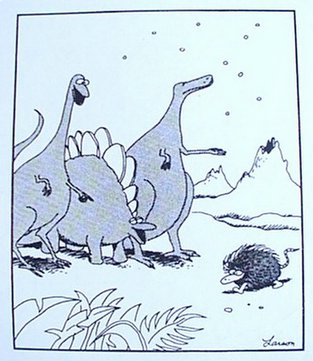
  Posted by Picasa There is no doubt when you look around the various Ministries and Education Departments around the world the dinosaurs are alive and well.

The world at the beginning of the 21stC seems to have much in common with the age of the dinosaurs. The comet is on the horizon and climatic change is upon us but like dinosaurs we all happily go on as if nothing could ever change.

And, like the dinosaurs unable to change, we seem doomed for extinction. Quite the contrary we seem determined to use whatever resources we have in a frenzy of greed – nations fight over the last drop of oil ( under the name of freedom of course!) .Locally we buy up beach land and build monuments to ourselves and generally pollute our environment.

There are a few who can see beyond expediency and are beginning to worry that it can’t go on as it is – the industrial age has all but destroyed itself and its institutions like school are caught in the same trap.

But who is listening?

In the meantime, out of view, ideas are emerging like the placental mammals in dinosaurs days, that, although they maybe smaller, are more adaptable and flexible. It would be hard for the dinosaurs to believe that they will become the dominant form of the future.

Of course dinosaurs couldn't think and it seems the same could be applied to the current educational dinosaurs.

Who will know what will emerge but one thing we can be sure of – it won’t be because of the current educational ‘elites’: strategy plans, targets, curriculums, contracts and guidelines. These ancient ideas are the last dance of the dinosaurs creaky bones, about as valuable as rain dances in these fast moving times.

Like the old dinosaurs before them the 'educational dinosours, when the future arrives, won't know what hit them! And those that replace them won’t even care except to place them in museums of failed ideas!

If you want to survive keep an eye open for some crazy new ideas!

Monday, March 06, 2006

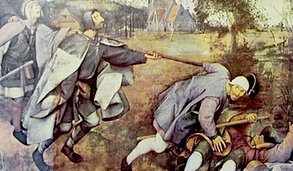
Stumbling into the future; the blind leading the blind

  Posted by Picasa

As a country we continue to stumble our way into the future led by politicians who seem to believe that the future will some sort of extension of the past when, in reality, we need some new visionary thinking.

It is not as if there are no signs that things aren’t working out. Almost all our organizations and institutions are failing to do their task as designed – our health system, the justice system, our roads, our industries, our prisons and our schools. The trouble is they were all planned in a past simplistic industrial age where people at the top new best. Add to this environmental problem and the oil crisis and it would seem new thinking would be obvious.

The trouble is our current government is bogged down in the status quo. They need to realize it is time to at least begin a dialogue on worrying issues but they seem bereft of any idea of what is required and simply drift from crisis to crisis. And the opposition is no better.

The future will be different and not a linear extension of the past. We are in the middle of a major change from an industrial society to one based on ideas and creativity. To thrive in this new, as yet undefined world, we will need to rethink all our organizations and, in particular, schools if we are to develop ‘new minds for a new millennium’. The status quo needs to be interrogated and hidden faulty assumptions uncovered if we are to break the unthinking habits that tie us to the past if we are to live with ease in changing world.

As a country we deserve better but too many citizens are all too focused on their own personal needs (survival or greed) to consider the bigger picture. It is the blind leading the blind!

Would it be great if out ‘lame duck’ government faced up to the situation and, realizing that they have little chance of being re-elected, actually started the process of developing a new sense of direction for us all; one that we all could aligning our creative efforts behind. It is about the power of vision.

The reality of the failing current situation needs to be placed in front of all citizens so they can consider the various options available. Until this is done we will remain stuck in either or arguments when what we need is a range of options to think about – and with the thought there is no one right answer. The future will require constant rethinking.

Out of this national dialogue/conversation a new vision could be created. Or at least it would be a start.

What we need is some inspirational thinking from out politicians if we are to transform our country. Transformation is a word politician’s love to use but action is now required. Actions mean change. Change means upsetting the status quo. Upsetting the status quo requires courage.

The trouble is our government has become insulated from the needs of people and is too busy listening to their political analysts, advisers and ‘spin doctor’s, all of whom are employed to tell the government what they want to hear!

We need to reinvent ourselves. Other countries have done it: Singapore, Ireland and Finland.

So far there is no real need for change coming from anywhere. We are all too blind to see we can’t keep going on as we are but eventually the signs of trouble bubbling away in our complacent society will become too great to ignore. Change will be forced on us; but by then it might be too late.

Far better to control our own destiny.

Sunday, March 05, 2006

The Big Count : Census 2006

  Posted by Picasa No doubt teachers throughout New Zealand will be focusing on the census this week? The big count!

The five- yearly Census of Population is the largest official survey taken in New Zealand to see who where are as a country. It will go out to 4.2 million people and 1.6 million dwellings and will cost 70 million dollars

Every person and household will be involved and so it will affect all our students.

What a great chance to involve students in authentic research and to involve them in important social issues.

Students could research why we need to have a census.

Where does the word census come from?

Who might use the data?

Why does the census have to be compulsory?

As well it is great opportunity to consider how New Zealand, their local community or their school, has changed over the years. Students could draw up a set of their own question to ask of their parents?

Then they will need to decide how they are going to present their findings.

Our local paper provides information about how the population has grown since the 1901 census. The changing figures make an interesting graph and the basis for all sorts of discussions. The 1901 census asked how many servants households had! In 1926 they asked how many chickens people owned! The number of people living in the country and the town has changed dramatically over the years. Now people are asked about numbers of cars and their ethnic nationality groups. A new question this year is about the number of people who smoke!

Schools will have been sent information packs for teachers to use and, if not, the official NZ Census site might be worth a look? Also look up Statistics New Zealand.

Be great if citizens were to be asked to comment on what kind of country we want New Zealand to become – it doesn’t seem right to let the direction of our country to be left in the hands of politicians and technocrats.

May be we need a new survey – a national conversation about what kind of country we want to be seen as?

Where are we going is just as important as where we are now and where we have come from.

Wednesday, March 01, 2006

Walking through your classrooms

  Posted by Picasa It is early days yet in our classrooms but not too early to get a picture of what has been achieved so far by individual teachers.

Perceptive teachers will by now have developed environments that clearly indicate the important messages they want their students to gain while in their classroom. Equally perceptive principals – that is if they are educational leaders – will have indicated agreed school expectations to all teachers.

Take a quick walk around the classrooms at your school to see what impressions they give to you – a good idea is to pretend you are taking around a group of new parents or visitors.

This is not as superficial as you would think. Malcolm Gladwell in his book ‘Blink’ talks about ‘thin slicing’ – the ability to gather a lot of information in a glance. Of course the quality of the information depends on the expertise of the individual. Wine connoisseurs can tell at a sip the quality of a wine while others of us are none the wiser after a bottle!

So what does your room environments tell about what the school values?

Before you say it is to early – think if you were opening a new shop in the local mall – would you leave first impressions to chance?

Are the room’s colourful, exhibiting student’s art and examples of work from their projects? By now the first class unit of the year ought to be coming to fruition. Does the room reflect the key questions for the unit and outline expected tasks?

Do the class whiteboards / blackboards illustrate teacher planning and management?

And do the student books that are in view show an effort to inculcate appropriate design and presentation standards – by Easter the student’s book work should be showing qualitative improvement in design and content but only if that is the teacher and school expectation.

Is their evidence of negotiated class rules and behavior expectations to be seen?

All this can be taken in by an expert 'blink' – the power of 'thin slicing'. Equally for those without the expertise the room could be patchy, flat, and dull, and not even be noticed.

If I were a parent I would avoid such rooms – but luckily most parents are not so aware - or are they?

For a teacher who understands the power of design and emotions it is a great point of differentiation. It I were a teacher today I know what you would see if you came into my room – I wouldn’t leave it to chance! And I would have to tell you – you would see it at a glance.

Ideas to halp:

Classroom criteria
Presentation of student work
Developing a sense of quality
Classroom display for unit of work