Showing posts sorted by relevance for query elwyn richardson. Sort by date Show all posts

Tuesday, May 22, 2018

Time again to focus on teacher creativity - the legacy of Elwyn S Richardson


Returning to the early world of creative education
Elwyn Richardson 1925-2012
He toi whakairo he mana tangata – where there is artistic excellence there is human dignity.

Back to the future

There was a time when New Zealand  primary education was internationally recognised for placing the learner at the centre of learning. When education was driven by a belief in the creative power of the learners themselves; when learning was based on the internal and external lives of the
children.

But sinceTomorrows Schools things have changed.  Today schools have been distracted by assessment, achievement data and measurement by standards.  The evidence is becoming clear in our rush to towards achieving measurable results children’s curiosity has been eroded.

As part of this change educational decision making has shifted from innovative teachers to political imperatives and their non-teaching policy makers. Today ‘flexible learning environments’ and access to modern information technology are seen as the answer, associated with all the appropriate words: student agency, collaborative learning and teacher teamwork.

For all this what has been forgotten that it is the quality of the teacher that ensure such modern environments are conducive to learning; it’s the pedagogy, or teaching beliefs, that teachers hold is all important.

Dr Beeby
New Zealand’s earlier recognition was based on the writings of outlier Sylvia Ashton Warner, the developmental programmes led by junior school teachers , the leadership of the then Director of Education Dr  Clarence Beeby who created the environment for educational transformation and Dame Marie Clay.

And, of course, the ideas were not entirely new having their genesis in the writings of American Educator John Dewey..

Dr Beeby appointed Gordon Tovey to develop an art advisory service who were integralto the identifying and supporting creative teachers throughout the country and in the spreading of creative teaching ideas; an education where feeling and intellect, living and learning were inseparately intertwined.

Time to place student creativity central once again

Today we have come full circle and it time to put the lives of our children and our trust in their creative power back into classroom practice.

The creativity of pioneer teacher Elwyn S Richardson

One teacher stands out as the best known exemplar of such teaching- Elwyn S Richardson. I wonder how many teachers today are even aware of the pioneer creative work achieved by Elwyn.
Thankfully he wrote, what many people still think was the best book ever on teaching and learning, ‘Inthe Early World’ first published in1964 and perceptively recently reprintedby the NZCER in 2012.

The book is timely indeed as essential elements of child centred practices have been diluted, even distorted, by those who have little understanding of how students learn and the reality of being a classroom teacher  and with their desire to assess and measure learning –  in the process narrowing the curriculum and the  side-lining  of the creative arts.

A community of scientists and Artists

Elwyn saw his classroom as a busy community of scientists and artists whose role with him as their guide to explore their natural world and the world of their feelings; students active in the process of seeing themselves as worthwhile individuals.

 Tomorrows Schools side-lined creative teachers

Before Tomorrows Schools it was creative teachers who were seen as the key to educational transformation. Today the power lies with the curriculum developers, accountability experts, and
leadership of principals. Today it is time to return the focus to identifying and sharing the ideas of creative teachers and for principals to see their role as creating the conditions for such teachers to have the confidence to return to centre stage.

The 2007 New Zealand Curriculum, having been side-lined by the previous government, now needs to be fully implemented.

Developing a meaningful curriculum based on curiosity.

Elwyn forged connections with the children’s lives and created a meaningful curriculum. He placed student curiosity at the heart of all that was done focussing on intriguing questions that motivated them to pursue avenues of inquiry naturally integrating the curriculum. He encouraged the freedom to explore, the opportunity to observe closely, and the discipline to record findings in various ways, He upheld the value of the arts and realised that one subject informs another; that scientific understanding is enhanced by the aesthetic, and vice versa.

Development of high standards of excellence

Like JohnDewey he did not allow just any activity to count as learning. He challenged children to explore, ask questions, try things out, consider alternatives, and craft and recraft to produce high quality work; art work worthy of exhibitions, science projects like those of real scientists, vivid poetry and other writing published in regular school magazines. This is teaching at its finest. Children like adults, enjoy the feelings of being stretched and achieving something they are proud of. At his school, Oruaiti in the far north, his pupils were afforded the dignity of being taken seriously as critics, writers, artists, scientists and thinkers.

Breaking away from teacher dominated approaches.

Printing on cloth
Elwyn’s book outlines his own story in breaking away from the then teacher dominated approach in the process learning to trust the creative power of the children.  In this respect he is both a teacher and a learner constantly, through child and error searching for the balance between being a teacher and being a learner. The book shows that he struggles with this dual role; ‘Am in over directing or am I under directing’ and he often abandons his own planning in favour of the teachable moment. In the end the children are triumphant and the learning is based on their own lives. Real satisfaction comes from losing oneself in a subject which evokes a depth of focus and appreciation giving children licence to bring who they are and what they cherish to their learning.

This is teaching as an art form; the artistry of the creative teacher.

Observing nature
The student’s work, which is a feature of Elwyn’s book underlies how values and excellence are formed in the process of creative achievement. Elwyn’s process is based in recognising small excellences in student’s work and through discussions developing community standards of excellence. Such minor excellences were seen as stepping stones for further thinking and in-depth expression.

Developing such standards of excellence is the professional artistry of a caring teacher who esteemed the voice and thinking of the children. This is in strong contrast to today where students are judged against adult standards and criteria that impinge on student’s individuality. Such current teacher dominated approaches are the antithesis of chid centred learning, all about conformity rather than creativity.

Student creativity taken seriously

The work included in Elwyn’s book shows that his student’s took their work seriously; the
Observation to printing
sensitive poetry, the careful observation of their immediate environment, the graphic print and ceramic work and dramatic experiences.  The book makes clear the process that the teachers introduced to develop quality personal achievements.

The process was a delicate one, with the teacher leading and directing but at the same time humbly ready to learn from the children. The idea that that the end product doesn’t matter –it’s only the process, is simple minded. Children will only grow in a classroom where high standards prevail and where their work will be tested by the critical insight of others. Each new achievement is a springboards for later leaps in imagination and understanding. In such a learning community students are perpetually challenged to achieve their creative powers and the work they create becomes a record of their achievements.

Developing security for student creativity

The patterns of work in Elwyn’s classroom was akin to being a science and art workshop with enough structure to provide students with the security necessary to be creative. Sometimes

Drawing of roosters
patterns were free at other times more formal.

Elwyn’s book provides a way through the current compliance environment (for both teachers and students) that the past decades have imposed. Many teachers will not be aware of alternatives and, for them, the first step would be to acquire his book In the Early World and be inspired by the creativity of Elwyn’s teaching and his student’s creativity.

A slow transformation into a creative community

Every classroom can be transformed into a learning community and slowly more and more choices given back to the student’s as teachers gain confidence and student’s independent working skills. Going too fast might be counterproductive and every teachers needs to design their
Rooster painting 
own progress. A good time to experiment might be at the end of the term when you will have the time in the holidays to reflect on how it went and what you might do next time. And it is good advice to work slowly towards developing a truly creative classroom by the end of the school year. In this way you will be imitating the trial and error process that underpinned Elwyn’s development as a teacher. With time teachers will move towards the satisfaction of this kind of teaching.

Planning the school day link
.
Acknowledgment of sources.

To write the above I have unashamedly made use of phrases from the introduction Elwyn’s book Inthe Early World – particularly the forewords to the original and the recent edition and the preface to Elwyn Richardson and the early world of creative education in New Zealand by Margaret McDonald (NZCER 2016). For those interested in the historical development of creative education in NZ I recommend the later.

Taranaki developments 1970 until Tomorrows Schools 1985

http://leading-learning.blogspot.co.nz/2011/03/good-old-days.htmlA group of teachers in Taranaki in the 70s developed ideas inspired by Elwyn’s writings and friendship. One teacher, Bill Guild, wrote a photo book of his student’s achievements A World of Difference a summary of is well worth a look.

Further writings about Elwyn Richardson:


Monday, December 14, 2015

Christmas /holiday reading. A new inspirational book about Elwyn Richardson - New Zealand's pioneer teacher

A new book about Elwyn's inspirational ideas


In my early days, a long time ago, one book inspired a group of us to develop integrated student centred learning . The book was 'In The Early World' written by Elwyn Richardson and outlined his work with his students in an isolated North Auckland rural school in the 1950s.


Elwyn's book has been recently been reprinted by the NZCER and it remains one of the worlds most inspirational educational books. 

All schools should have a copy

Described by one reviewer as “possibly the best book about teaching ever written”, this book is important not only as a brilliant demonstration of the creative capacities of all children but also in its profound implications as to the nature of the learning process.

Elwyn developed his school as a community of artists and scientists - more relevant than ever.


A lifetime of creative teaching
I have recently been given notice of a new book about Elwyn's ideas written by Margaret MacDonald. A year or so ago Margaret completed a thesis on Elwyn  and  it is this thesis that Margaret has referenced as the basis for her book.
Margaret Mac Donald

The book has been published by the NZCER and is available for sale this week.

International customers: Email sales@nzcer.org.nz to place order and arrange shipping

If you want more information below are extracts from the forward  to the book written by Prof Deborah Fraser University of Waikato.
Prof Deborah Fraser


'There is no doubt that Elwyn Richardson made a hugely significant contribution to education. Margaret MacDonald peels back the layers of influence of the man and the teacher whose innovative pedagogy remains an outstanding example of teaching.

There are deeper lessons for all educators in this book that are both timely and urgent.

Do policy makers today consider the education of the whole child, or are they distracted by data entries, achievement graphs and measurement by standards?

Do we value the legacy of outstanding teachers such as Elwyn, and, if so, where is the evidence of this in contemporary schools?

Where are the arts-rich schools that integrate curriculum and capitalise on children’s natural curiosity? 
Sir David

When US president Obama met with world-renowned naturalist Sir David Attenborough, Sir David argued that the question is not about how to interest children in the natural world—they are fascinated by the life they find under an ordinary rock.

The question is: How do they lose that fascination?

Schooling has an important responsibility here. Do we fan the flame of enquiry, or do we contribute to extinguishing that flame? The evidence of late suggests we are eroding children’s curiosity in our rush towards completing activities and achieving results, as measured by narrowly defined outputs.

Teachers do not intend to erode children’s curiosity; they do so by default, caught up in the incessant demands of an assessment-driven curriculum. Elwyn, like Sir David Attenborough, recognised that children are mini-scientists in the making, if only they are given the opportunity and guidance.

One of Ekwyn's student's painting
Elwyn realised education should enrich who we are and resonate with relevance. He deliberately built the curriculum around the internal and external lives of his students. When teachers forge connections with children’s lives like this, they create a meaningful curriculum.

Screen printed cloth
Weaving this web of connection helps teachers stay alert to what really matters in education.

What matters is a curriculum that places children’s natural curiosity at the heart, so that they are encouraged to explore who they are and the world around them.

This is evident in Elwyn’s use of an integrated curriculum, focusing on intriguing questions that motivated children to pursue avenues of enquiry. He encouraged the freedom to explore, the opportunity to observe closely, and the discipline to record findings in various ways. He also upheld the value of the arts as a vivid means of expression and not secondary to other subjects. He also realised that one subject informs another; that scientific understanding is enhanced by the aesthetic, and vice versa.
Magnificent art

 His school and its surrounds reflected children’s creations, constructions and projects. For educators to claim that new furniture and devices create a high-quality learning environment misses the point. It is the quality of the teaching that takes place in any space that is the litmus test of whether an environment is conducive to learning.

John Dewey
Elwyn Richardson and the early world of creative education in New Zealand While Elwyn referred to himself more as guide than teacher in traditional terms, he, like John Dewey, did not allow just any activity to count as learning. (Elwyn) challenged children to explore, ask questions, try things out, consider alternatives, and craft and re-craft to produce high-quality work: art work worthy of exhibitions, science projects like those of real scientists, vivid poetic and other writing which the children published in their regular school magazine. This is teaching at its finest.

 Children, like adults, enjoy the feeling of being stretched and achieving something they are proud of. At Oruaiti they were afforded the dignity of being taken seriously as critics, writers, artists, scientists and thinkers.

Teacher education has much to glean from Margaret’s keen analysis.

 It is to our detriment if we perpetuate ahistorical ideas that do not acknowledge the wealth of beliefs, movements and theories that have informed education. No teacher education programme can cover everything, but we need to know about the finer aspects of our past—the people, policies
and philosophies that have shaped us and continue to shape us—in order to reveal, as Margaret does, the rich soil from which our best ideas and practices came. If not, we risk a mediocre deference to—or worse, a seduction by—whatever latest trend is marketed the hardest by those who decide what counts as fashionable, regardless of its longevity and worth.


Republished book available NZCER

We risk a superficial interpretation of complex educational ideas that have been debated over time. This book explores central tenets in education and associated debates on topics such as child-centred education, the role of the teacher, progressive education and child art..

Teacher education also needs to consider what teaching as identity- work might mean. Elwyn’s early interests and influences are readily apparent in his pedagogy. There is a seamlessness between his own interests and his teaching, particularly in his abiding curiosity for the natural
world. Teachers who share their keen interests, as he did, open a wondrous world for children—a world they may not ever experience as enticing if such a teacher did not provide both pathway and beacon.
Elwyn

 The thing we most recall about our favourite teachers is the passion they had for a certain field or fields, and such passion, along with an enquiring manner, is contagious. It is vitally important that teachers bring their own interests to teaching, revealing aspects of who they are and the satisfaction that comes from losing oneself in a subject; that delicious blurring of self and subject, which evokes depth of focus and appreciation. In so doing, teachers also give children licence to bring who they are and what they cherish to the table of learning.

This important book brings together the strands of influences that shaped Elwyn Richardson and, more broadly, the landscape of education in New Zealand. 

Observational rooster
We need more such stories that acknowledge the complex interface between personal identity and social, cultural and historical influences. We need this timely reminder of what is possible, as teachers feel increasingly shackled by forces beyond their control. This book is neither romantic accolade nor polemic. It is a series of inter-related stories with the theme of hope—as relevant today as at any time in the history of schooling'.

Professor Deborah Fraser
The University of Waikato

August 2015

International customers: Email sales@nzcer.org.nz to place order and arrange shipping

Making drums and playing music


Saturday, October 10, 2009

Reclaiming the joy of learning


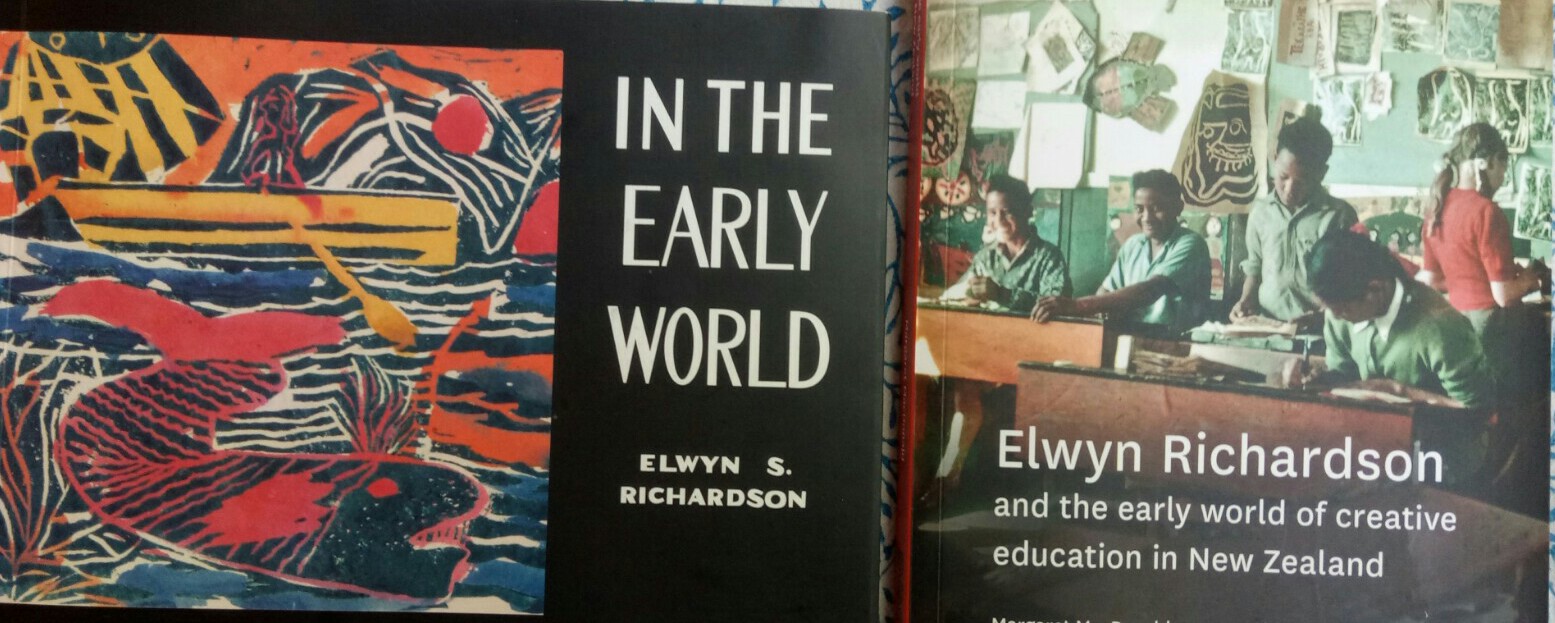
Painting from the cover of Elwyn Richardson's book 'In The Early World' re-published by the NZCER.
The ideas of Elwyn have been a strong influence in my own thinking particularly in trying to place curiosity, creativity, environmental awareness and imagination at the centre of learning. Once someone said I was ,'locked into the 60s' ( when this book was published). At the time I reacted against this but now I no longer mind. Ever since the 'experts' have imposed national curriculums on schools creativity has been at risk. Recently someone said ( but not to me) that my recent book was old fashioned . No apologies from me. The best of education is as much back to the future as it is reaching forwards. Only the status quo is unacceptable - and the imposition of National standards. We need to do the 60's again but this time properly!
It seems proper when thinking of creativity our classrooms to reflect on the writings of 1950s pioneer creative teacher Elwyn Richardson. His ideas are to be found in his inspirational book ‘In the Early World’ first published by the NZCER in 1964 (reprinted 1994).

In the forward to Elwyn’s publication John Melser writes that the book, ‘gives a vivid picture of a school full of vitality in the pursuit of values deeply rooted in the children’s lives and capable of serving them lifelong’. ‘Oruaiti School’, Melser continues, ‘functioned as a community of artists and scientists who turned a frank and searching gaze on all that came within their gambit. Curiosity and emotional force led them to explore the natural world and the world of their feelings…..Studies and activities grew out of what preceded them. New techniques were discovered and skills practiced as each achievement set new standards.’

From such environmental inquiries Elwyn’s students learnt answers, Melser writes, to the question ‘who am I? They gained respect for their and others achievements, taking great pride in their craftsmanship or artistry.’ It was a form of disciplined personalized learning set in a ‘community of artists and scientists.’ Elwyn’s work was based on an awareness of the natural world involving careful scientific observation and a demand for personal and excellence of their ideas in whatever medium used.

Elwyn’s role in achieving personal and artistic excellence was a delicate and encouraging one, always humbly ready to learn from the children. Elwyn has written elsewhere that ‘the children were his teachers as much as he was theirs’. The results were certainly not the standardization of product that one sees today; the result of over teaching. Believing in high standards to Elwyn each new creative product mattered as much as the process.

Elwyn, along with all the other creative teachers I have had the privilege of working with, responded to all children’s efforts and achievements with sincere interest and pride. His book is a testament to his love of children’s ideas and imagery and, the respect he gave their work, respect that was returned in kind to Elwyn. Elwyn gave his students Melser writes, ‘an opportunity to reach their full heights as artists, as craftsmen, as scientists, and as students’ in a ‘community of mutual respect’.

Creative teaching is not new it has just been sidetracked.

It is this vision of creative teaching that has inspired me and one reinforced by the all the creative teachers I have seen over the years. Creative teaching ideas though have a long history leading back to such writers as John Dewey who wrote about similar ideas in early years of the 20th C in such books as ‘Education Through the Arts’ and ‘Education through Experience.’ In the United Kingdom, after the dark days of World War 2, innovative teachers made a break from the arid formalism of pre-war days, and developed child centred programmes leading to official approval expressed in the 1967 Plowden Report. In the US an ‘open education’ movement added to the impetus. Ironically official approval was a kiss of death as teachers scrambled to get on to the bandwagon. Creativity it seems works best when working for a change. In New Zealand, under the leadership of the then Director-General of Education Dr Beeby, similar ideas were being encouraged – ideas that were also soon under attack from conservatives but not before creative teaching was at least established. Richardson was working in these times. Creative ideas were spread throughout New Zealand by means of art advisers led by their charismatic National Director Gordon Tovey. The art advisers ran Related Arts courses, spreading the idea of integrated learning. I was lucky enough to become involved in the mid 60s and during this time assisted a local teacher to develop the first six week integrated unit in our province based around exploring the life in a local stream.
And today our reactionary Education Minister is dismantling the last of the Art advisers to focus on literacy and numeracy not realizing the problem is engaging learners not measuring them! 'Learnacy', to quote Guy Claxton, 'is more important than literacy'. And Sir Ken Robinson who says, 'creativity is as important as literacy or numeracy. What is really required is to return to the approach of Elwyn Richardson and to integrate it with the power of ICT.
The Taranaki approach to creativity.

In the 70.80s group of Taranaki teachers became well known for what was called ‘environmental’ or ‘quality’ education. Encompassing many of the above ideas the teachers involved believed strongly in making use of the immediate environment, and the need to value effort and perseverance so as to achieve quality work. A particular feature was the stimulating room environments featuring displays of student’s research, language, observational and creative art. Key phrases used by such teachers were the ‘need to do fewer things well’ and to ‘slow the pace of students work’ so as to allow time teachers to come ‘alongside the learner’ to provide assistance. Aspects of this quality learning are still to be seen in local schools today but now as whole school approach. One important idea creative teacher’s hold is that process of achieving success is itself a powerful transformational experience – providing such experiences is the challenge for teachers.

Real change depends on creative teachers.

From my experience, then and now, I believe that all real lasting educational change will only come from such creative classroom teachers particularly if it is a whole school ‘learning community’ approach. Unfortunately, since the late eighties, the climate has changed against such creativity as we entered recent decades of standardized curriculums and imposed compliance requirements. It is reassuring to still find creative teachers working away ‘under cover’ throughout New Zealand and it is to them that we must look for a creative revival.

Sunday, March 13, 2005

Personalised learning - exciting but not new!


The best book ever on student creativity! Posted by Hello

Perhaps the person who most influenced my own teaching philosophy was Elwyn Richardson.

Elwyn taught in a small rural school in New Zealand the 195Os and later in schools in Auckland.

In the 60s in New Zealand creative teaching ideas began to spread throughout New Zealand influenced, in particular, by the work of the then Art and Craft advisers, under the leadership of the National Director of Art and Craft Gordon Tovey.

There has always been progressive idea in education but after World War Two the idea of a more democratic creative form of education began to spread. The NZ Labour Government of the times developed a liberal philosophy of education system to develop all individuals no matter where they lived. The Director of Education, Dr Beeby, was a seminal influence and was later to be blamed by conservative critics as introducing the ‘play way’ method of teaching.

The establishment of the school advisory service was part of this movement.

Under the leadership of Gordon Tovey a small group of ‘native’ schools were given permission and help from advisers to develop creative teaching ideas. Elwyn Richardson, although not included in this group, became associated with the ideas. Permission was needed because schools in the 1950s were a very traditional.

In later years most innovative ideas were to be found in isolated rural school supported by school advisers .The advisers set up an unofficial network of creative teachers and I was lucky enough to tap into the excitement created by the ideas when I began my teaching career.

Elwyn Richardson stood out as a most important figure. In the 60s he published his book ‘In the Early World’ which become on inspiration to us all.

We again seem to be in a similar situation to one Elwyn faced in the 50s. The past 15 years has imposed on teachers a technocratic ‘standardized’ curriculum which has all but crushed the initiative of creative teachers. Now around the world there are signs that we need to return to a more personalized style of teaching so as to ‘customize’ education to develop the talents of all and, in particular, the students who keep falling through the cracks, no matter how obsessive schools and the Ministry get about assessment

Elwyn’s book is as relevant as ever and has been reprinted by the NZER. Creative teachers would be well advised to acquire a copy. A greater contrast to current curriculum documents could not be found! Written in personal narrative style it is full of creative examples of students language and art.

This remarkable book is all about ‘integrated curriculums, values education, the arts, inquiry learning, philosophy and creative thinking’. ‘It is a story about teaching told by a teacher who believed passionately that creative thinking and intellectual growth are inexorably intertwined.’

‘It is timely in the 21stC to recapture teaching as an art. ‘In The Early World’ inspires teachers to take risks, to contemplate values and philosophies as central to the teaching learning process and to adapt prescribed curriculum to the children’s own desire to explore, inquire and create'.

Just as all the technocrat curriculums have exhausted creative teachers we now being asked to consider what is being called personalized learning. Personalized learning is capturing the imagination of teachers, particularly in the UK, but as exciting as it is it certainly not new.

‘It has the potential to make very young persons learning experience creative, fun and successful. It means shaping teaching around the very different ways students learn and it means taking the time to nurture the talents of every pupil.’ For further information download this UK pamphlet.

If the Ministry were to have the courage they would identify groups of schools throughout NZ who are already trying out personalized learning, as was done in the 1950s. They would also have to give such schools give the some for of protection; excusing them from having to comply with many of the current distractions.

I the 50s it began with creative individual in small schools. Today it needs to be established in networks of school of all sizes.

We have the creative teachers; we just need to create creative conditions for their ideas to grow and spread.


(Some of the ideas on our site that owe much to the work of Elwyn Richardson are: developing writing; personal writing; and environmental studies.)

Monday, January 14, 2013

Elwyn S Richardson 1925 -2012 Creative teacher.


On December the 24th Elwyn Richardson, New Zealand pioneer creative teacher died. Richardson was born July 8, 1925.
Elwyn was an inspiration to teachers who were interested in a creative approach to learning. I first learnt about Elwyn in the early 60s, first by reputation, and then through his book ‘In the Early World’ published by the NZCER in 1964.
In the sixties there were a number of NZ teachers experimenting along the same lines as Elwyn. In the UK, there were also teachers interested in freeing up the traditional curriculum. In 1969, in the UK, the Plowden Report was published which gave ‘child centred’ education official approval. In the late 60s I worked with local teachers whowere integrating their programmes placing first hand experiences and thecreative arts central. At this time I made my first contact with Elwyn - the beginning of a long association.
A little background about Elwyn. He applied for the remote country position at Oruaiti School in 1949 largely because of its distinct fauna of sea life, but also because the sole-charge posting offered him the opportunity to work out his own ideas about teaching and learning alone. .
Elwyn’s educational philosophy was based on the belief that all real learning must be anchored in personal experience. It was this conviction that provided the foundation for his developmental approach to education. Central to this was his theory of integration, a personalised process whereby children moved from one expressive medium to another, between all subject areas. Richardson’s theory of integration was informed by his conception of artistic ability as a universal human attribute, his well-developed ideas about the nature of artistic development in children and a firm belief in the learning potential of every child.
 At Oruaiti School Elwyn discarded the official syllabus and turned to the children’s lives and immediate environment for the basis of his curriculum. Using the children’s natural curiosity and interest, he taught them how to observe closely the world around them and to record their new discoveries and their own responses to these. From here, he developed a school programme that was anchored in the children’s surroundings and real lives. Through environmental studies the children learned the basis of scientific method, and brought these skills to bear on studies that spanned all subjects. His method was a revolt away from science as a separate subject to an integrated programme of arts and science.
Elwyn’s book ‘In the Early World’ was published by The New Zealand Council for Educational Research NZCER in 1964. The book tells the story of how his students became increasingly aware of their own capacity for personal expression, while collectively establishing a shared understanding of aesthetic values.

The book was well received by the New Zealand educational establishment and widely taken up as a text by teacher training colleges in New Zealand in the 1960s and 1970s. Joseph Featherstone former professor of education emeritus at Michigan State University, reviewed the book and stated, 'it may be the best book about teaching ever written.' Following Featherstone’s review Pantheon Books published a Canadian and an American edition simultaneously in 1969. The book was praised by international reviewers. British writer and musician R. W. B. Lewis wrote, 'Not only does this book point to a new direction in education, its very existence is a landmark in the recognition of human potential and dignity.' Over the next decade Richardson and his school became an international symbol of progressive education in New Zealand with a particular focus on arts and crafts.
 A third edition witha new foreword and a twenty page appendix of children's art work has beenpublished by NZCER  June 2012.


The new edition of Elwyn's book.
I was invited to attend the opening in Auckland – it was to be my last contact with Elwyn.  

In the forward to the first edition of Elwyn’s book John Melser wrote that the book, ‘gives a vivid picture of a school full of vitality in the pursuit of values deeply rooted in the children’s lives and capable of serving them lifelong’. ‘Oruaiti School’, Melser continues, ‘functioned as a community of artists and scientists who turned a frank and searching gaze on all that came within their gambit. Curiosity and emotional force led them to explore the natural world and the world of their feelings…..Studies and activities grew out of what preceded them. New techniques were discovered and skills practiced as each achievement set new standards.’
Elwyn’s role in achieving personal and artistic excellence was a delicate and encouraging one, always humbly ready to learn from the children. Elwyn has written elsewhere that ‘the children were his teachers as much as he was theirs’. The results were certainly not the standardization of product that one sees today. Believing in high standards  Elwyn  believed  each new creative product mattered as much as the process.
Elwyn, along with all the other creative teachers I have had the privilege of working with, responded to all children’s efforts and achievements with sincere interest and pride. His book is a testament to his love of children’s ideas and imagery and, the respect he gave their work, respect that was returned in kind to Elwyn. Elwyn gave his students Melser writes, ‘an opportunity to reach their full heights as artists, as craftsmen, as scientists, and as students’ in a ‘community of mutual respect’.
Unfortunately since 1986 the winds of change worldwide have sent school off in another direction towards standardised education -an approach that undermines the very creativity and diversity that New Zealand educators had gained world-wide respect for.  Unfortunately, in recent decades, 'experts' from outside the classroom have become the sources of ‘official’ knowledge and this has led to a reduction in the importance of those creative teachers. This is a shame.
It is time for schools to return to believing in the importance of creative teachers as the source of lasting change.  Teachers will need to work together (they now have the technology to do so) to articulate a set of beliefs for the new century - one thing that they could do is get behind the almost side tracked 2007 New Zealand National Curriculum.
The new edition has a hard hitting forward written by educationalist.  Gwenneth Phillips.
Gwenneth writes  that the book comes at an opportune time as the current government is finally showing its true 'market forces' neo liberal competitive ideology with its intention to introduce 'League Tables' based on National Standards data to encourage competitionn through students and school comparison.
 Schools she believes now have a moral dilemma - to comply to such impositions that will narrow the curriculum and encourage teachers to teach to the tests and the side lining of the creative arts, or  to be creative. Ironically countries that have imposed such approaches are well behind New Zealand in international testing!
'Times have changed,’ Gwenneth writes,’ educational decision making has shifted from such innovative educators to non-teaching politicians and policy makers; and in the classroom from practicing teachers to academics.'
‘This new guard of decision makers' Gwenneth writes, ‘juggle political, fiscal and/or research agendas’. ‘Teachers’, she writes, 'have long struggled with the conflicting demands.....in particular the demands for accountability- based on the precise articulation of outcomes as well as their measurement. As a result, the basic tenants of our unique child-centred approach...have been compromised.....the child's creative power has been strangled and the child marginalised'.
One might add so has the creative power of teachers and creative schools.

'An old challenge has re-emerged. How can we put the lives of children and our trust in their creative power back into classroom practice?' And how can we develop trust in teachers to be creative in our present risk averse surveillance culture!
Gwenneth believes this new edition of Elwyn's book is both timely and important, for this challenge is at the heart of present debate. It presents a backdrop to current issues in education and to teachers' concerns - the narrowing of the curriculum, the setting of externally prescribed adult motivated progressions and outputs that neglect the developmental nature of learning'.
Elwyn's student's success was sustained by the knowledge and professional artistry of a caring teacher who esteemed the voice and thinking of the children. As Elwyn himself wrote, ' they were my teachers as I was theirs, and the basis was sincerity, without which, I am convinced, there can be no creative education.'
The ways of working captured in Elwyn’s book are 'in stark contrast to that have emerged in the last decades. Current ways are based clearly articulated and predetermined pathways. The children are forced to state goals and are evaluated through criteria and standards that conform not to their own understandings of themselves in the world, but by expectations dissected from the forms and structures of adult thinking.' These approaches, Gwenneth writes, 'are the antithesis of child centred approaches. They marginalise children and show little respect for their creative power to develop their own life-learning pathways'
The choice for schools is clear: Standardisation of learning or personalization that celebrates every student’s unique gift and talents.
Unfortunately many schools are well down this imposed formulaic 'best practices' approaches. Gwenneth writes, 'for many teachers, especially primary teachers, the knowledge and professional artistry of their child-centred practice has been usurped; the courage and tenacity of the pioneering spirit stifled; and the recognition and trust of the child's creative power has been undermined.'
'In The Early World, together with the stories of other early pioneers, tempered with new insights...has the power to inspire a '"new" guard of educational pioneers'. It is a book that 'celebrates the pioneering spirit of New Zealand teachers'
Creative teaching is not new it has just been side-tracked.
Elwyn remains as an inspiration of what can be achieved if we want to develop the talents and gifts of all students.
I recommend that all schools acquire a copy of the latest edition if only to show what could have been.

Sunday, June 29, 2008

Creative teaching - timeless

Elwyn Richardson - pioneer New Zealand creative teacher 1950-60s. Forget the research and current conformist 'best practice', go back and see what teachers like Elwyn did that we have forgotten about.


According to Kelvin Smythe, and I agree with him, creative 'teaching in its fundamentals has hardly changed, nor is it likely to change.' Kelvin has written widely about Elwyn Richardson, a pioneer New Zealand teacher from the 1950/60s on his site and, for those curious, it is well worth reading what he has to say.

While schools rush to get on board the 'new' New Zealand Curriculum Kelvin offers a critical and informed voice. Along with people like myself Kelvin believes strongly in the creativity of classroom teachers - creativity he feels that has been put at risk by the obsessive assessment requirements, and the demands of impossible standardized curriculums, imposed during the 90s. Ironically the Ministry is now 'rescuing' us from such demands( imposed by themselves) with their 'new' curriculum!

The four characteristics, according to Kelvin, of Elwyn's teaching were his:

Attentiveness and sensitivity to the responses of children.

His demand for children to be rigorous in their observations, thinking, and expression.

The way he linked thinking with imagination.

And his determination to work things out for himself.

I would add a fifth;

The immediate environment was seen as an important resource to explore leading into both artistic expression and scientific study.

Elwyn' curriculum 'emerged' out of a mix of student and environmental interests but the key to it was for students to be encouraged to express their 'voice' and create works of outstanding quality and diversity.

Elwyn, a biologist by training, saw his students as teaching him as much as he taught them.

Kelvin writes, as society becomes more technocratic, pressured, and impersonal, and less beguiling- there will be greater demand for teaching about creativity and expression.

As we leave the Industrial Age and enter, what some call 'The Age of Creativity', or the 'Second Renaissance, it will be important to make certain all all students have their personal skills and talents developed because these are the very things that will ensure they will be able to thrive in the future.

Kelvin makes the point that we do not have to go to America's Howard Gardner, and the like to seek inspiration so as to develop programmes that feature creative expression we have out own heritage and icons. Personally Howard Gardner is one American educator I really like as he challenges the traditional one dimensional academic approach to learning but I take Kelvin's point. All too often when visiting New Zealand classrooms you see evidence of all sorts of thinking processes but all too often little real quality work to show for it. Process and product are intertwined but sometimes you get the impression all students need is process - knowledge can be gained as required.

Elwyn's approach, when it was finally accepted by authorities as 'best practice', influenced a great many teachers throughout New Zealand and worldwide.

There is, writes Kelvin, a universality about Elwyn's creative approach and it does not preclude the use of information technology not available at the time to Elwyn. Elwyn was a great fan of the printing press as a means to share his students art , research ad language work.

We need to be careful with the current obsession with imposed 'best practice' and be more concerned about creating our own ever changing 'best practices'. By all means be 'informed' by research but not 'led'; we need to use professional judgement as to how value it is in your circumstances - research is never as objective as it claims to be and you ought to know your classroom best! As with Elwyn, we need to work things out for ourselves!

I know, from my own experience visiting school, such teachers still exist. Perhaps with 'new' curriculum giving 'permission' such teachers now have the opportunity to expand their creativity if they have the courage to take it.

What is really required is courageous and creative school leadership to create the conditions for both staff and students to develop their talents, gifts and passions.

Better still would be for groups of school to work together sharing the expertise of their own teachers.

If this were to be achieved then the work of pioneer teachers, such as Elwyn Richardson, would live on.